

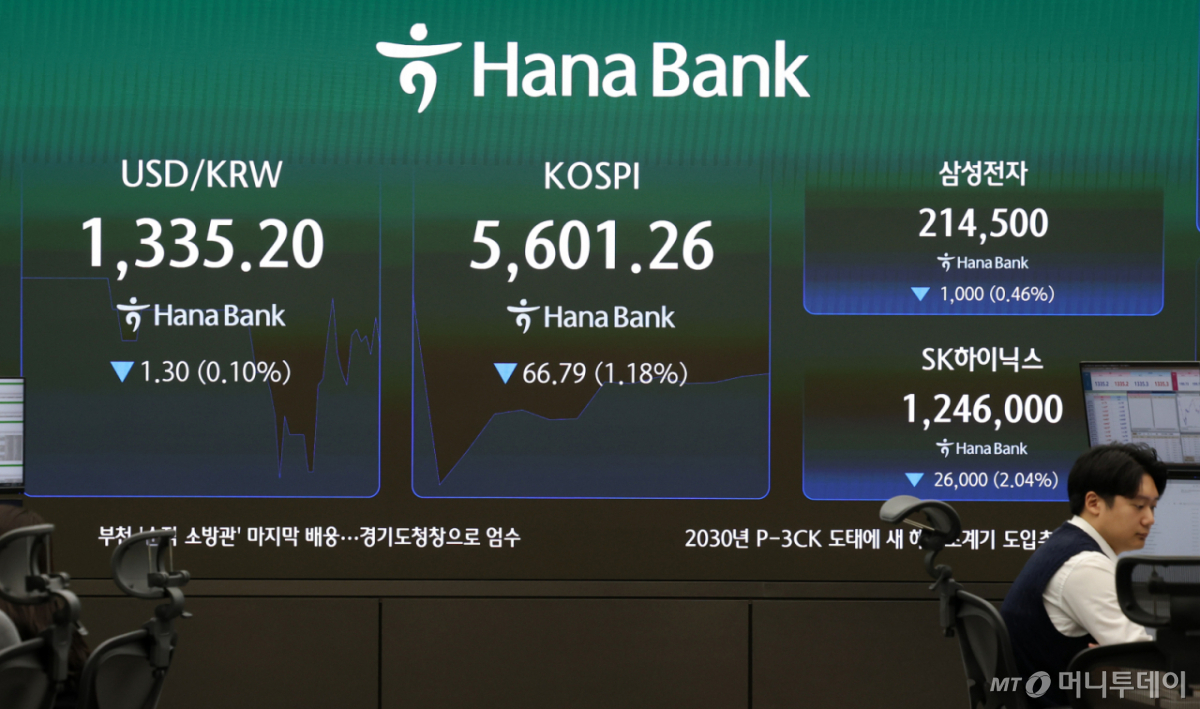
A forecast emerged that the KOSPI, which has slipped to the 5,500 range, could fall further to the 5,100 level. The advice is to adopt a mechanical split-buying strategy down to around the 5,150 level while keeping downside exposure open.
On the 19th, Korea Investment & Securities released a report titled "Mechanical Split Buying and Risk Management" containing this content.
Kim Dae-jun, a researcher at Korea Investment & Securities, diagnosed that "the Korean stock market is continuing its sluggish performance amid external shocks," adding that "cracks have begun to appear in AI (artificial intelligence) optimism during the prolonged high-interest-rate phase, and doubts have arisen over whether investments made by AI companies through borrowing can actually generate cash."
The researcher explained that "the KOSPI has a high correlation with the Philadelphia Semiconductor Index, with a 52-week moving correlation coefficient of 0.6 on a weekly basis, so it could not escape this shock," and noted that "the decline rate of the KOSPI was also high due to its heavy weighting in tech stocks."
Fortunately, Korea's CDS (credit default swap) premium remains at a stable level in the 20bp range, leading to the judgment that financial markets are not exposed to systemic risk. However, it was analyzed that predicting a rapid trend reversal is difficult given the current phase of doubts about the AI growth path.
Although the KOSPI is in an oversold phase, the forecast is that the index could fall further due to the emergence of supply-demand gaps.
The researcher stated that "foreign investors, who determine stock market supply and demand, are selling IT (semiconductors, home appliances, hardware) and financial (insurance, banking) sectors with high KOSPI market capitalization weights to recover liquidity," adding that "macro materials to lead a stock market rebound are also absent."
He said, "With liquidity supply blocked and AI infrastructure risks unresolved, betting solely on price could leave one fully exposed to increased market volatility," and added, "Rather, it is appropriate now to keep downside exposure open under the premise that the index may fall further."
The researcher viewed that the KOSPI could drop to around 5,150, which corresponds to a 12-month forward PBR (price-to-book ratio) of 1x.
The researcher advised, "Investment intervals must be calculated thoroughly down to 5,150 before approaching with mechanical split buying," and noted that "risk management is necessary before confirming Meta's earnings on the 21st (local time)."
He continued, "The timing for aggressive bargain hunting will likely be after Meta's earnings release," adding, "If Meta presents clear ROI (return on investment) guidance proving the justification of its AI CAPEX (capital expenditure) alongside solid earnings, confidence in the possibility of AI growth can be restored." He further stated, "Now is the time to watch for events that can reverse investor sentiment," and added, "Risk management is required until this is confirmed."

 in STOCK
