

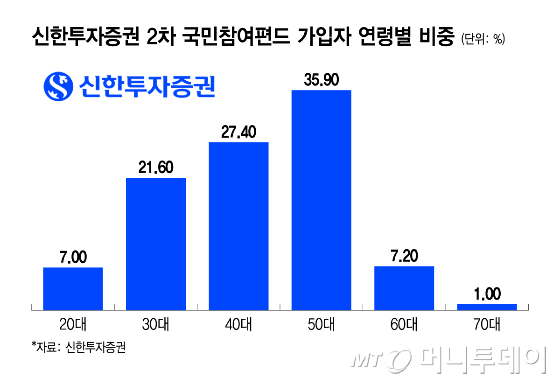
Three in 10 investors who subscribed to the second National Growth Fund for public participation through securities firms were in their 20s and 30s. While the figures point to strong interest among younger investors in policy-backed investment products, average investment amounts per person were significantly higher among those in their 70s.
Analysts say differences in accumulated wealth and investment capacity across generations were reflected in subscription amounts.
According to the financial investment industry on Wednesday, among subscribers to Shinhan Securities for the second National Growth Fund, which concluded sales on the 15th, 28.6% were in their 20s and 30s.
The Fund is a policy-based investment product launched to supply private capital to cutting-edge strategic industries and innovative companies and to share growth outcomes with the public. It is divided into a basic type and a general type, with the basic type targeting individuals with labor income of 50 million won or less.
Considering that 60% of young subscribers in the first round of the Fund opted for the basic type, the government expanded the priority allocation ratio for the basic type from the previous 20% to 50% in the second round of sales. This measure was taken to broaden participation opportunities for younger generations who have relatively limited investment capacity.
During the first round of sales in May, those in their 20s and 30s accounted for 19.5% of total subscribers. While it is difficult to directly compare subscription status between all sellers in the first round and specific securities firms in the second round, the fact that participation from younger generations was not negligible is a noteworthy point.
The age group with the highest proportion of subscribers was those in their 50s, accounting for 35.9%. Those in their 40s followed with 27.4%. Compared to the first round of sales, where those in their 40s and 50s accounted for approximately 70% of total subscribers, the age distribution of second-round subscribers at Shinhan Investment Corp showed a relatively balanced pattern.
However, clear generational gaps were evident in actual investment amounts. The average subscription amount per person for subscribers in their 70s through Shinhan Securities was recorded at 34.25 million won for the basic type and 65 million won for the general type.
In contrast, the average subscription amount for those in their 20s was only 7.22 million won for the basic type and 16.25 million won for the general type. This means that those in their 70s invested approximately 4.7 times and 4 times more than those in their 20s, respectively.
The difference was also significant when compared to those in their 50s, who had the highest proportion of subscribers. The average subscription amount for those in their 50s was 10.49 million won for the basic type and 20.21 million won for the general type, with those in their 70s investing more than three times as much as those in their 50s in each category.
This signifies that even as participation from younger generations increases, older generations who have accumulated assets exert a significant influence on actual investment scale.
Meanwhile, while the Fund filled its entire target amount of 600 billion won during the first round of sales in May, it managed to raise only 519 billion won, or 86.5% of the target amount, in this second round of sales.
The securities industry cites the main background for the sluggish sales as the contraction of investor sentiment due to increased volatility in the domestic stock market recently, unlike during the first round of sales. Despite its nature as a policy-based product, it was not immune to changes in investment demand driven by market conditions.
Pointers have emerged that for the Fund to consistently attract participation from various generations going forward, it must enhance product competitiveness and investment convenience.
Key tasks mentioned include improving the return rate of the first National Growth Fund, which remains in the 1st% range, determining whether existing subscribers will be allowed to re-subscribe, and ensuring liquidity for bank subscribers.
A source in the financial investment industry said, "For policy-based funds to continuously attract public participation, stable management performance must follow above all else."

 in STOCK
