

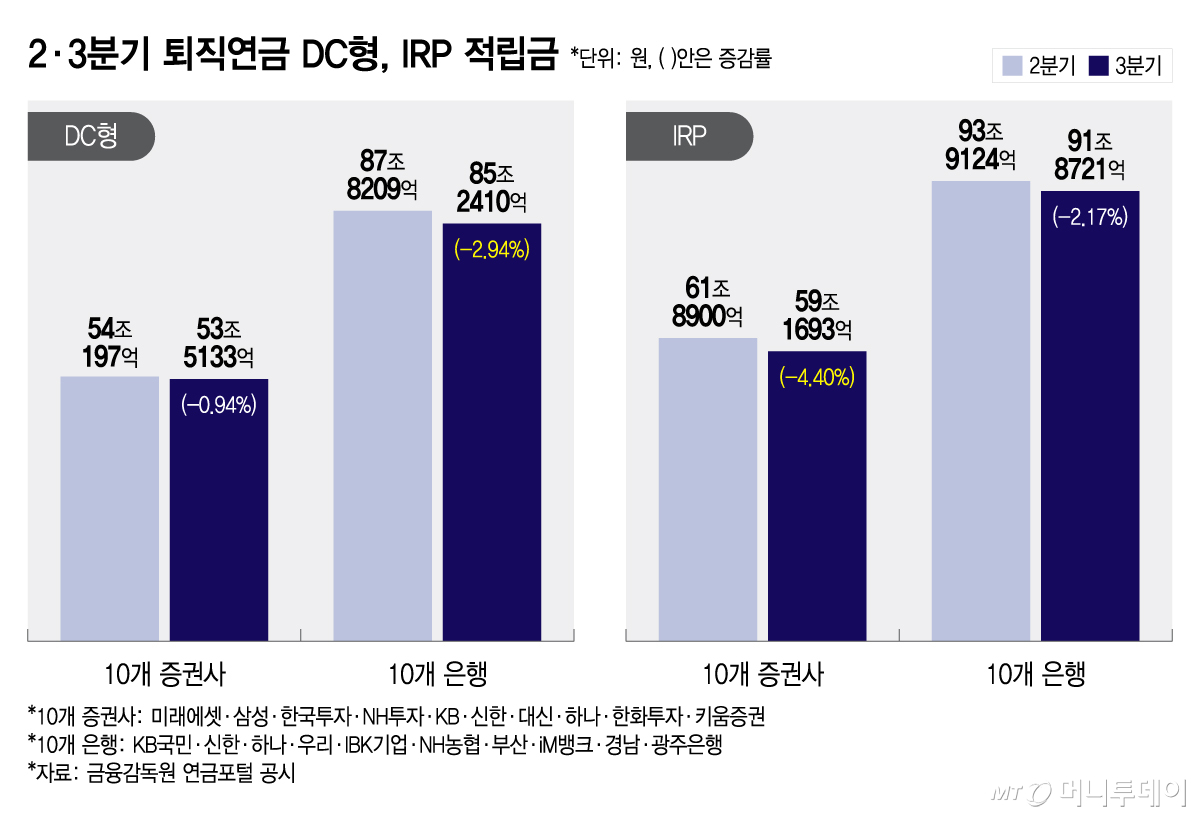
Securities firms, where 75% of clients are willing to tolerate principal losses, are anticipating a second "pension money move" (large-scale fund transfer) in conjunction with the easing of the risk asset cap (70%) for retirement pensions. Although securities firm IRP (Individual Retirement Pension) assets declined by over 4% in the third quarter due to sluggish stock market performance, forecasts suggest that they will be chosen by subscribers seeking active management as regulatory easing and improved investor sentiment take hold.
According to data submitted on Monday by the Financial Supervisory Service to the office of Democratic Party of Korea lawmaker Park Hong-bae, 74.62% of clients at the top 10 comprehensive financial investment business operators (comprehensive securities firms) exhibited an aggressive investment propensity of "risk-neutral" (Grade 3) or higher. Out of a total of 17,685,779 individuals who underwent investment risk propensity grading, 13,332,200 were aggressive investors pursuing medium-to-high returns even at the risk of principal loss.
By grade, growth-seeking type (Grade 2) was the most common at 30.95% of the total, followed by risk-neutral type (Grade 3), which pursues medium risk and medium return, at 21.84%. Growth type (Grade 1), which pursues high returns even while tolerating a total loss of principal, accounted for 21.83%. Conservative investment propensities were limited to just one-quarter of all clients, with stability-seeking type (Grade 5), which prefers guaranteed principal protection, at 10.54%, and stability-pursuing type (Grade 4) at 14.83%.
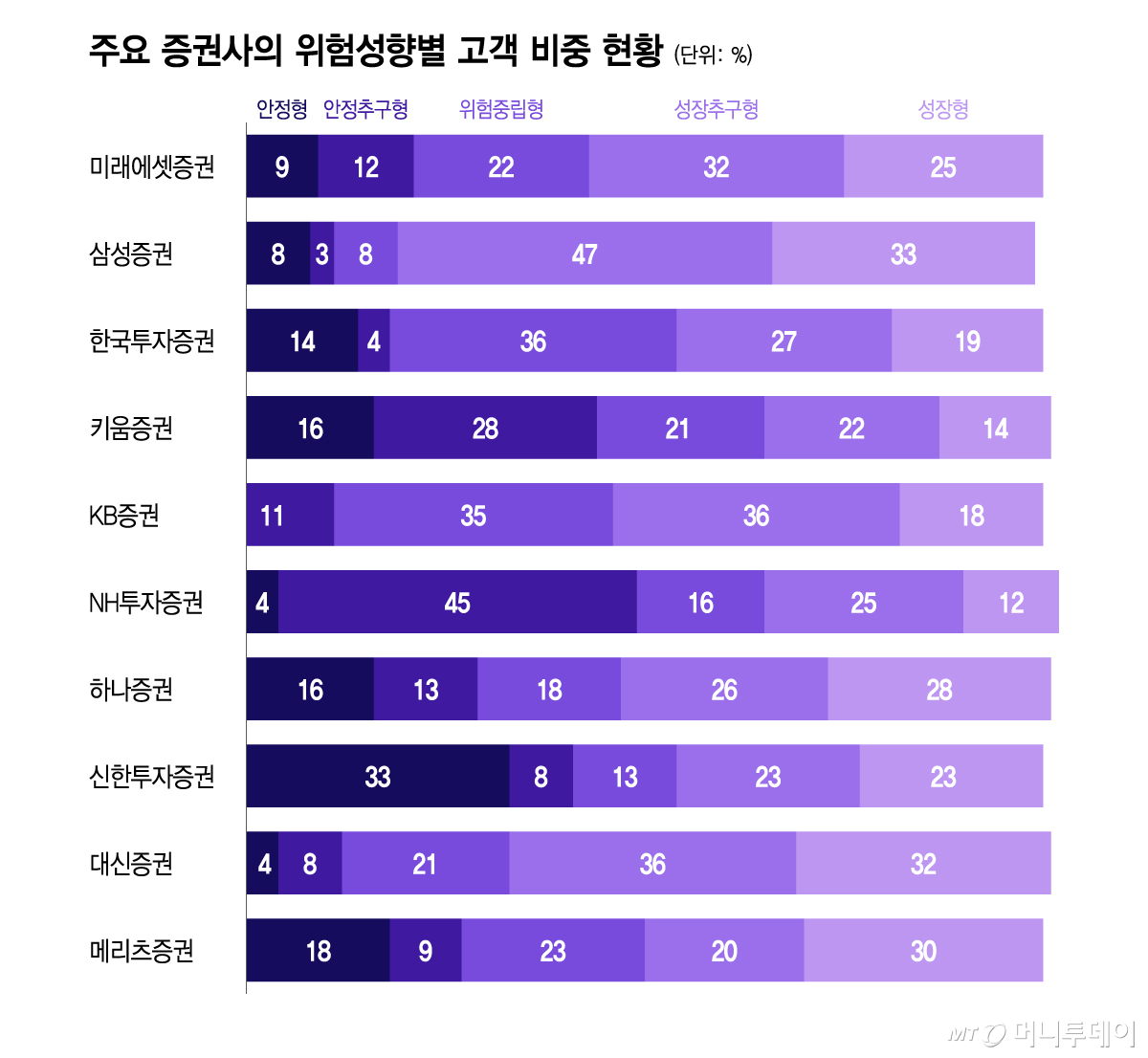
The proportion of clients with aggressive investment propensities was also high at individual securities firms. Samsung Securities had a combined share of growth type and growth-seeking type (Grades 1 and 2) reaching 80.7% of its total, followed by Daishin Securities (67.7%), Mirae Asset Securities (56.7%), KB Securities (53.9%), and Hana Securities (53.6%).
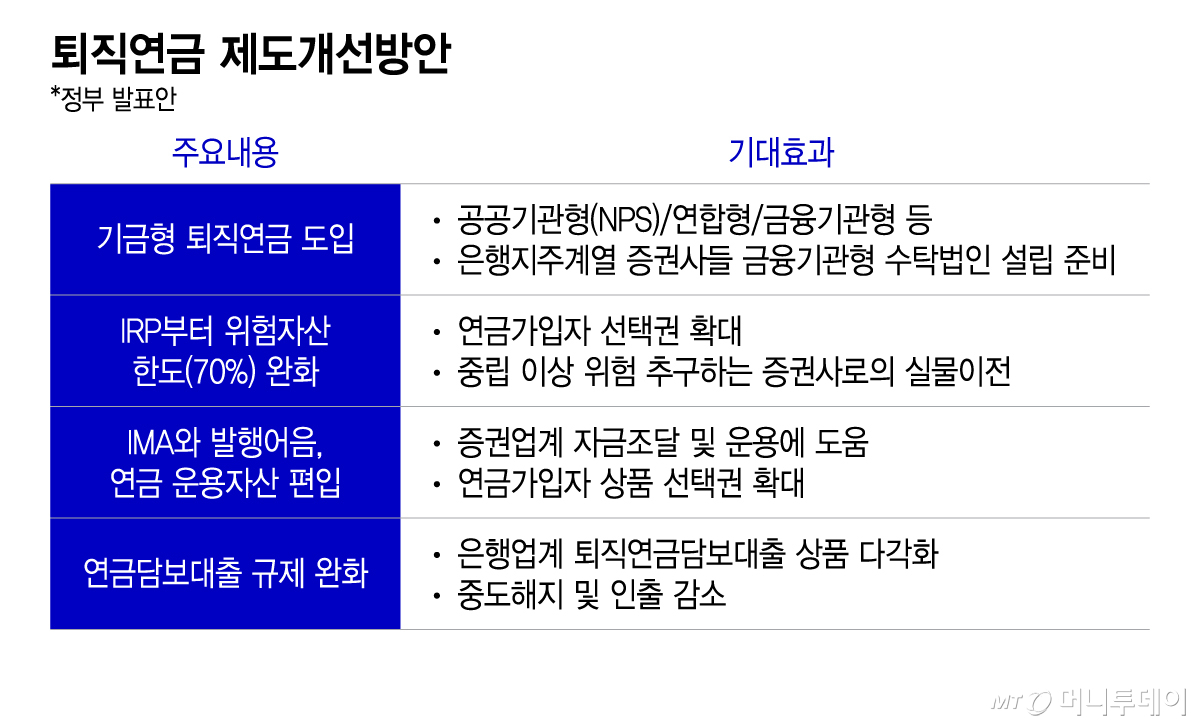
Securities firms with a high number of aggressive investors are paying close attention to the easing of risk asset limits included in the government's retirement pension improvement plan. Currently, only up to 70% of IRP assets can be invested in risk assets, but the government has decided to gradually ease this cap.
The reason the financial investment industry welcomes regulatory easing is that it suffered from outflows of retirement pension assets in the third quarter. Since the implementation of the retirement pension physical transfer system, which allows pension assets to be moved between accounts of the same type without cancellation, securities firms have consistently been cited as "winners" of the money move. However, in the third quarter, risk-averse sentiment grew due to sluggish stock market performance, causing a significant drop in assets.
In fact, according to the Financial Supervisory Service's pension portal, IRP assets at 10 securities firms stood at 59.1693 trillion won as of the end of the third quarter, a decrease of 2.7207 trillion won (4.4%) from the previous quarter. This is roughly double the decline rate (2.17%) in IRP assets at 10 banks over the same period.
The decline rate in combined DC and IRP assets was also higher for the securities industry than for banks. While bank assets (based on 10 firms) decreased by 2.54%, securities firms saw a 2.78% drop. In particular, Mirae Asset Securities' assets fell by 1.6712 trillion won (3.6%). Among the 10th firms, Daishin Securities (5.76%), Hanwha Investment & Securities (4.59%), NH Investment & Securities (4.12%), and KB Securities (4.05%) recorded decline rates exceeding 4%. Only Kiwoom Securities, which fully launched its pension business in June last year, saw an increase of 108.3 billion won (166.9%) in DC and IRP assets.
The financial investment industry also welcomes the inclusion of IMA (Integrated Margin Account) and commercial paper, which are funding channels for comprehensive securities firms, as pension investment targets, and the decision to evaluate default option (pre-designated operation system) products based on yield. A securities industry official said, "This plan will significantly enhance the product appeal of contract-based IRPs," adding, "Pension subscribers will have a wider range of product choices, which is positive for yield management."

 in STOCK


