

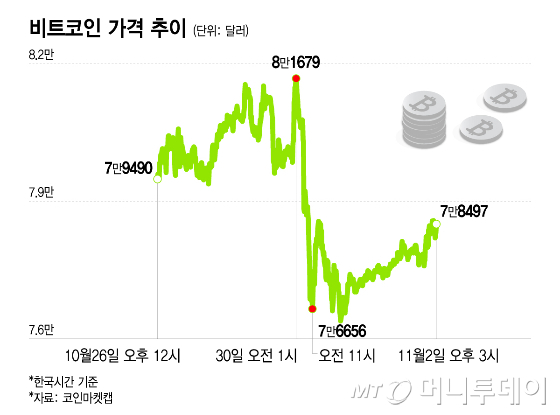
Major cryptocurrency prices, which had plunged following the Binance hacking incident, have turned to a gradual recovery. Concerns had been raised both inside and outside the market that a wave of panic selling could erupt immediately after Binance resumed withdrawals (asset outflows), but it is interpreted that only a negligible number of investors chose to cash out after withdrawals were actually reinstated.
As of 3 p.m. on the 2nd (all times Korea Standard Time), Bitcoin was trading at $78,497, according to cryptocurrency market data platform CoinMarketCap. The price, which had fluctuated in the $81,000 range since the 23rd of last month, plunged starting at 1 a.m. on the 30th of the same month, sliding about 6% over roughly 10 hours to the $76,000 range before rebounding for three consecutive days off its support line. At this time, the trading price on Upbit is 156.5 million won.
Binance has been sequentially resuming withdrawals by cryptocurrency asset and network since 3 p.m. on the 1st, after having suspended them entirely citing security checks. The net outflow reached $3.64 billion (approximately 4.9 trillion won) as of 9:36 a.m. on the 2nd, based on its own announcement, and $6.737 billion (approximately 9.0545 trillion won) as of 3 p.m. on the same day, according to DataLlama data. Although trillions of won in funds flowed out alongside the resumption of withdrawals, price volatility has remained at ordinary levels.
Even compared with past exchange hacks, the shock of the Binance incident on prices has been limited. In August 2016, when 119,754 Bitcoin (worth 96.3 billion won at the time) were stolen from Bitfinex, the price of Bitcoin plunged by more than 20%.
Market analysts suggest that participants are responding by moving their holdings to other exchanges or hardware wallets rather than cashing them out. This means they have merely changed where their assets are stored to avoid risks associated with a specific exchange, and movements to leave the market are limited. On DataLlama, while net outflows from Binance, the largest exchange by asset size, accelerated, $496.3 million (approximately 667 billion won) flowed into OKX, the second-largest, showing a pattern of funds dispersing to competing exchanges.
Some observers also note that it is difficult to explain Bitcoin's sharp drop on the 30th of last month solely by the Binance hack. This is because a broader contraction in investor sentiment toward risk assets, including weakness in U.S. tech stocks, occurred simultaneously. The NASDAQ Composite Index closed with a sharp decline of over 2% that same day.
Shim Su-bin, a researcher at Kiwoom Securities, stated, "Last year's Bybit hack resulted in limited initial declines in Bitcoin prices despite approximately $1.5 billion in damages; rather, the downward trend intensified amid macroeconomic headwinds such as uncertainty over U.S. tariff policies that emerged afterward." She added, "It is difficult to judge market shock based solely on the absolute scale of hacking damages. Binance's rapid loss compensation and measures to freeze stolen assets may have suppressed further spread of instability."
She continued, "The 18,270 Bitcoin stolen by hackers have not yet been sold, so potential selling pressure remains a factor to watch. In the short term, it appears necessary to pay attention to whether this volume moves, but in the medium to long term, macroeconomic conditions will likely have a greater impact on price direction than the hack itself, as seen in the Bybit case."
Experts pointed to the U.S. midterm elections, with vote counting beginning in the early hours of the 4th, as the market's next turning point. The prevailing view is that while the Binance incident will cause short-term shock, it will serve as grounds for regulation in the medium to long term.
Yang Hyeon-gyeong, a researcher at iM Securities, stated, "The possibility of this incident spreading into broader market credit risk and chained leverage liquidations is limited." She added, "If the Democratic Party secures control of Congress in the U.S. midterm elections, regulatory uncertainty will increase, intensifying pressure for a further pullback in 'Trump Trade' positions. It cannot be ruled out that Bitcoin could fall to $69,000, as it did just before the U.S. presidential election."
Lim Hyeong-seok, a researcher at Zengle, noted, "In the Binance incident, stablecoin issuers Tether and Circle restricted token movements using their issuer authority. This presents the paradox that cryptocurrencies, which grew based on freedom, may need to restrict decentralization in order to maintain trust and utility value." He added, "Going forward, defining intervention rights and responsibilities after incidents will become important, such as granting freezing and recall powers to issuing and operating institutions, or strengthening loss compensation liabilities for exchanges and custodians."

 in STOCK
