

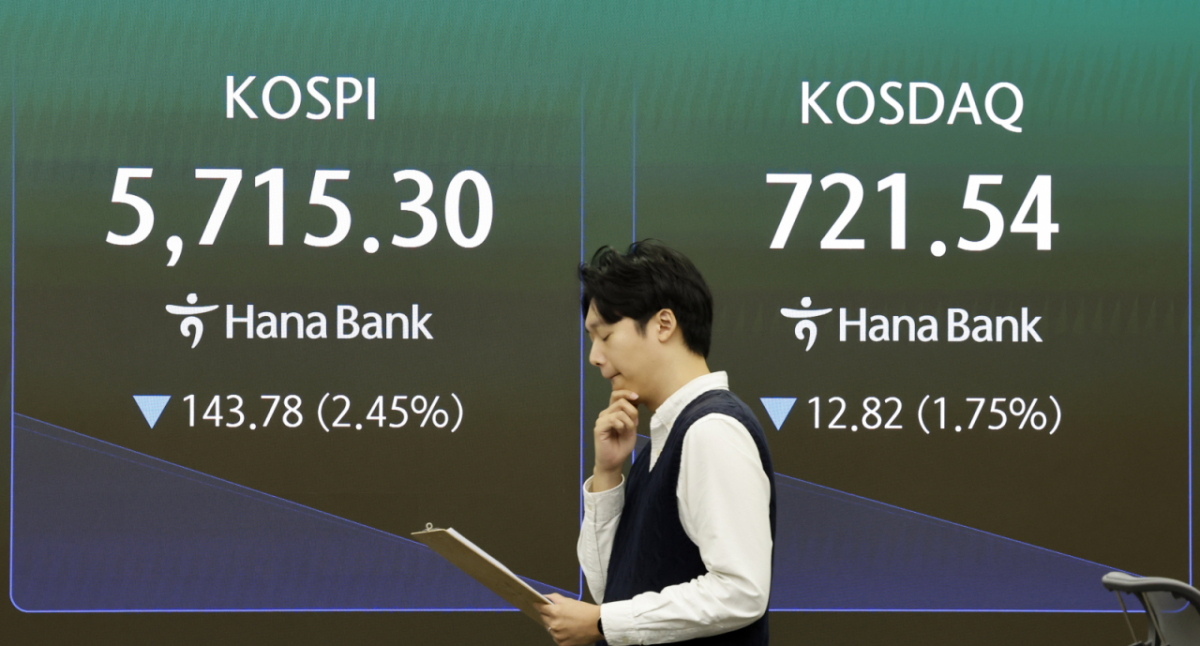
The KOSPI index slipped amid the aftermath of a sharp decline in U.S. tech stocks. While tech companies are pouring massive resources into AI (artificial intelligence) infrastructure investment, market concerns over whether these investments can be recouped remain unresolved.
As of 11:23 a.m. on Tuesday, the KOSPI stood at 5,717.36, down 141.72 points (2.42%) from the previous trading session. The index opened at 5,715.19, down 143.89 points (2.46%), holding above the 5,700 line before briefly falling into the 3% range and trading in the 5th,600s. It subsequently recovered to the 5,700 line on the back of net buying by other corporate investors, at one point rising to the 5,730 level.
The securities industry diagnoses that the capital burden associated with AI investment, which was highlighted in the U.S. stock market overnight, dragged down the KOSPI index on this day.
Lee Sang-yeon, a researcher at Shin Young Securities, said, "Starting with Alphabet's weak third-quarter earnings, negative news related to AI has continued to emerge, adversely affecting investor sentiment toward tech stocks," adding, "It appears we will need to wait and see until the AMD third-quarter earnings and the U.S. midterm elections on the 3rd (local time) are successfully concluded, as well as the Anthropic IPO (initial public offering) and NVIDIA's earnings release."
In New York on Monday (local time), international oil prices (WTI) plunged by over 7% as expectations for a peace agreement between the U.S. and Iran gained momentum, but selling pressure centered on tech stocks emerged amid rising concerns over AI investment profitability.
The S&P 500 index closed at 7,541.40, down 38.67 points (0.51%) from the previous close, while the NASDAQ Composite Index ended trading at 25,164.32, down 272.68 points (1.07%). The Dow Jones 30 Industrial Average closed at 51,983.98, up 213.67 points (0.41%) from the previous close.
The decisive factor was news that Oracle had announced plans to raise a total of $20 billion—$10 billion each through a rights offering (paid-in capital increase) (common stock) and corporate bonds—to secure funding for AI infrastructure investment. Oracle's stock price plunged 8.8%, and semiconductor stocks including Micron Technology (-5.80%), AMD (-7.52%), Intel (-8.83%), and Arm (-4.57%) also fell in tandem.
Yang Hyeon-gyeong, a researcher at iM Securities, said, "Despite the decline in international oil prices and U.S. long-term interest rates due to expectations for negotiations between the U.S. and Iran, tech stocks showed weakness, indicating that the market is paying more attention to AI investment cost recovery and funding burdens than to falling interest rates." She added, "While expectations for AI infrastructure demand remain intact, the market is reacting sensitively to the increased debt and equity dilution burden accompanying expanded investment."
The U.S. midterm elections are cited as a key factor expected to drive a stock market rebound. This is because one source of "political uncertainty"—the midterm elections—could be resolved amid accumulating macro variables such as the Middle East war, oil prices, and interest rates.
Lee Jun-young, a researcher at Eugene Investment & Securities, said, "In all six midterm elections held since 2000, the KOSPI rose by an average of 4.7% in November, recording double the overall November average (2.30%)," adding, "Given that political and macro uncertainties have accumulated ahead of the election, there is room to expect relief after certain bills are passed."
A potential savior supporting the KOSPI index is SK hynix's share buyback. On the 28th of last month, SK hynix's board of directors resolved on a third-quarter cash dividend of 1,400 trillion won and a share buyback of 200 trillion won.
Of the treasury shares to be purchased, the 100th trillion won intended for shareholder return is planned to be fully cancelled, while the remaining approximately 100 trillion won will be used for employee compensation and is not included in the shareholder return amount. The share buyback began on the 29th of last month and is scheduled to continue until the end of January next year.
Net buying by other corporate investors, attributed to SK hynix's share buyback, was limited to 21.3 billion won on the 28th according to Korea Exchange data, but has recorded 334 billion won on the 29th, 282.7 billion won on the 30th, 473.8 billion won on November 2, and 122.3 billion won as of approximately 11:20 a.m. on the 3rd.

 in STOCK
