

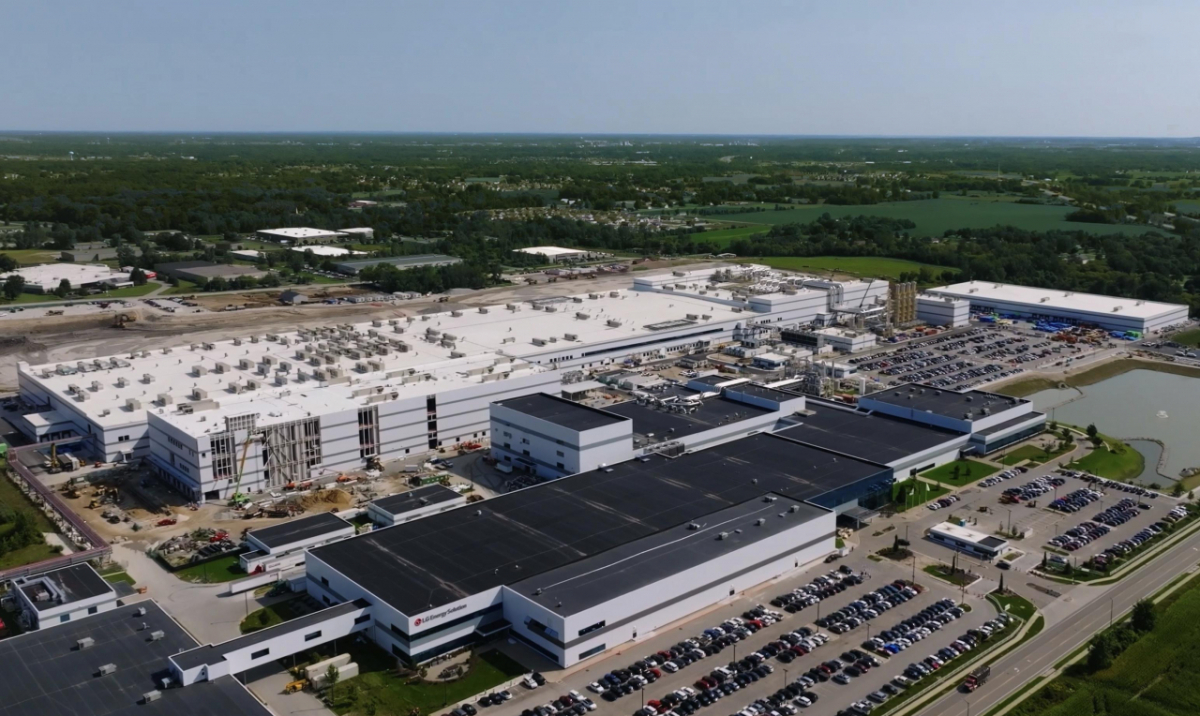
LG Energy Solution has raised its annual revenue growth target to 35-40%. The company is accelerating its push into the AI (artificial intelligence) data center market after signing its first direct Battery Energy Storage System (BESS) supply contract with a global Big Tech firm.
Lee Chang-sil, CFO of LG Energy Solution, said at the earnings announcement briefing for the third quarter of 2026 on Tuesday: "We expect Energy Storage System (ESS) shipments to increase by approximately 40% and total company revenue to grow by about 10% in the fourth quarter compared to the previous quarter."
He added, "Robust shipment flows of high-voltage mid-nickel pouch batteries and cylindrical batteries for European customers are expected to continue through year-end, and production volumes from the North American GM joint venture (JV), which began operations in the third quarter, will also be added."
LG Energy Solution raised its revenue growth target for this year, including North American production subsidies, from a previous range of mid-10% to 20% year-on-year to 35-40%. The company plans to achieve a mid-single-digit annual operating profit margin, including North American production subsidies, and reduce capital expenditure (CAPEX) by more than 40% compared to the previous year. In fact, cumulative capital investment for the first three quarters of this year was 3.8 trillion won, a 53% decrease from the same period last year.
LG Energy Solution secured new ESS orders in the third quarter. The CFO said, "Following additional project orders from existing power grid customers, we signed our first direct BESS supply contract with Big Tech, strengthening our business position in the AI data center market."
He explained, "This is a result that demonstrated our just-in-time supply capability based on local North American production sites, stable operational experience, and Supply Chain Management (SCM) competitiveness. As of the end of the third quarter, the ESS order backlog stood at approximately 160 GWh (gigawatt-hours)."
The expansion of the ESS business also contributed to revenue growth in the third quarter. Consolidated revenue for the third quarter of this year was 9.6434 trillion won, a 59.0% increase from the same period last year. Operating profit was 756 billion won, up 25.7% over the same period.
Compared to the previous quarter, revenue and operating profit increased by 27.6% and 567.3%, respectively. In particular, ESS shipments rose by more than 60% from the previous quarter, expanding their share of total revenue to the low 30% range. The operating profit margin also rose from 1.5% in the previous quarter to 7.8%.
LG Energy Solution also emphasized that most of its ESS supply volumes through 2028 have been finalized based on currently planned production capacity. This is because customer demand for locally produced cells in North America has surged due to policy factors favorable to Non-Prohibited Foreign Entity (Non-PFE) companies.
Customers under discussion for supply include not only existing power grid and utility customers but also AI data centers and hyperscalers seeking BESS, including Behind-the-Meter (BTM) direct purchase demand, and the company is discussing additional orders.
Accordingly, LG Energy Solution will expand its North American ESS production capacity. The CFO said, "We plan to have an ESS production capacity of 70 GWh by the end of next year, including new prismatic lines, up from over 50 GWh of pouch capacity by the end of this year."
He added, "At Arizona, our first North American cylindrical battery production hub, we are preparing to operate 46-series lines without issue by year-end. Mass production of LFP (lithium iron phosphate) 2170 batteries for Battery Backup Units (BBU) is targeted for the second quarter of next year."
In Europe, the company will diversify its production portfolio. Under the revised recommendations of the Industrial Acceleration Act (IAA), the scope recognized as local production has been narrowed to focus on the 27th European Union member states, and the Cost Gap threshold for recognizing exceptions to local origin requirements has been raised to 40%, strengthening localization demands within the region.
The CFO said, "For our Poland plant, which converted part of its EV production lines to ESS starting last year, we plan to secure 46-series production capabilities from 2029. We will respond to the diverse needs of automakers with pouch-type mid-to-low-cost solutions and cylindrical high-nickel products."

 in INDUSTRY
