

The introduction of cornerstone investors, major institutional players required to hold their allocated IPO shares for at least six months, is expected to reshape retail investors' approach to IPO investing. It could also help structurally reduce the pattern of IPO stocks surging on their first day of trading before plunging within hours, a phenomenon often described as the IPO "boom-and-bust cycle."
On the other hand, concerns have emerged that stock prices may become volatile once cornerstone investors’ shares are released into the market. Experts advise retail investors to make investment decisions based on a company’s cash flow and growth potential rather than seeking short-term profits from immediate post-listing price fluctuations.
Changes in the IPO market are expected to take effect starting the 13th, following the approval of an amendment to the Enforcement Decree of the Capital Markets Act at the State Council meeting on the 3rd. The amendment includes specific provisions regarding pre-demand forecasting and the cornerstone investor system.
Key elements include: △underwriters assessing institutional investors’ demand before finalizing the desired offering price range (pre-demand forecasting), and △introducing a mandatory holding period of at least six months for shares allocated to cornerstone investors (cornerstone investor system). It is expected that underwriters will calculate the desired offering price range more appropriately by reflecting market demand, and that securing institutional investors committed to holding shares for over six months in advance will prevent the pattern of "limit-up on listing day followed by a sharp drop."
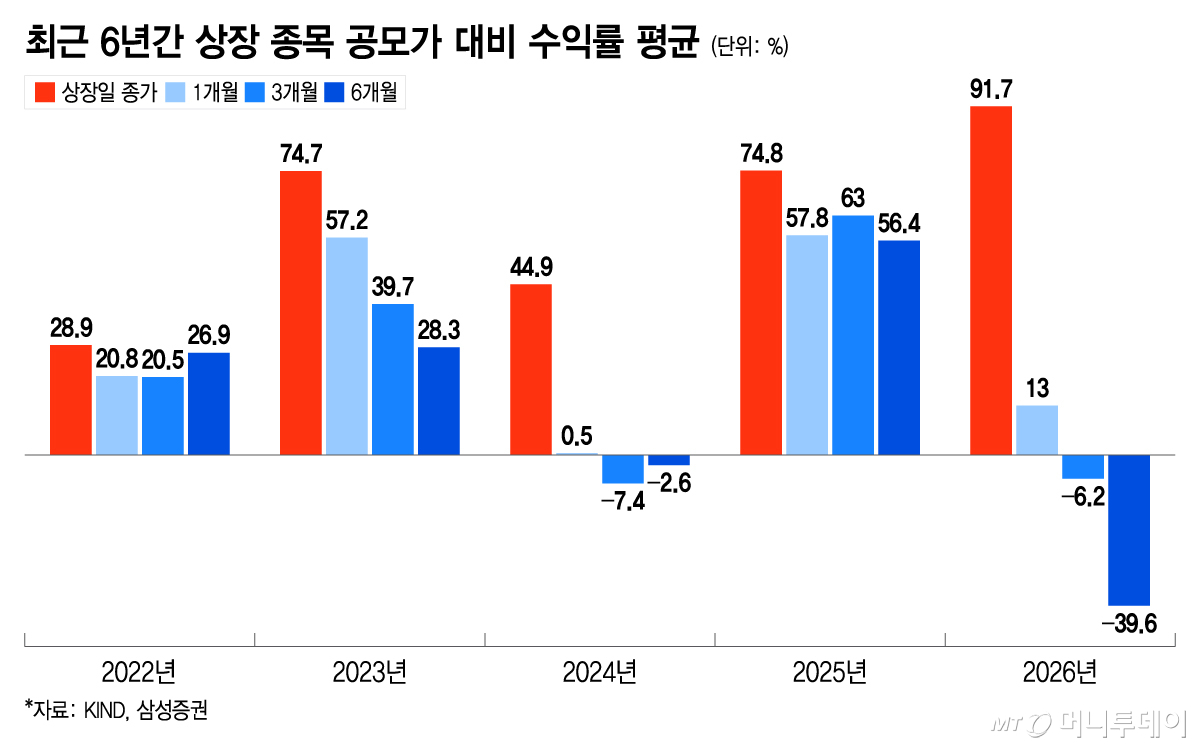
Retail investors need to review their investment strategies in line with these regulatory changes. Until now, IPO investing has been perceived primarily as a means of realizing short-term profits. Indeed, looking at this year’s IPO returns, gains have only been positive in the short term.
Kang Young-hoon, a researcher at Samsung Securities, analyzed in a report released the previous day, "This year’s IPO market can be summarized as 'good in the short term, poor in the long term' from an investment return perspective," adding, "While performance on listing day is excellent compared to last year, it is significantly weaker over the medium to long term."
According to KIND, the Korea Exchange’s corporate disclosure channel, and Samsung Securities, the average return relative to IPO price for this year’s listings was 91.7% based on closing prices on listing day, higher than last year’s 74.8%. However, the three-month return turned negative at -6.2%, contrasting with last year’s 63.0%. The gap in six-month returns was even larger. This year’s IPO stocks posted a six-month return of -39.6%, lower than 2024 (-2.6%), when the KOSPI was confined to a trading range.
The cornerstone investor system, introduced to address these issues, is expected to bring significant changes to supply and demand structures over different periods. This is because cornerstone investors are obligated to hold their allocated shares for a minimum of six months and up to a maximum of ten months. Of the allocated shares, 50% are subject to a lock-up period of six months, 30% for eight months, and 20% for ten months. Consequently, half of the cornerstone investors’ allocation cannot be sold on the market until after six months have passed.
Investors who have participated in IPO housing subscriptions seeking short-term profits immediately after listing must now note that cornerstone investor shares will not enter the market for at least six months. While stock price volatility may decrease during this period, prices could actually fall when institutional investors release their holdings after six, eight, or ten months.
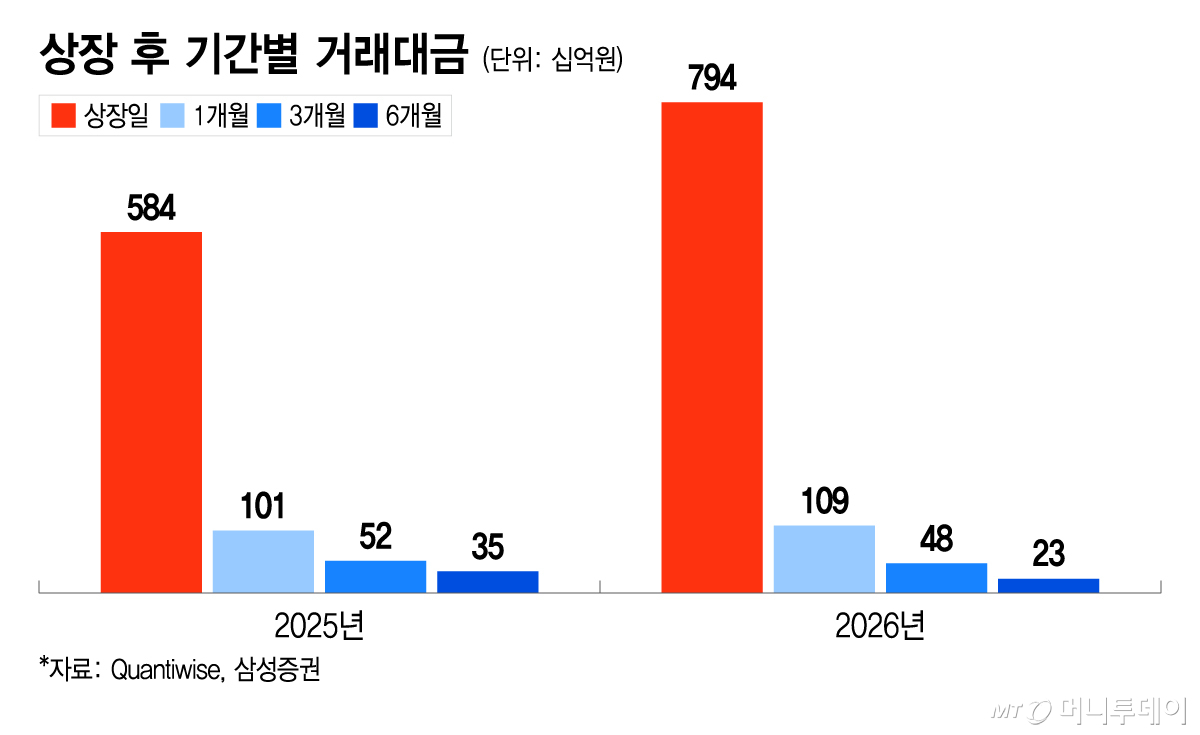
As the IPO market is expected to gain momentum this month and retail investor participation in housing subscriptions is increasing, attention to regulatory changes is necessary.
Park Jong-sun, a researcher at Eugene Investment & Securities, said, "There are eight companies (as of October 30) that have completed institutional investor demand forecasting and are proceeding with listings, and including these, a total of 17 companies are targeting November listings, suggesting the IPO market will become active at levels seen in previous years." He added, "The general subscription competition ratio for October was 1,079 to 1, the highest among all October competition ratios since 2017."
Accordingly, retail investors need to consider comprehensively factors such as disclosures that allow verification of a company’s cash flow and growth potential, supply and demand changes by period, and trading volumes in small- and mid-cap stocks.
Lee Seok-hoon, a senior research fellow at the Capital Markets Institute, pointed out in a 2024 report, "In cases where IPOs are for small companies or have a high proportion of restricted shares, resulting in low initial circulating supply, overheated buying patterns can be significantly amplified." He warned that "retail investors may misinterpret this as a signal of 'high-quality stocks' and engage in follow-on buying."
To gauge the direction of stock prices for newly listed companies, one method is to use KOSDAQ small- and mid-cap trading volume as a leading indicator for long-term IPO supply and demand. Researcher Kang added, "For newly listed stocks to expect stable subsequent supply and demand over the medium to long term after listing, supply and demand must spread to KOSDAQ small- and mid-cap stocks." He concluded, "Until this medium- to long-term recovery in supply and demand is confirmed, a more cautious approach is required for long-term mandatory holding commitments of three months or more, taking into account fundamentals, valuation, and other factors."

 in STOCK

