

While the likelihood of a "Blue Wave" (simultaneous Democratic Party control of both chambers of Congress) is high in the upcoming U.S. midterm elections, forecasts suggest that federal-level artificial intelligence (AI) policy will not change significantly.
However, given growing voter backlash against data center construction, it is also expected that state governments may adopt policies aimed at slowing down construction "speed." Analysts note that a slowdown in data center investment could impact the future profitability of AI-related companies, including domestic semiconductor firms.
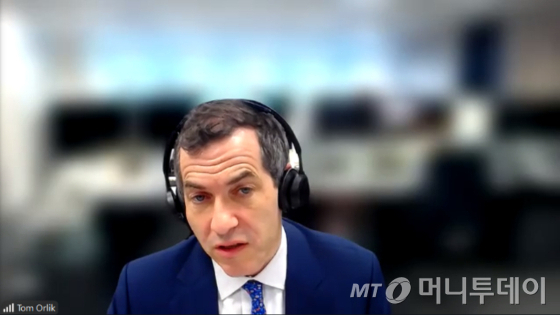
Tom Orlik, Bloomberg's chief economist, said at the "2026 U.S. Midterm Elections and Macro Outlook Webinar" hosted by the Korea Financial Investment Association on Wednesday, "Because U.S. President Donald Trump can exercise his veto power, it will be difficult to pass national-level AI legislation even if the Democratic Party takes control of both chambers."
He added, "However, governors have the authority to change policies in ways that affect the speed of data center construction." Orlik is a macroeconomic and monetary policy expert who has served as an economist at the UK Treasury and the International Monetary Fund (IMF), as well as a Beijing correspondent for The Wall Street Journal.
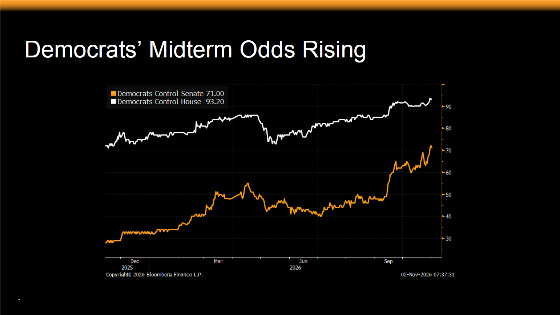
Orlik predicted that the Democratic Party would achieve a landslide victory over the Republican Party in both chambers in this midterm election. According to betting market prediction data, the probability of the Democratic Party taking control of the House is over 90%, and for the Senate, it is over 70%. He cited inflation as the reason for the Democratic advantage.
Orlik said, "Inflation has risen due to policies introduced by President Trump," adding that "the trade war, the U.S.-Iran conflict, and the AI revolution have contributed to high inflation."
The basis for this claim is that import prices and gasoline prices rose due to the trade war and the U.S.-Iran conflict, respectively, while memory chip prices surged due to the AI revolution, driving up the cost of PCs and mobile devices. Additionally, the burden of electricity and water bills has increased due to data center operations.
Orlik assessed that such election results would be positive for financial markets. This judgment is based on the view that in a gridlock where the Democratic Party controls Congress and the Republican Party holds the White House, there is a low probability of new policies, regulations, or taxes being enacted. According to him, the U.S. S&P 500 index has risen every year following midterm elections held since 1950.
However, he viewed that obstacles could arise in data center construction, a core facility of the AI industry. This is because data center construction is an issue of common concern for both the Democratic and Republican parties, as it drives up local electricity and water bills and causes inflation.
He diagnosed that investors are now questioning AI profitability rather than immediately getting excited just because something is labeled "AI." It is expected that this midterm election will serve as an opportunity to view the AI revolution with balance rather than extreme optimism.
Orlik explained, "The majority of data centers planned in the U.S. from this year through 2028 are located in states where this midterm election is being held," adding that "if the number of Democratic governors increases, or if Republican governors also heed the signal that voters do not want data centers, construction speed could slow down."
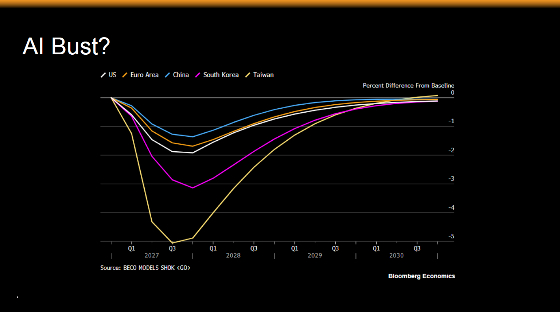
If data center construction is delayed, orders and profitability for Korean semiconductor companies could be hit. While Orlik expects AI capital investment to continue, he said, "If the U.S. stock market falls by 20% and credit spreads widen, leading to a one-year halt in data center investment, South Korea and Taiwan could face significant economic shocks."
He said that since these two countries are the biggest beneficiaries of expanded AI investment, a sharp market correction could result in substantial shock.
Democratic Party control of Congress could also impact Korean companies' agreements on investment in the U.S.
Orlik said, "If the Democratic Party takes control of Congress, it will focus on checking the Trump administration rather than advancing economic policies," adding that "the U.S. government's acquisition of equity stakes in private enterprises and investment agreements with foreign companies, including those from South Korea, could be subject to strict scrutiny."
He viewed the possibility of tariff policies being further strengthened after the midterm elections as low.
Orlik predicted, "President Trump is using tariffs as a threat tool against specific countries," adding that "the midterm election will not serve as a trigger for returning to strong tariff measures."
However, Kwon Hyo-seong, Bloomberg's Korea and Taiwan economist, said, "Given the substantial current account balance surpluses of South Korea and Taiwan, pressure to expand investment in the U.S. by semiconductor companies may continue."

 in STOCK


