


As the U.S. Democratic Party secured a landslide victory in the midterm elections held on Tuesday (local time), gaining majority status in both the Senate and the House of Representatives, forecasts suggest that "Trump-style protectionism" may also face a check.
This is because President Donald Trump has expressed his intent to accept the election results and cooperate with the Democratic Party, which could lead to changes in trade policies that had applied high tariff rates to major trading partners. The Democratic Party has long sought to curb Trump's tariff policies.
Since its inception, the Trump administration has imposed indiscriminate tariffs on major trading partners and continued trade pressure, citing American-first principles. In this process, South Korean companies have had to bear significant uncertainty regarding exports to the United States.
Forecasts suggest that the situation will change if the Democratic Party secures control of Congress. This is because at the congressional level, it would be possible to verify the tariff imposition process and economic effects of the Trump administration, as well as expand hearings and investigations into tariff policies. The growing burden on U.S. consumers' prices due to tariffs is also a factor pressuring policy changes.
If changes occur in tariff policies, opportunities will arise for domestic consumer goods companies, including K-food and K-beauty. The United States is already the largest export market for K-food brands such as CJ CheilJedang, Nongshim, and Samyang Foods.
According to the Ministry of Agriculture, Food and Rural Affairs, K-food exports to the U.S. in the first half of this year reached $1.04 billion, an 11.3% increase from the same period last year. Instant noodles, snacks, and kimchi led the growth. In particular, instant noodle exports increased by 24.4%, demonstrating the competitiveness of Korean food products in the U.S. market.
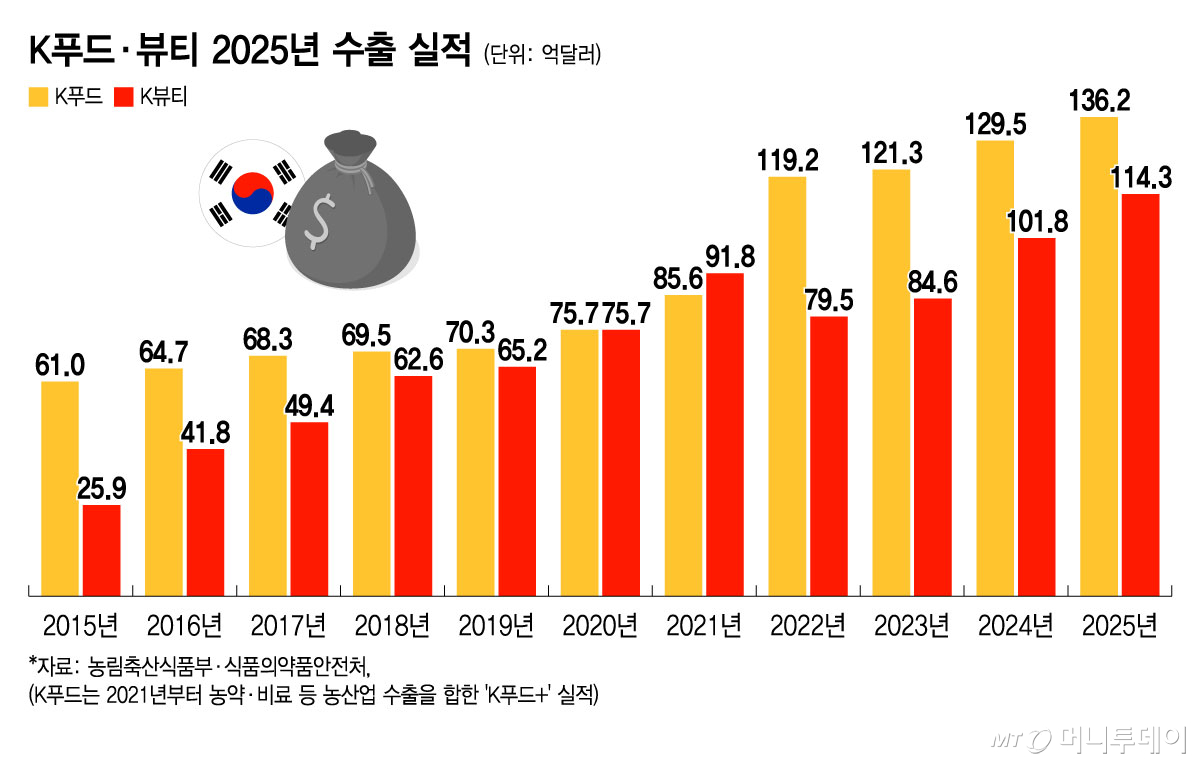
The same applies to K-beauty. According to the Ministry of Food and Drug Safety, domestic cosmetics exports from January to September this year reached $11.1 billion, a 31.1% increase from the same period last year. Among these, exports to the United States amounted to $2.35 billion, up 40.6%. The U.S., which became the largest export destination for Korean cosmetics for the first time last year, is maintaining its top position this year as well.
As K-food and K-beauty have already demonstrated growth potential in the U.S. market, if the U.S. protectionist stance eases or the predictability of trade policies increases, exports could gain further momentum.
Above all, K-brands are in a favorable position as they are recognized by U.S. consumers for their quality relative to price and differentiated product competitiveness. K-food is expanding its consumer base through instant noodles, frozen foods, and sauces, while K-beauty is expanding its presence in major U.S. distribution networks centered on skincare. In a situation where U.S. consumers have become sensitive to high prices, Korean products boasting reasonable prices and high quality possess sufficient competitiveness.
Of course, there are also points noting that President Trump's tariff policies will not change immediately just because the Democratic Party takes control of Congress. This is because President Trump has veto power and the administration holds considerable authority to impose tariffs based on existing laws. In fact, Reuters predicted that even if the Democratic Party wins, it would not be easy for a tariff repeal bill to pass through Congress and lead to substantive policy changes.
Ham Sun-ok, chair of the K-Food Industry Innovation Association (Professor at Yonsei University), said, "If President Trump suffers a complete defeat in this midterm election and changes occur in tariff policies, it will be a great help for exports of K-brand consumer goods, including K-food."
However, she added, "The broader trade policy framework of protecting domestic industries in the U.S. may not change after the election, so we need to watch carefully."

 in LIVING

