

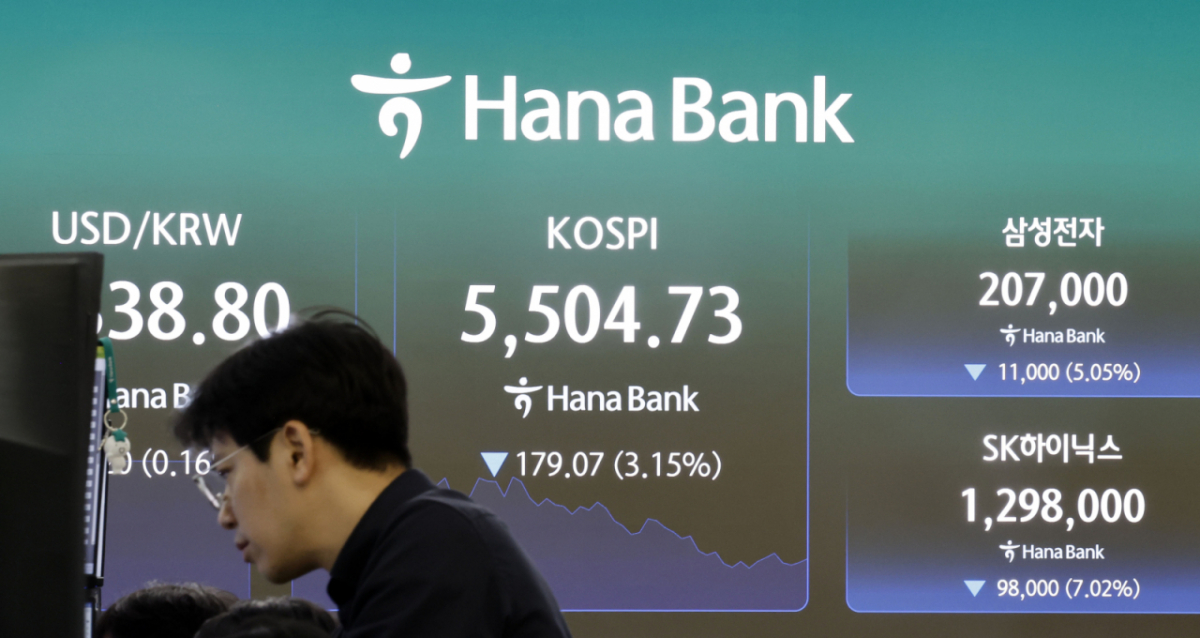
The KOSPI fell more than 4 percent in early trading on Thursday as Samsung Electronics and SK hynix shares plunged amid concerns that a Democratic sweep in the U.S. midterm elections could lead to tighter regulations on AI data centers.
The Korea Exchange also triggered a sell-sidecar on the Kospi market.
It was interpreted that concerns over potential delays in data center construction and semiconductor orders, despite the resolution of uncertainty following the U.S. midterm election results, triggered selling pressure on semiconductor stocks.
While foreign investors are dumping shares, buying interest is being dispersed into some stocks in the automotive, financial, and biotechnology sectors.
Down 42% from All-Time High…Sell Sidecar (Futures Market Circuit Breaker) Also Activated
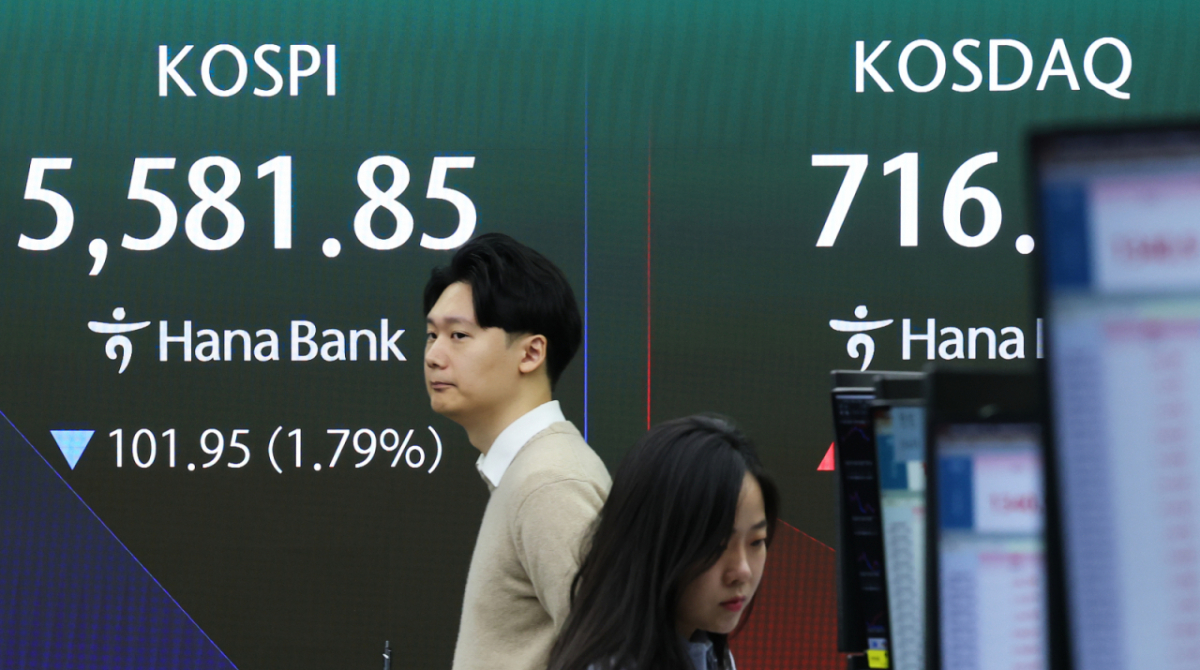
As of 10:39 a.m., the KOSPI is trading at 5,446.79, down 237.01 points (4.17%) from the previous trading day. After opening down 103.71 points (1.82%) at 5,580.09, the index widened its decline to fall below 5,500, dropping as low as 5,386.29, a decrease of 5.23%, during intraday trading. Foreign investors and institutional investors are net selling 1 trillion 125.2 billion won and 6 billion won, respectively, while retail investors are net buying 1 trillion 46.2 billion won.
The current KOSPI index level is 3,938.80 points (41.97%) lower than the all-time high of 9,385.59 recorded on June 19. This significantly exceeds the standard threshold of a 20% drop from the peak, which is typically considered a bear market. In a bear market, there is a strong tendency for accumulated sell orders to be released to reduce losses whenever the index experiences short-term rebounds.
The Korea Exchange activated a sell sidecar in the KOSPI market at 10:16 a.m. on this day. The KOSPI sell sidecar is a market stabilization mechanism that suspends the validity of program sell orders for five minutes if the KOSPI 200 futures price remains down more than 5% from the previous trading day for one minute. This sidecar is the 56th activation in the KOSPI market this year and the 29th in the sell direction.
Samsung Electronics is trading at 205,000 won, down 5.96%. SK hynix showed a price of 1,288,000 won, down 7.74%. Among other top market capitalization stocks, Samsung Electro-Mechanics (-11.48%), SK Square (-7.90%), Samsung Electronics Preferred Shares (-4.95%), and LG Energy Solution (-4.23%) showed weakness. Conversely, Celltrion (7.00%), Hyundai Motor (4.06%), KB Financial Group (3.96%), and Samsung Biologics Logistics (2.21%) showed strength.
In the U.S. midterm elections held on the 3rd (local time), the Democratic Party secured a majority of seats in both the Senate and the House of Representatives, while the U.S. stock market saw mixed results with major indices rising and semiconductor stocks weakening. Although election uncertainty has been resolved, concerns over restrictions on new data center permits have emerged as Democratic candidates won in Texas, Georgia, and Ohio, which are considered key data center regions within the United States.
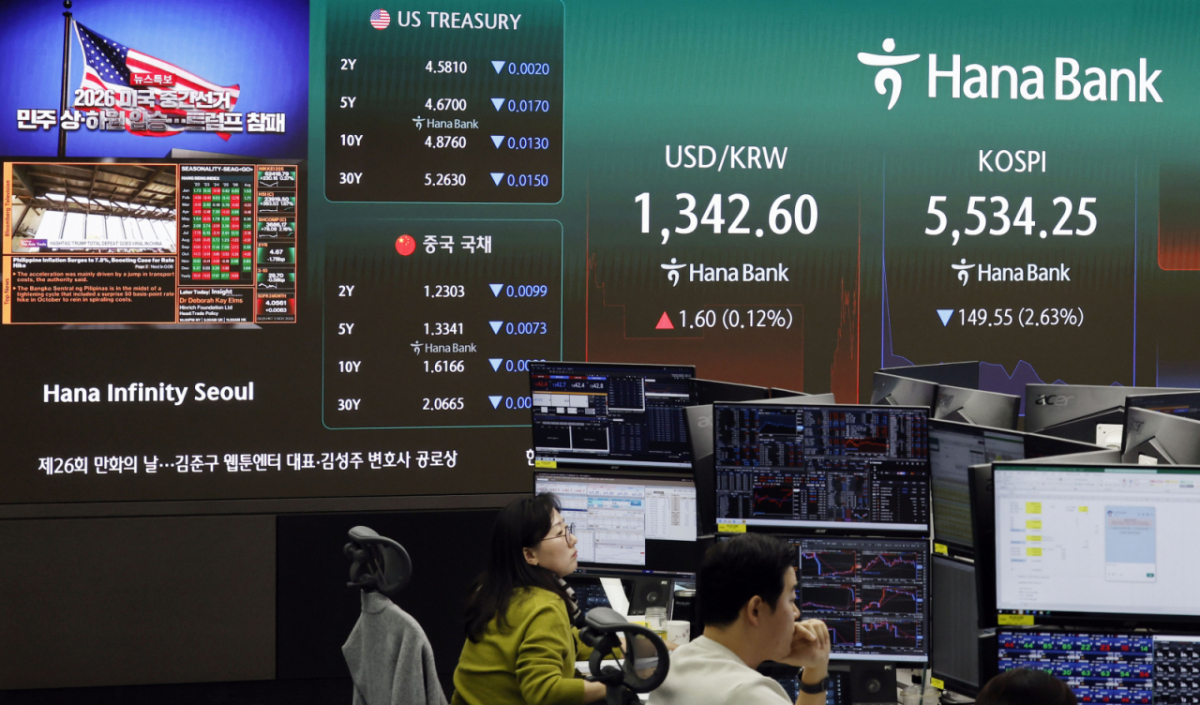
In the U.S. stock market as well, major indices rose while semiconductor stocks weakened simultaneously. The Dow Jones Industrial Average closed at 53,356.12, up 1,569.40 points (3.03%), and the NASDAQ Composite Index closed at 25,736.51, up 364.50 points (1.44%). In contrast, the Philadelphia Semiconductor Index fell 3.13%. The domestic stock market is failing to follow the upward trend of the U.S. market due to the significant weight of large-cap semiconductor stocks.
Key Question: Will Buying Interest Extend to Other Sectors…“Extremely Undervalued Market”
The key issue is whether the decline in oil prices and changes in U.S. policy resulting from the Blue Wave will translate into buying interest in other sectors.
Researcher Yang Hyeon-kyung of iM Securities said, “While selling pressure on large-cap semiconductor stocks continues, expectations for reduced cost burdens due to falling oil prices are spreading to aviation and transportation, so it is necessary to check whether rotation trading will appear in non-semiconductor sectors.” She added, “Secondary batteries and solar power are expected to maintain benefits from U.S. policy changes, but profit-taking sell orders may emerge for stocks that surged sharply the previous day.”
The alleviation of price burden due to recent stock price declines is cited as a factor supporting short-term rebounds. Researcher Byun Jun-ho of IBK Investment & Securities noted, “Empirically, markets after midterm elections have shown a common tendency to react more sensitively to positive news than negative news. Given that the KOSPI recently plunged preemptively during intraday trading to around 1 times its 12-month forward price-to-book ratio (PBR), indicating extreme undervaluation, it appears likely to be more sensitive to positive news than negative news, as in the past.”
He added, “It is also positive that rebounds appeared toward areas of major historical support levels without eco-friendly theme stocks reflecting expectations for a Blue Wave ahead of the midterm elections.”
The KOSDAQ traded at 684.19, down 30.76 points (4.30%) from the previous trading day. Foreign investors are net selling 136.9 billion won, while retail investors and institutional investors are net buying 126.5 billion won and 7.8 billion won, respectively.
Among top market capitalization stocks, Simmtech (-16.02%), Iotech (-13.35%), Jusung Engineering (-10.23%), Ecopro BM (-8.85%), Lino Industrial (-7.73%), Ecopro (-6.89%), Rainbow Robotics (-5.04%), Samchundang Pharm (-2.10%), and HLB (-1.19%) declined.

 in STOCK


