

It was argued that regulations should distinguish between physical spin-offs and dual listings by listed companies. Critics pointed out that while a physical spin-off does not necessarily lead to the dual listing of a subsidiary, granting share buyback rights for all physical spin-offs makes it difficult for companies to restructure their businesses.
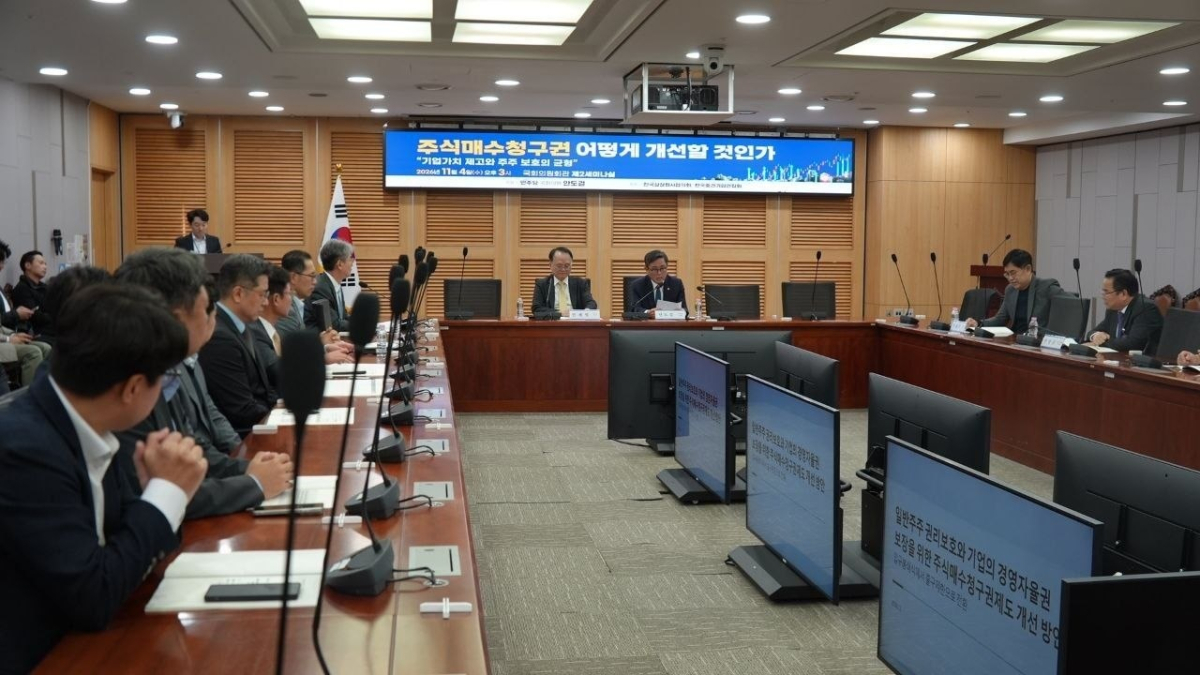
According to financial investment industry sources on the 5th, at the "Symposium on Improving the Share Buyback Rights System" held at the National Assembly the previous day, hosted by Democratic Party of Korea lawmaker Ahn Do-geul, Professor Shin Hyeon-han of Yonsei University, who served as a presenter, stated this while saying, "You end up burning down the thatched roof trying to catch bedbugs."
A physical spin-off is a method in which a company separates a specific business division into an independent subsidiary and the parent company retains all shares of the newly established company. In the past, problems have frequently arisen during the process of dual-listing subsidiaries. This is due to concerns that when a subsidiary goes public, the parent company's ownership stake in the subsidiary may decrease, and as the value of core businesses becomes concentrated in the subsidiary's stock price, the shareholder value of the parent company could be impaired.
A representative case is the physical spin-off and listing of LG Energy Solution from LG Chem. At the time, shareholders of LG Chem strongly protested after the battery division, a key growth business, was separated into an independent company and listed. Subsequently, to strengthen protection for general shareholders, the government introduced a system granting share buyback rights to shareholders who oppose physical spin-offs by listed companies.
Share buyback rights are the right of shareholders who oppose specific corporate decisions to request that the company purchase their shares at a certain price.
Under the current system, if a listed company pursues a physical spin-off, opposing shareholders can exercise share buyback rights. However, it is argued that improvements are needed because the same regulations apply even when the subsidiary is not listed after the physical spin-off and is operated as an independent legal entity.
Professor Shin pointed out, "The actual problem is not the physical spin-off itself but dual listing, yet the current system grants share buyback rights for all physical spin-offs," adding, "It cannot be definitively stated that the direction after a physical spin-off will necessarily lead to a dual listing, so the cause and remedy are mismatched."
He further added, "There are also numerous research results indicating that physical spin-offs have a positive impact on stock prices," and noted, "As an alternative, there is a proposal to change the timing of granting share buyback rights from the physical spin-off stage to the subsidiary dual listing stage."
Professor Shin stated that strengthening corporate communication with shareholders is also necessary alongside regulatory relaxation. He said, "We must reflect on the fact that corporate communication with shareholders has been insufficient, such as general meetings of shareholders still remaining a formal procedure," adding, "Alongside institutional improvements, substantive expansion of communication between companies and shareholders should be achieved."
Professor Ahn Tae-jun of Hanyang University, who participated as a discussant, said, "The current system excessively suppresses physical spin-offs themselves." Park Yang-gyun, head of the Policy Division at the Korea Federation of Mid-Sized Companies, emphasized, "For companies to survive, they must be able to restructure their businesses in a timely manner."

 in STOCK
