

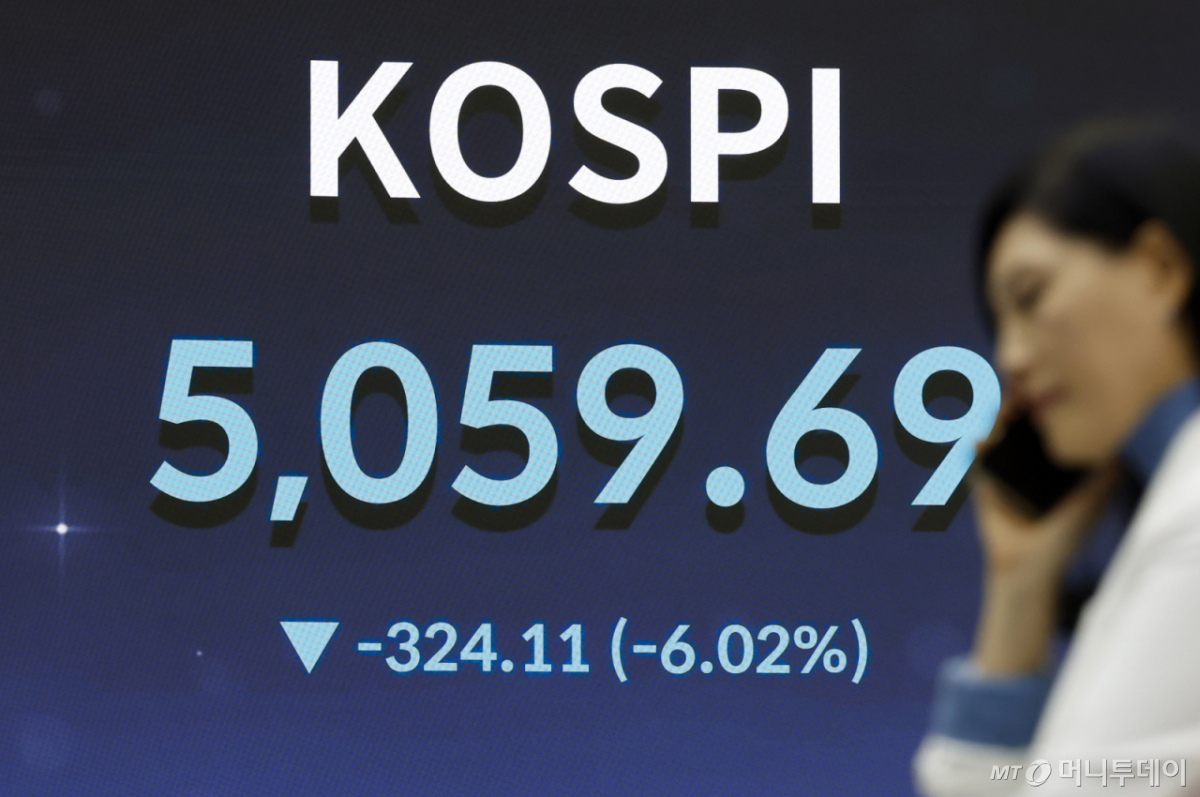
The KOSPI plunged more than 13% over two sessions following the 'blue wave' that gave the U.S. Democratic Party control of both houses of Congress, barely managing to hold above the 5,000 mark. Financial industry experts said the sell-off driven by concerns over tighter regulations on AI data centers was excessive but expected volatility to persist for the time being.
On Friday, the KOSPI ended trading at 5,059.69, down 324.11 points (6.02%) from the previous session. The KOSPI plunged by more than 8% from the start of trading and fell as low as 4,911.28 during the day. This marked the first time since February 6 that the KOSPI dipped below the 5,000 line intraday, a span of 273 days. At 9:03 a.m., Stage 1 sidecar (futures market circuit breaker) was triggered, and trading was suspended for 20 minutes.
This was due to growing anxiety that the U.S. Democratic Party would strengthen regulations on AI data centers. On Thursday (local time), the NASDAQ Composite Index fell by 5.52%. The S&P 500 Index dropped by 4.36%, and the Dow Jones Industrial Average declined by 3.44%. The Philadelphia Semiconductor Index slid by more than 12% on the day.
Lee Kyung-min, head of FICC Research at Daishin Securities, said that "the main cause of the crash on this day was concerns over strengthened AI data center regulations following the U.S. midterm elections," adding that "deteriorating funding conditions for AI infrastructure also weighed on investor sentiment."
He continued, "Supply and demand instability intensified with news including Microsoft's review of its NeoCloud project, concerns that CoreWeib's corporate bond yield would break through the 17th% line, SpaceX CDS hitting an all-time high amid expanding credit anxiety, and large-scale position liquidations by Leopold Aschenbrenner's AI hedge fund."
He assessed, "However, the possibility of a complete halt to AI data center construction is limited, and market concerns are excessive."
In the KOSPI market, foreign investors made net sales of 2.7688 trillion won. Retail investors and institutional investors made net purchases of 604.9 billion won and 1.7 trillion won, respectively.
Among KOSPI sectors, electrical/electronics and medical/precision instruments fell by more than 7%. Manufacturing and machinery/equipment dropped by more than 6%, securities by more than 5%, while insurance and finance showed declines in the 4% range. In contrast, telecommunications rose by 2.1%, and IT (information technology) increased by 1.51%.
Among the top 20 stocks by KOSPI market capitalization, only Naver (NAVER) jumped by 2.87%. All others declined. SK hynix plunged by 10.44%. SK Square also slid by 10.61%. Samsung Electronics fell by 6.35%, and Samsung Electro-Mechanics dropped by 7.84%.
The KOSDAQ recorded 644.27, down 34.14 points (5.03%) from the previous session.
In the KOSDAQ market, retail and foreign investors made net sales of 110.3 billion won and 101.4 billion won, respectively. Institutional investors made net purchases of 205.6 billion won.
Among KOSDAQ sectors, all sectors declined except for entertainment/culture, which closed flat. Medical/precision instruments fell by 8.57%. Metals, non-metals, and machinery/equipment slid by more than 7%. Electrical/electronics dropped in the 6% range, and manufacturing fell in the 5% range.
Among top KOSDAQ market capitalization stocks, PSK Holdings, ISC, and PSK all fell by more than 10%. Wonik IPS and HPSP closed weak in the 8% range. Alteogen showed a decline in the 5% range, Ecopro in the 6% range, and Ecopro BM in the 7% range.
In contrast, Pharma Research rose by 4.22%, and Peptron jumped by 3.84%. Robotis also climbed by 1.37%.
On this day, the won/dollar exchange rate ended daily trading at 1,342.1 won per dollar, up 0.6 won from the previous session's closing price.
Experts believe that stock market volatility is likely to continue in the future. This is because traditional fundamentals logic, such as earnings and valuation, is not being reflected in stock prices due to excessive fear. Additionally, events that could impact AI investment sentiment remain on the horizon, including CoreWeib's earnings release and Anthropic's push for an IPO (initial public offering).
Lim Jeong-eun, a researcher at KB Securities, stated, "It is expected that we will not be able to avoid a trend of repeated sharp rises and falls for the time being," adding, "As U.S. October non-farm payrolls and unemployment rate are released tonight, and U.S. October CPI (consumer price index) and PPI (producer price index) are scheduled to be disclosed next week, it will be possible to gauge the Federal Reserve System (Fed·Federal Reserve)'s interest rate path."
Therefore, advice is emerging that rather than selling stocks immediately, one should watch the situation and manage their portfolio. Yoon Seok-mo, Head of the Research Center at Samsung Securities, explained, "Rather than joining in a panic sell-off immediately, a wait-and-see stance is needed until market noise subsides," adding, "Oil prices have fallen significantly from their peak on expectations of changes in the Middle East situation, and this has also led to a downward trend in market interest rates, which can be a factor that greatly reduces financial burdens related to AI."

 in STOCK
