

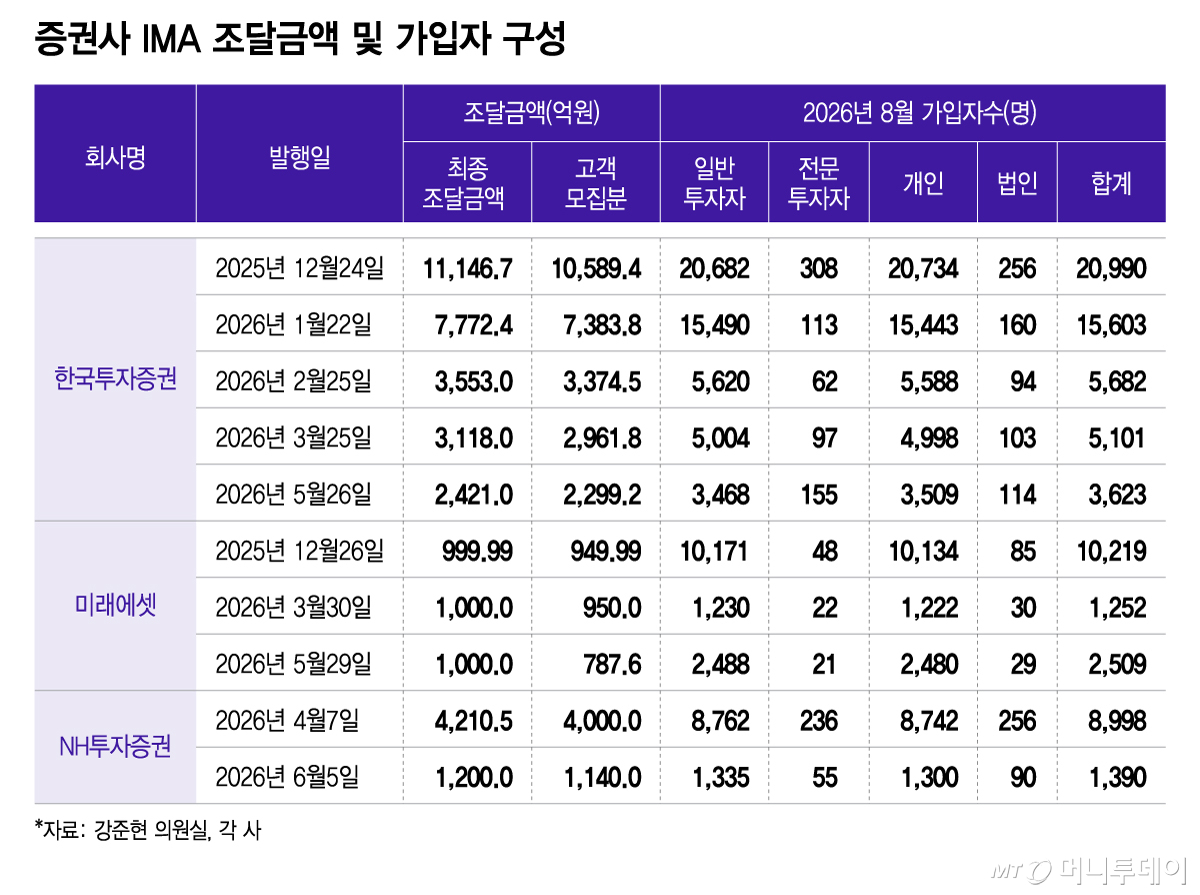
It was revealed that 98.4% of subscribers to the Integrated Margin Account (IMA) offered by comprehensive financial investment business operators with capital of 8 trillion won or more are individuals. As funding raised through IMAs has surpassed 4 trillion won, and given the overwhelming share of individual investors, there are calls for strengthened risk management of underlying assets such as overseas private placement bonds. It is also argued that disclosure of operational status and comparative information needs to be enhanced from the perspective of investor protection, as basic information such as returns is difficult to access.
According to documents submitted on the 9th by the Financial Supervisory Service to the office of Democratic Party of Korea lawmaker Kang Jun-hyun, a member of the National Assembly’s Political Affairs Committee, the share of individual subscribers among the three major comprehensive financial investment business operators that launched IMA products was 98.4% as of the end of August. Even when divided into general and professional investors, the share of general investors reached 98.5%.
An IMA is a performance-based product in which a brokerage firm manages funds entrusted by customers for corporate finance and other purposes, distributing profits according to performance. The brokerage firm presents a benchmark return rate and pays this amount to the customer without deducting performance fees. If returns exceed the benchmark rate, a portion of the excess is distributed to the customer, while the remainder goes to the brokerage firm. Thus, the structure allows the brokerage firm to retain more as it generates higher profits.
The IMA, which existed only in name after its introduction in 2017, saw its first product launched in December last year, coinciding with the government’s policy to promote productive finance. Korea Investment & Securities, which has most actively issued and solicited IMAs since the system was fully implemented, had the highest per-capita subscription amount among the three firms at 52.17 million won (as of the end of August). During the same period, NH Investment & Securities stood at 49.48 million won, and Mirae Asset Securities at 19.22 million won. It is interpreted that high-net-worth individual investors have relatively flocked to Korea Investment & Securities’ IMAs.
The per-capita subscription amount for IMA S6 issued by Korea Investment & Securities in May was 63.46 million won, showing a trend of increasing per-capita amounts with each successive solicitation round. On an individual product basis, the per-capita subscription amount for the IMA issued by NH Investment & Securities in June was approximately 82.01 million won, the highest as of the end of August.
The share of individual and corporate investors also varied by company. NH Investment & Securities had a corporate share of 3.33% based on the number of subscribers, more than double that of the other two firms (in the 1% range). The share of professional investors was also higher at NH Investment & Securities at 2.8%, compared to Korea Investment & Securities (1.4%) and Mirae Asset Securities (0.7%). An official from NH Investment & Securities explained, “The share of corporate funds among the funds solicited from customers was 56.7% cumulatively for the first through third tranches,” adding, “This reflects an increase in choices by institutional investors and corporate investors who prioritize stability.”
With about one year having passed since the full implementation of the IMA system, opinions are emerging that risk management should be strengthened given the high proportion of retail investors. Korea Investment & Securities’ IMA S1 had substantial loan interest income of approximately 24 billion won (as of the end of September) and income related to investment securities of approximately 21.5 billion won, but all valuation, disposal, and other gains/losses recorded negative figures. During last month’s National Assembly Political Affairs Committee national audit, it was pointed out that some Korea Investment & Securities IMA products had a high overseas private placement bond investment share in the 20% range, which did not align with the intent of the IMA system. An official from Korea Investment & Securities stated, “The cumulative return rate for IMA S1 as of the end of September was 3.03%,” explaining, “We achieved a return in the 3% range after deducting management fees associated with product operations.”
While each company discloses quarterly IMA operational details through the Korea Financial Investment Association and their own websites, it is not easy to grasp returns at a glance. Mirae Asset Securities and NH Investment & Securities publish operational reports on their websites containing cumulative return rates since inception, annualized return rates, specific investment details, management plans, asset composition ratios, and key management personnel. In contrast, Korea Investment & Securities discloses the composition of major operating revenues, requiring investors to calculate returns individually. While operational reports are provided to subscribers, investors considering subscription find it difficult to compare returns by product or understand specific operational status.
The Financial Supervisory Service is scheduled to hold a meeting with executives on brokerage IMAs and issued notes on the 12th.
Advice is being offered that brokerage firms should increase the supply of venture capital in line with the intent of the IMA system, while simultaneously improving consumer access to information and risk management systems. Lawmaker Kang Jun-hyun emphasized, “During this national audit, concerns about insolvency risks were raised regarding the investment direction of funds raised through IMAs,” adding, “Since a structure where deepening insolvency negatively impacts investors’ expected returns exists, managers and financial authorities must thoroughly strive in IMA operations and management.”

 in STOCK
