

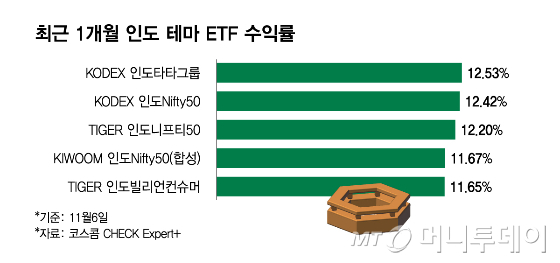
While major Asian indices such as those in South Korea, Japan and Taiwan plunged over the past month, only the Indian stock market rose on its own. Exchange-traded funds (ETFs) investing in the Indian stock market, including the Nifty 50 Index, also posted double-digit returns during the same period.
Experts diagnose this trend as being driven by the fact that the Indian market, which has a low allocation to AI, has emerged as an alternative amid concerns over the profitability of AI investments and the election of candidates in the U.S. midterm elections who are expected to strengthen regulations restricting data center construction.
According to KOSCOM CHECK Expert+ on the 9th, the one-month return for 'KODEX India Nifty50' as of the previous trading day was 12.42%. 'TIGER India Nifty50' (12.20%) and 'KIWOOM India Nifty50 (Synthetic)' (11.67%) also achieved double-digit returns, ranking among the top performers among all ETFs listed domestically.
According to Investing.com for the same period, the India Nifty 50 Index rose by 2,254.25 points (9.9%), while the KOSPI index fell by 1,881.7 points (27.1%). The Taiwan Weighted Index and Japan's Nikkei Index dropped by 11,120.91 points (20.3%) and 13,249.21 points (18.7%), respectively. This means that while major Asian emerging market indices weakened in tandem, only the Indian index rose.
Until recently, the Indian stock market had been relatively overlooked in the global AI investment boom due to its low allocation to AI technology stocks such as semiconductors. However, the situation reversed after concerns over the financial soundness of neocloud company CoreWeave emerged, followed by news that tech companies like Meta and Oracle were issuing high-yield corporate bonds to fund AI infrastructure investments.
As concerns spread over whether massive investment funds could be recovered and monetized, AI technology stocks plunged. Furthermore, as Democratic Party candidates won governorships in key regions with major data centers, including Texas, in the U.S. midterm elections, expectations grew that data center construction regulations might be strengthened or delayed.
Lee Jun-jae, a manager at Samsung Asset Management, analyzed, "India is centered on financials, consumer goods and industrials, so it has almost no exposure to AI, highlighting it as an 'AI hedge' alternative for global funds." He added, "Foreign investors sold India at record levels this year to fund semiconductor purchases but switched to net buying this month, leading the rebound."
The decline in international oil prices also acted as a positive factor for India, which has a high dependence on crude oil imports. This is because falling oil prices reduce crude oil import costs, thereby easing burdens on inflation and the current account balance. As of the 6th (local time), Brent crude futures for January delivery closed at $98.32 per barrel on the London ICE Futures Exchange in the UK.
Manager Lee added, "For India, a net oil importer, Brent crude below $100 is a factor that eases burdens on inflation, the current account balance and the rupee." He noted, "The valuation appeal has increased due to corrections throughout the year."
However, when the investment period was extended to three or six months, the returns for 11 India-themed ETFs, excluding 'Asset Plus India Top Companies Focus 20 Active,' all recorded negative figures. It is assessed that it remains to be seen whether the recent upward trend will lead to a sustained rebound.
Lee Ji-sun, a manager at Asset Plus Asset Management, explained, "The current rebound is strongly driven by supply and demand." She added, "While the pullback appeared quickly given the significant decline since the beginning of the year, for it to turn into a trend-based rise, India's growth potential expected by investors must be confirmed through actual corporate earnings."
Experts recommended utilizing India ETFs as a 'diversification tool' to complement core investment assets. Manager Lee Jun-jae advised, "Domestic investors have a heavy bias toward semiconductors and AI, so including India, which has a different sector composition, yields significant diversification effects." He added, "Considering emerging market volatility and exchange rate risks, it is appropriate to hold a portion of overseas stock allocations long-term through systematic investment plans."

 in STOCK
