

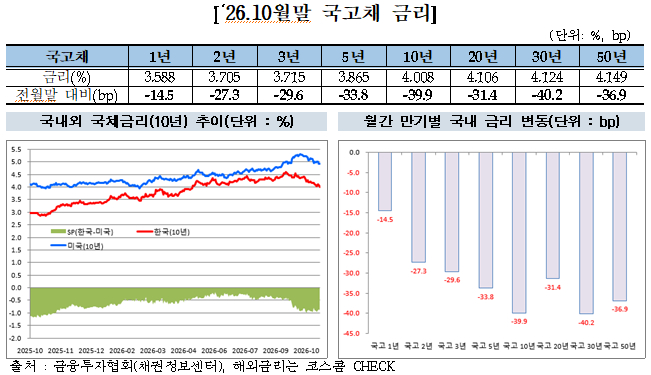
Driven by foreign investors’ purchases of government bond futures and a growing preference for safe-haven assets among investors, government bond yields closed lower across all maturities last month. In particular, the decline was pronounced in medium- to long-term bonds, with the 30th-year yield rising by 0.402 percentage points. Last month, foreign investors shifted from net selling to net buying of bonds, purchasing a total of 8.5 trillion won worth of securities.
According to the “October 2026 Over-the-Counter Bond Market Trends” released on the 10th by the Korea Financial Investment Association, government bond yields closed lower across all maturities compared with the previous month last month. The 3-year yield fell by 29.6 basis points (1bp = 0.01 percentage point) from the previous month to 3.715%. The 10-year yield dropped by 39.9 basis points to 4.008%, while the 30th-year yield rose by 40.2 basis points to close at 4.124%.
The Korea Financial Investment Association stated, “Government bond yields generally declined in early October, driven by falling international oil prices and foreign investors’ buying of government bond futures.” It added, “By the end of the month, both the Bank of Korea’s Monetary Policy Board and the Federal Reserve System (Fed) held their policy rates steady, while a weakness in global tech stocks sustained safe-haven demand, resulting in government bond yields closing lower across all maturities in October.”
Last month, foreign investors made net purchases of bonds worth 8.5 trillion won, an increase of 9.6 trillion won from the previous month. Net buying was driven by increases of 7.4 trillion won in government bonds and 1.4 trillion won in treasury bills, leading to a shift toward net purchases by foreign investors.
The Korea Financial Investment Association analyzed, “As CRS (currency swap) rates fell rapidly from early in the month, widening the swap basis strengthened foreign investors’ incentives for carry trades.” It added, “Foreign buying of bonds was sustained, centered on medium- and long-term maturities, including inflows associated with inclusion in the WGBI (World Government Bond Index) at the end of the month.”
Last month’s total bond issuance increased by 4.5 trillion won from the previous month, as issuance of government bonds and corporate bonds declined while special-purpose bonds and financial bonds surged. Net issuance stood at 33.1 trillion won, and the total outstanding balance reached 3,219.1 trillion won. Corporate bond issuance fell by 3.4 trillion won from the previous month to 7.4 trillion won. Credit spreads remained unchanged for AA- rated bonds compared with the previous month, but widened slightly for BBB- rated bonds.
Last month’s corporate bond demand indication amount totaled 2.055 trillion won across 29 deals, down by 1.556 trillion won from the same period last year. The total participation amount in demand indications was 114.5 trillion won, a decrease of 94.21 trillion won from the same month last year. The participation rate (demand indication participation amount / demand indication amount) fell by 20.6 percentage points to 557.4%.
Over-the-counter bond trading volume decreased by 14.1 trillion won from the previous month to 434.6 trillion won, while daily average trading volume dropped by 70 trillion won to 217 trillion won. Specifically, government bonds saw a decline of 34.5 trillion won and treasury bills fell by 6 trillion won, whereas financial bonds increased by 18.1 trillion won and corporate bonds rose by 50 trillion won, showing differences in trading volume by bond type. Compared with the same month last year, total bond trading volume surged by 724 trillion won.
Retail investors’ net purchases recorded 826.6 billion won in government bonds, 242.8 billion won in special-purpose bonds, and 241.4 billion won in corporate bonds, with total net purchases at 271.35 billion won, down by 130 trillion won from the previous month.
Last month’s CD (certificate of deposit) yield rose by 10 basis points from the previous month to 3.32%. A total of four new QIB (Qualified Institutional Investor) bonds worth 173.65 billion won were registered.
The Korea Financial Investment Association explained, “Domestic and foreign interest rate upward pressures, changes in funding methods such as banks’ preference for issuing long-term CDs, and rising rates in the CD secondary market all occurred simultaneously.”

 in STOCK
