

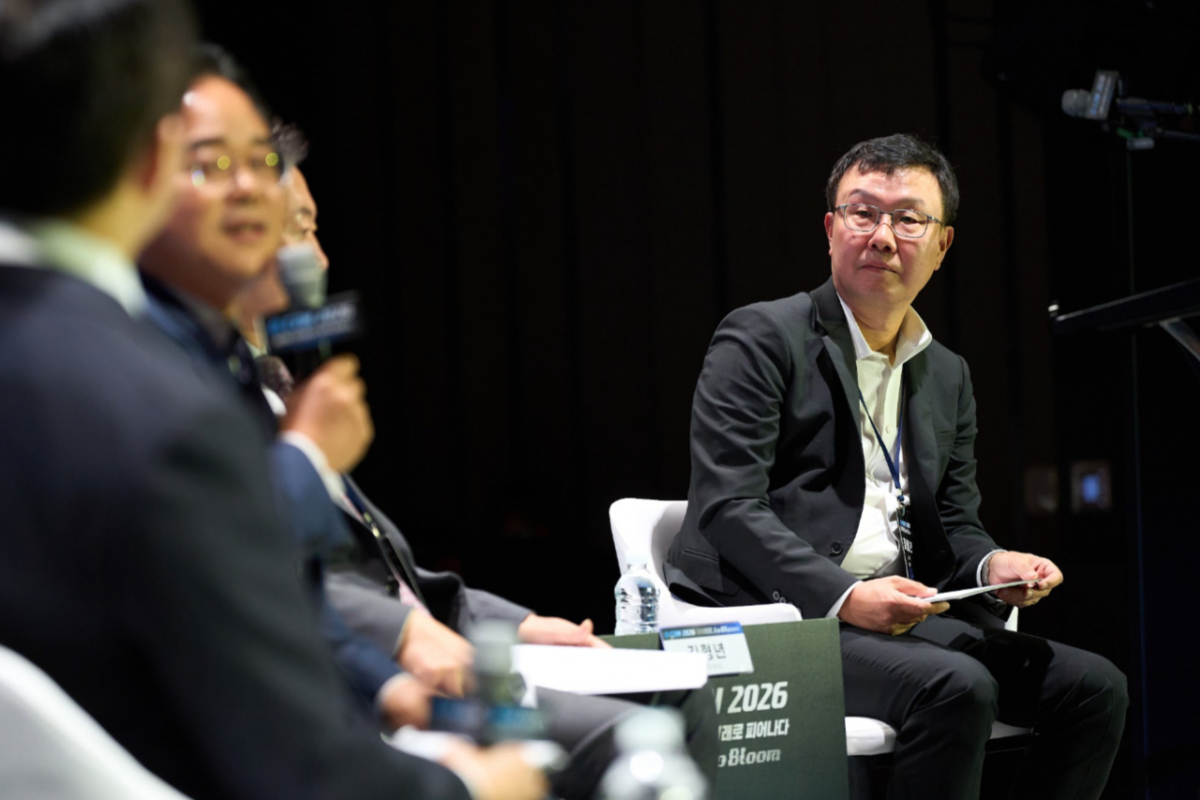
Dunamu Vice Chairman Kim Hyoung-nyun said Tuesday the company is working to convince the Fair Trade Commission of the need for its proposed merger with Naver Financial, as the antitrust regulator formally launched its review of the deal.
"We are working hard to explain (the need for the merger)," Kim told reporters after the Digital Asset Policy Conference (D-CON) 2026, hosted by Dunamu in Yeouido, Seoul. Asked whether approval could come by the end of this year, he gave that response.
Kim declined to provide details on the review process. Asked whether the company had submitted proposed corrective measures to address potential restrictions on competition, as requested by the FTC, he said, "We will communicate closely with the FTC."
Kim holds a 13.1 percent stake in Dunamu, making him its second-largest shareholder after Chairman Song Chi-hyung, who owns 25.5 percent. The two lead the company's owner-management structure. Kim is also seen as a potential executive who could help lead Naver Financial following the merger.
On domestic digital asset policy, Kim said it was time to reduce regulatory uncertainty. He pointed to slower progress in legislation on stablecoins, tokenization of traditional securities such as stocks and bonds, and foreign investment compared with other countries.
During a discussion at the conference with Rep. Min Byung-duk of the Democratic Party of Korea and Rep. Park Soo-min of the People Power Party, Kim said Dunamu was studying the role traditional financial institutions could play as digital assets evolve, following equity investments in the company by Hana Bank, Hanwha Investment & Securities and Samsung Group affiliates. He added that the company was also applying for regulatory sandbox approval.
Kim voiced concern that interest-bearing dollar-backed stablecoins could discourage users from converting their holdings into Korean won. He said U.S. stablecoin issuers were approaching Korean cryptocurrency exchanges in an effort to pay interest to holders of dollar-backed stablecoins.
On tokenized securities, Kim said it was disappointing to see shares of Samsung Electronics and SK hynix traded as tokenized stocks on overseas cryptocurrency exchanges. He said South Korea had the necessary technology but strict capital market regulations were limiting domestic investors' ability to trade Korean stocks around the clock and use leverage through overseas platforms.
"Non-residents living outside Korea are still barred from trading on won-based cryptocurrency markets," Kim said. Allowing them to bring dollars into the country and trade freely, he added, could help take the domestic market to the next level.
Kim also said the operational framework for cryptocurrency exchange deposits, including investment methods and interest payments, was already established under the Act on the Protection of Virtual Asset Users. Since managing won-backed stablecoins would not be fundamentally different from managing customer deposits, he said, companies could study and apply the technology once the regulatory framework was in place.
"If the right regulatory framework is established, we will work to become a global player, not just a leading Korean company," he said.

 in STOCK
