

The performance outlook for securities firms that received the largest-ever fine over a government bond bidding cartel has been thrown into turmoil. Some firms are required to pay fines exceeding 40% of their first-half net profit. Several firms have also faced criminal referrals, adding investigation-related risks.
According to the financial investment industry on Wednesday, KB Securities, which was sanctioned by the Korea Fair Trade Commission for violating the Monopoly Regulation and Fair Trade Act in connection with its government bond primary dealer (PD) business, is in a situation where it must pay a fine equivalent to approximately 40% of its first-half net profit this year.
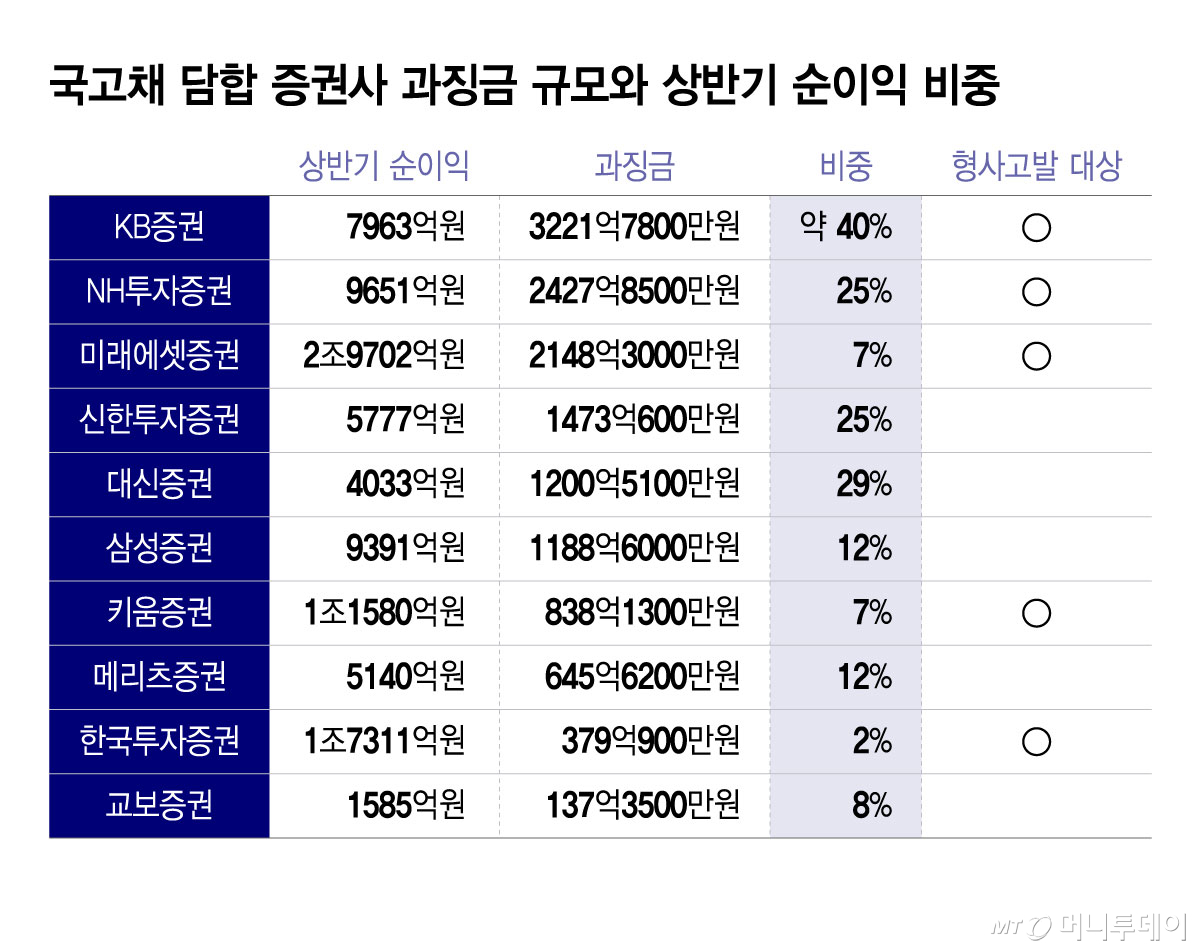
KB Securities' first-half net profit this year was 796.3 billion won, while the imposed fine was 332.178 billion won. KB Securities' fine is the largest among the 15th PDs that received sanctions.
In addition, based on first-half net profit, the proportion of fines reaches △Daishin Securities 29% △Shinhan Investment Corp 25% △NH Investment & Securities 25% △Samsung Securities 12% △Meritz Securities 12%, among others.
For Mirae Asset Securities, Korea Investment & Securities, and Kiwoom Securities, which recorded net profits in the trillions of won range, the fine proportions ranged from 2% to 7%, varying according to performance. In the case of Kyobo Securities, which received the lowest fine (13.735 billion won), the fine accounts for 8%.
While most of the securities industry is expected to file administrative lawsuits, it views the likelihood of winning in court as high. The industry has maintained that it is illegal for the FTC to calculate fines based on contract amounts (government bond winning bid amounts) rather than operating revenue as the relevant sales amount.
The industry explains that PDs act as de facto intermediaries who distribute government bonds over a short period after acquiring them, without holding them in-house.
It argues that it is unfair to calculate fines based on contract amounts when it is difficult to generate profit merely by buying and selling government bonds. The industry has also argued that the structure of government bond bidding, which involves numerous institutional investors, makes cartels impossible.
An industry official said, "It is difficult to view this as a cartel, and the criteria for calculating the fine are not reasonable, so we see a high probability of winning in court if an administrative lawsuit is filed."
The official added, "Even after reflecting the fine, soundness indicators such as the Net Capital Ratio (NCR) are expected to maintain a stable level exceeding regulatory standards."
The issue is the criminal referral. The Korea Fair Trade Commission decided to refer seven firms—Mirae Asset Securities, NH Investment & Securities, KB Securities, Kiwoom Securities, Korea Investment & Securities, IBK Industrial Bank of Korea, and KDB Industrial Bank—to the Serious Crime Investigation Agency due to long cartel participation periods and a high number of bidding cases. Five of the seven are securities firms.
Unlike fines, criminal referrals cannot be contested through administrative lawsuits. Once an investigation begins, management must respond at the company level, which could become another source of uncertainty.
Another industry official said, "Because we do not believe this constitutes a cartel, there is a mood to accept the criminal proceedings calmly." The official added, "Since it is an issue affecting the entire industry rather than just some firms, the burden is relatively low."

 in STOCK
