

An emergency has been declared at securities firms and banks that received the largest fines in history for colluding on government bond bids. Some securities firms must pay fines exceeding 40% of their first-half net income, while banks face increased burdens in managing capital ratios. Most are expected to file administrative lawsuits, but some have also faced criminal referrals, heightening investigation risks.
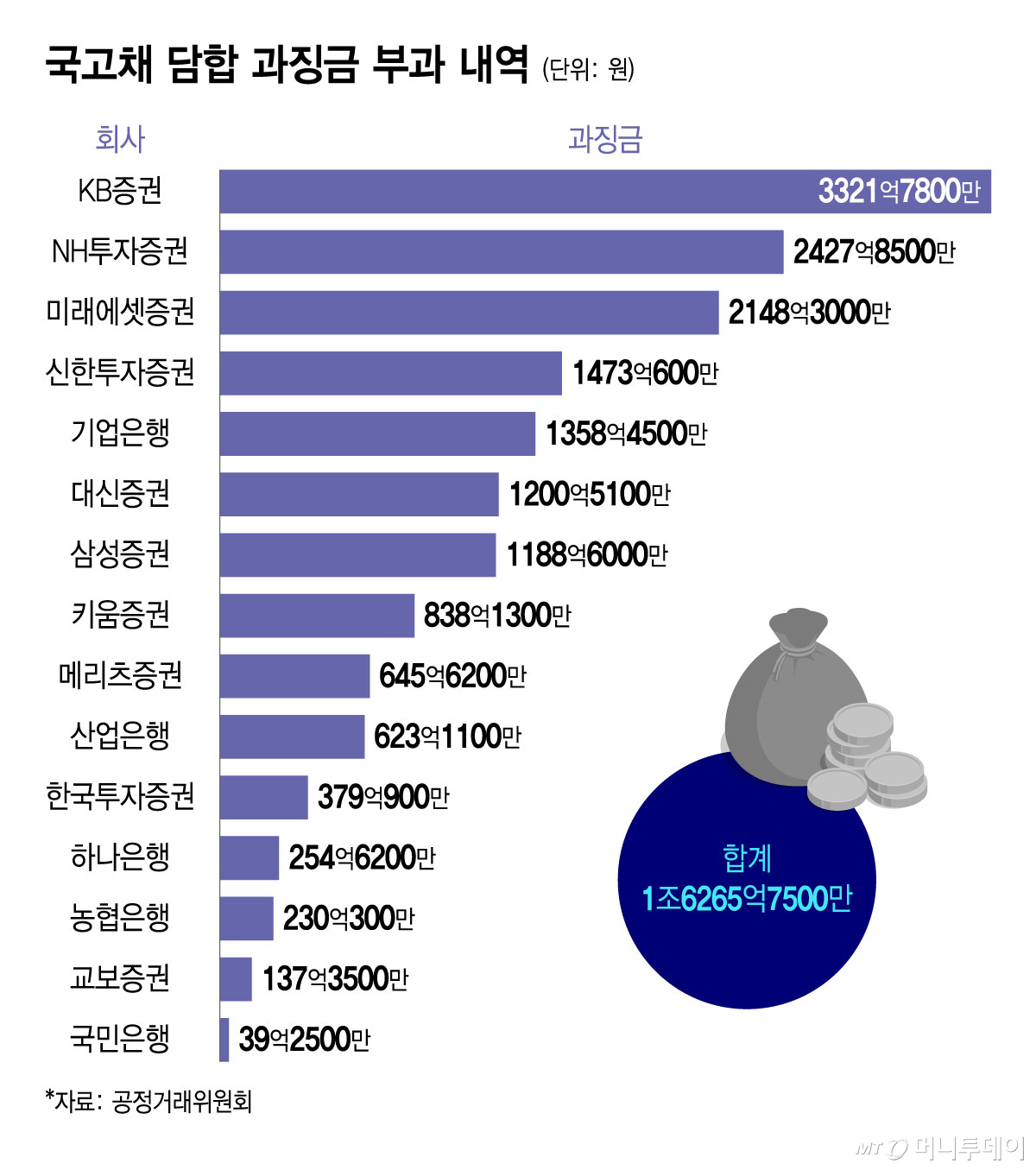
According to the financial investment industry and banking sector on the 11th, the Korea Fair Trade Commission imposed fines totaling 1.6266 trillion won on 15 government bond primary dealers (PDs), levying 1.3760 trillion won on 10 securities firms and 250.5 billion won on five banks. The commission decided to refer seven entities—Mirae Asset Securities, NH Investment & Securities, KB Securities, Kiwoom Securities, Korea Investment & Securities, IBK Industrial Bank of Korea, and KDB Industrial Bank—to the Serious Crime Investigation Agency for criminal prosecution.
Among securities firms, KB Securities suffered the most significant impact. Its fine of 332.2 billion won exceeds 40% of its first-half net income (796.3 billion won). The ratio of fines to first-half net income is 29% for Daishin Securities and 25% for Shinhan Investment Corp and NH Investment & Securities, respectively. Mirae Asset Securities, Korea Investment & Securities, and Kiwoom Securities, which posted net income in the trillions of won range, face ratios between 2% and 7%. The industry expects that even after reflecting the fines, soundness indicators such as the Net Capital Ratio (NCR) will remain above regulatory standards.
In the banking sector, IBK Industrial Bank of Korea faces the highest fine at 135.8 billion won, followed by KDB Industrial Bank at 62.3 billion won, Hana Bank at 25.5 billion won, NH NongHyup Bank at 23 billion won, and KB Kookmin Bank at 3.9 billion won. Although the fines were reduced by 30% because related sales revenue and penalty rates were lowered compared to the review report stage, and claims that there was no unjust enrichment were accepted, the burden remains significant.
Managing capital ratios is also a challenge. Most banks are known not to have set aside provisions in advance. IBK Industrial Bank of Korea’s Common Equity Tier 1 (CET1) ratio, which stood at 11.48% at the end of the third quarter, is estimated to drop to approximately 11.43% if the full amount of the fine is reflected as an expense. A banking sector official said, “We will reflect provisions for liabilities considering various possibilities such as the scale of the fines and litigation.” KB Kookmin Bank, Hana Bank, and NH NongHyup Bank received their second sanctions within a week. The Financial Services Commission imposed fines totaling 361.9 billion won on seven banks on the 4th over incomplete sales of Equity-Linked Securities (ELS) linked to the Hang Seng Index, of which 357.3 billion won was allocated to these three banks.
The financial sector denies any collusion. The securities industry maintains that it is illegal for the Korea Fair Trade Commission to calculate fines based on winning bid amounts rather than operating revenue as related sales. PDs are essentially intermediaries who distribute government bonds over a short period after acquiring them, making it difficult to generate profit solely through buying and selling. Banks argue that because bids involve executing orders from various institutional investors, winning interest rates cannot be determined by information exchange among some financial firms, and since PDs are obligated to acquire a certain volume, there was no incentive to collude. They also countered that they exchanged “goalpost rate” information rather than actual bid rates, but the Korea Fair Trade Commission ruled that goalpost rates should also be treated as bid rates. A securities industry official said, “It is difficult to view this as collusion, and the criteria for calculating fines are unreasonable, so we see a high probability of winning in court if an administrative lawsuit is filed.”
Criminal referrals pose another burden. Unlike fines, criminal referrals cannot be contested through administrative lawsuits, meaning management must respond directly once investigations begin. Another securities industry official conveyed that “there is a mood to accept the criminal proceedings calmly because we do not believe it was collusion.” Hana Bank stated, “We plan to review response directions from multiple angles after confirming specific grounds for judgment through future decision documents.”

 in STOCK
