

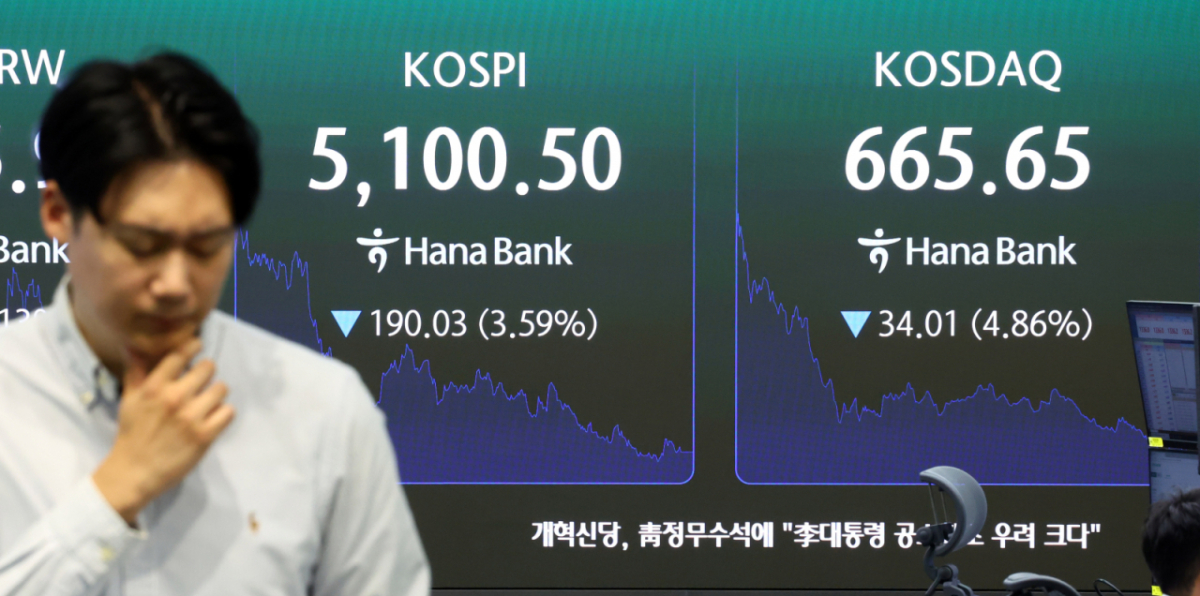
Financial authorities are reviewing changes to the sidecar system, including the possibility of scrapping it, amid growing doubts about its effectiveness. The measure was triggered 96 times on the KOSPI and KOSDAQ markets this year but has failed to curb stock market volatility.
According to financial authorities on Monday, the Financial Services Commission is reviewing improvements to the sidecar system. This year, the sidecar was triggered 58 times on the KOSPI, combining buy and sell orders, and 38 times on the KOSDAQ.
A financial authority official said, “While no direction has been set yet, we are examining the utility of the sidecar,” adding, “We are checking whether it actually mitigates volatility or rather amplifies it.” The financial authorities recently designated “market volatility management” as a key policy goal in response to increasing stock market volatility.
The sidecar is a market stabilization device that suspends the validity of program trading orders for five minutes.
The KOSPI sidecar is triggered when the price of the KOSPI 200 futures contract rises or falls by more than 5% from the previous day’s closing price for at least one minute.
For the KOSDAQ, it is triggered when the price of the KOSDAQ150 futures contract moves in the same direction by more than 6% from the previous day’s closing price and the KOSDAQ150 cash index moves by more than 3% for at least one minute.
The purpose is to provide a cooling-off period during sharp price swings to stabilize investor sentiment and prevent unnecessary price fluctuations.
The core of the controversy is that program trading can actually contribute to sharp stock market surges and plunges.
Program trading is a trading technique in which investment strategies for various market conditions are pre-programmed, allowing computers to process market analysis, timing judgments, and orders across multiple stocks in bulk.
It is primarily used by institutional investors or foreign investors who manage large amounts of capital. Rather than individual stocks, it involves trading stock baskets (groups) composed of multiple stocks.
Program trading is broadly divided into two types: arbitrage and non-arbitrage. Arbitrage is a trade that exploits the price difference between futures and cash (stocks).
For example, if futures are cheap and cash is expensive, one buys futures and sells cash to capture the profit from the difference. When bad news breaks, institutional investors and foreign investors first sell off large amounts of futures, resulting in futures prices falling faster than cash prices.
This leads to buying relatively cheaper futures and selling more expensive cash stocks. Large volumes of program sell orders flood into the KOSPI and KOSDAQ cash markets. During this process, if the decline in futures prices exceeds a certain threshold, the sell-side sidecar is triggered.
However, analysis suggests that as futures price fluctuations approach the sidecar threshold, programs dump buy and sell orders all at once before activation, causing the “magnet effect” of pulling down the index even faster.
It is also pointed out as a limitation that the mechanism only temporarily delays trading, meaning that pending orders may be released all at once after the sidecar is lifted, potentially triggering further sharp declines.
Non-arbitrage refers to trades arising from portfolio adjustments, such as managing index funds and exchange-traded funds (ETFs), or large-scale asset reallocation by pension funds, regardless of futures prices. It is unrelated to the price difference between futures and cash.
Amid this controversy over effectiveness, the United States abolished its sidecar system in 1999 and now operates a circuit breaker that halts trading across the entire market, as well as a “Limit Up-Limit Down” (LULD) price volatility restriction device for individual stocks.
A financial investment industry official said, “The sidecar is a device that temporarily suspends program trading and has nothing to do with retail investors, but there is a negative perception that removing a market stabilization device is being considered,” adding, “We need to consider ways to improve the uniform activation criteria, including the abolition of the sidecar.”

 in STOCK
