

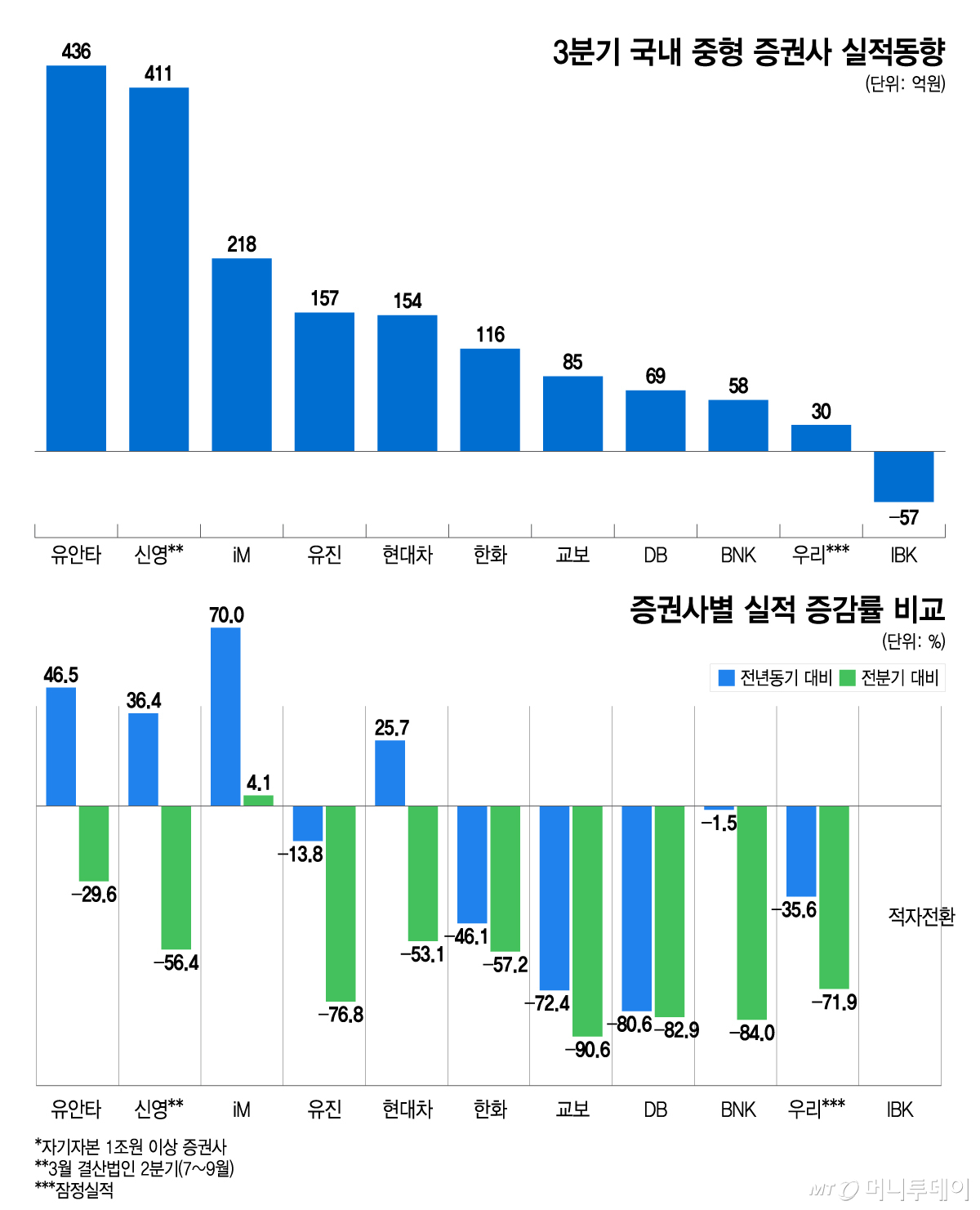
The decline in third-quarter net profit for domestic mid-sized securities firms was milder than that of large securities firms. While large firms were held back by a sharp drop in stock market trading volume and the impact of surcharges, mid-sized firms are assessed to have performed relatively well.
According to the Financial Supervisory Service's electronic disclosure system (DART) on the 16th, the combined consolidated net profit of 10 domestic large securities firms (with standalone equity capital of 4 trillion won or more) in the third quarter of this year was recorded at 842.9 billion won. This represents a sharp decrease of 66.0% from the same period last year and 85.8% from the previous quarter.
Mirae Asset (-405.6 billion won), Daishin (-133.8 billion won), and KB Securities (-83.9 billion won) all turned to losses compared to both the same period last year and the previous quarter. Korea Investment (281.8 billion won), Shinhan Investment (53.6 billion won), and Hana Securities (10.1 billion won) maintained profits, but their profit sizes decreased by 56.7%, 50.3%, and 83.9% respectively from the same period last year.
In contrast, the combined third-quarter net profit of 11 mid-sized securities firms with equity capital ranging from 1 trillion to 3 trillion won was 167.6 billion won, a decrease of only 24.4% from the same period last year (a 66.5% decrease from the previous quarter). Four out of the 11th firms increased their net profit, and only one firm, IBK Investment & Securities (-5.7 billion won), turned to a loss.
The main drivers behind mid-sized firms' performance were Yuanta, Shinyoung, iM, and Hyundai Motor Securities. Yuanta Securities posted the highest profit among mid-sized firms with a net profit of 43.6 billion won (a 46.5% increase from the same period last year). Shinyoung Securities (net profit of 41.1 billion won in Q2 for the March fiscal year-end, up 36.4%) and Hyundai Motor Securities (15.4 billion won, up 25.7%) also showed strong performance.
In particular, iM Securities not only saw its net profit surge by 70.0% to 21.8 billion won from the same period last year, but it was also the only firm among both large and mid-sized firms to increase by 4.1% from the previous quarter. BNK Investment & Securities (5.8 billion won, down 1.5%) and Eugene Investment & Securities (15.7 billion won, down 13.8%) minimized their declines and performed well, while DB (6.9 billion won, down 80.6%), Kyobo (8.5 billion won, down 72.4%), Hanwha Investment (11.6 billion won, down 46.1%), and Woori Investment Securities (3.0 billion won, down 35.6%) saw relatively large drops in profits.
The primary factor determining the disparity was the slowdown in brokerage (entrusted trading). As KOSPI trading volume plummeted due to the weak market in the third quarter, large firms with a high retail share hit a cliff in entrusted trading fees. While the narrowing of margin on commercial paper and valuation losses on proprietary investments (PI) were concentrated among large firms, mid-sized firms with relatively lower reliance on brokerage faced less shock.
The Fair Trade Commission's surcharge for collusion by government bond primary dealers (PDs) was also a variable that narrowed the gap. Of the 1.376 trillion won in surcharges imposed on 10 securities firms, the majority were concentrated on 9 large firms, while 10 mid-sized firms avoided sanctions, excluding Kyobo Securities. In particular, KB (surcharge of 332.2 billion won), Daishin (120.1 billion won), and Kiwoom Securities (83.8 billion won) front-loaded the surcharges in the third quarter, causing more than 500 billion won to evaporate from large firms' net profits and narrowing the gap with mid-sized firms.
In the fourth quarter, a clear differentiation is expected to emerge even among mid-sized firms. This is because the average daily KOSPI trading volume in November shrank to the 19th trillion won range, less than half of the second quarter, and rising interest rates and increased funding costs have heightened the burden on bond and commodity operations (trading) since the third quarter. The pressure from real estate project finance (PF) provisions, which had been dragging down the performance of small and mid-sized firms, also remains. Some securities firms, such as iM Securities, are proactively building up provisions and seeking high-quality businesses to look for a rebound.
Mid-sized firms, having keenly felt the limitations of their revenue structure, are focusing on retaining customers by strengthening asset management (WM) alongside corporate finance. Yuanta Securities led with funds, wrap accounts, bonds, and ELS tailored to volatility management, resulting in a 109.9% surge in financial product revenue (72.4 billion won) from the same period last year, setting a new quarterly record. Shinyoung Securities increased fee income through family offices and trusts. The competition to attract individual comprehensive asset management account (ISA) and pension customers, targeting year-end tax-saving demand, has also begun to heat up.
Meanwhile, no securities firm newly entered the 1st trillion won equity capital club in the third quarter. LS Securities saw its net profit surge by 118.0% to 6.4 billion won from the same period last year, but its standalone equity capital remained in the 920 billion won range at 927.7 billion won (921.0 billion won at the end of the first half).

 in STOCK
