

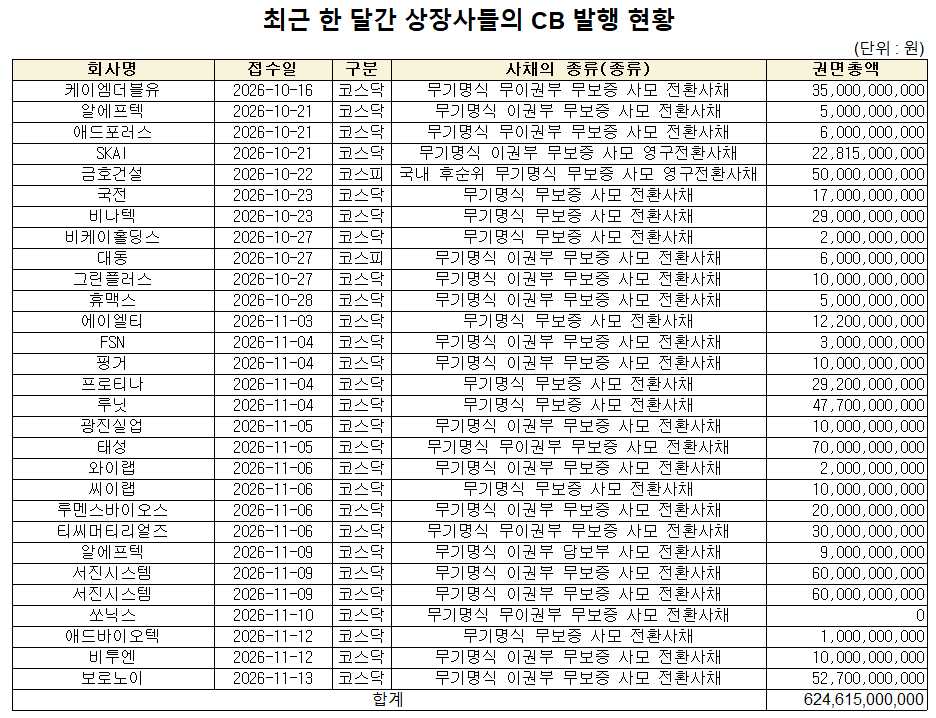
Small and mid-cap companies listed on the KOSDAQ are aggressively moving forward with convertible bond (CB) issuances at year-end. This is because the KOSDAQ Venture Fund (KOBEP) is purchasing large amounts of their CBs to meet its mandatory investment ratio by year-end. Of the 29th companies that issued private placement CBs in the past month, 27 were KOSDAQ-listed companies.
According to electronic disclosures from the Financial Supervisory Service on the 16th, the total face value of private placement CBs issued over the past month, from October 16 to the 16th, was recorded at 624.615 billion won.
Excluding CB issuances by KOSPI-listed companies, both the volume and amount of CB issuances this year have shown a clear increase compared to last year. During the one-month period from October 16 last year, excluding KOSPI and KONECT companies, the scale of CB issuance by KOSDAQ-listed companies was 423 billion won, with 22 companies issuing CBs.
According to the ECM (Equity Capital Markets) industry, the year-end CB issuance market this year is showing a different trend than last year. Supply and demand have shifted from large-cap companies to small and mid-cap companies.
During the one-month period from October 16 last year, eight KOSPI-listed companies issued CBs. Companies such as SK Innovation (600 billion won), Asiana Airlines (300 billion won), and Hyosung Chemical (100 billion won) saw their total CB issuance volume exceed 1 trillion won.
In contrast, this year has seen an increase in mezzanine securities (securities possessing characteristics of both equity and debt) issuances centered on small deals. There are no companies that issued CBs worth several thousand billion won during the same period this year. Additionally, only two KOSPI-listed companies issued CBs: Daedong (6 billion won) and Kumho Construction (50 billion won).
The increase in small deals is due to investment demand from KOBEP. As a policy fund, KOBEP must invest at least 15% of its funds in new shares of venture companies within a certain period after establishment (6 months for private equity funds, 9 months for public funds). Furthermore, more than 35% must be invested in small and mid-sized companies listed on the KOSDAQ within seven years after their designation as venture companies or after being removed from the venture company list. The mandatory investment ratio of KOBEP can be met not only through direct stock trading but also through CB purchases.
The atmosphere has also changed. It is assessed that CBs have gained attention as a funding method because the Financial Supervisory Service raised the threshold for reviewing rights offerings (paid-in capital increases) this year. As news emerged of corrections to rights offering plans by companies such as Hanul Semiconductor, A.I., and Sangji Construction, the stance of the financial authorities who reviewed these has had direct and indirect impacts on the overall issuance market atmosphere. In fact, according to the Korea Securities Depository, the total amount of rights offerings by listed corporations in the first half of this year was 7.0143 trillion won, a 66.8% decrease compared to the first half of last year.
The undervaluation appeal of the KOSDAQ and the government's policy direction promoting the KOSDAQ also contributed. The outlook for undervaluation of KOSDAQ companies is based on expectations that stock prices may rise in the future. If an investment company's stock price rises, CB investors can earn not only the maturity interest on their investment but also capital gains by converting CBs into stocks. On the 16th, the KOSDAQ closed regular trading at 665.65 points, down 34.01 points (4.86%) from the previous trading day. This is half of the 52nd-week high of 1,229.42 points recorded in April.
An IB (Investment Bank) industry official said, "It is not uncommon for deals to close even with term sheets (investment condition agreements) centered on companies issuing CBs at a premium," adding, "As market demand continues to align KOBEP weightings by year-end, there is an overburdened workload situation where one lead team at a securities firm is simultaneously reviewing more than 10 deals."

 in STOCK
