

Financial regulators temporarily eased regulations on the collateral ratio for credit extension to prevent a surge in forced liquidations following the sharp stock market decline, but forced liquidations in the KOSPI market increased by 231% in just one week last week. Pointers indicate that the effectiveness of the measures was overshadowed as the stock market fell further immediately after the regulatory easing and individual investor funds flowed out.
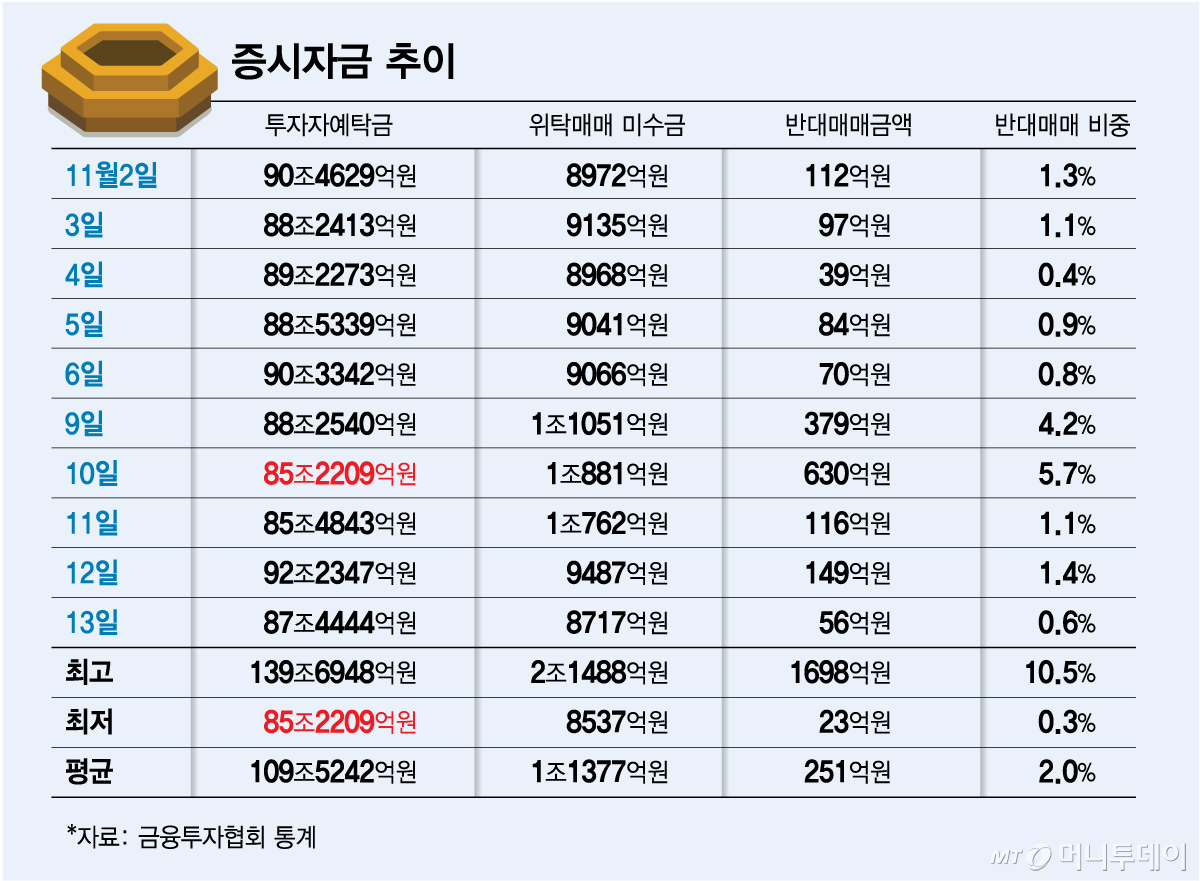
According to the Comprehensive Statistics Portal of the Korea Financial Investment Association on the 17th, the total amount of forced liquidations in the KOSPI market from the 9th to the 13th was 133 billion won, an increase of 92.8 billion won (230.85%) compared to Jeonju (40.2 billion won). The daily average amount of forced liquidations surged to 26.6 billion won, which is 3.3 times that of Jeonju, and also exceeded the year-to-date daily average (25.1 billion won).
This occurred despite the Financial Supervisory Service issuing no-action letters to securities firms on the 9th to relax the collateral ratio regulation for credit extension (the 140th% floor). Related agencies, including the Financial Services Commission, had previously held an emergency market situation review meeting on the 6th and decided to temporarily ease the collateral ratio regulation for credit extension for three months to prevent side effects of the sharp stock market decline. If the obligation to maintain 140% is waived, securities firms are not required to demand additional deposits or execute forced liquidations due to non-payment even if the collateral ratio of margin loan customers decreases.
Market vitality and soundness also deteriorated simultaneously. The average investor deposits in KOSPI last week were 87.7277 trillion won, a decrease of 1.83% compared to Jeonju (89.3599 trillion won). On the 10th, it recorded a year-to-date low of 85.2209 trillion won.
In contrast, unsettled amounts increased by nearly 13% during the same period. Unsettled amounts from entrusted trading rose from an average of 903.6 billion won in the first week of November to 1.018 trillion won last week, an increase of 12.65%. The proportion of forced liquidations among unsettled amounts was 4.2% on the 9th and 5.7% on the 10th, significantly exceeding the annual average (2.0%). However, the outstanding balance of margin loans across both the KOSPI and KOSDAQ markets decreased by 8% to a daily average of 26.4644 trillion won compared to Jeonju (28.7936 trillion won).
Market experts analyzed that the measures were at the level of a "weak painkiller" and, combined with the sharp stock market decline, were insufficient to prevent the surge in forced liquidations. An official in the financial investment industry stated, "Although the obligation to maintain the 140th% collateral ratio was waived, the implementation methods vary by securities firm, and it was too weak to prevent forced liquidations," adding, "Above all, the impact of the stock market falling further after the measures were announced was significant." Another official in the financial investment industry explained, "It is not easy for retail investors to apply immediately, as they must directly request a deferral of forced liquidation, and more time is needed for it to have practical effectiveness."
Amid this situation, risk-averse sentiment is manifesting as a supply-demand gap among foreign investors, individuals, and institutional investors, leaving concerns about the surge in forced liquidations persistent. Researcher Im Seung-mi of Hana Securities analyzed, "Investor deposits began to decrease as volatility increased in June and July, and funds that had held on during the sideways market in August and September are flowing out as they faced a second decline last month," adding, "With foreign investors making net sales for seven consecutive months and individual investor deposits also decreasing, the supply-demand entities supporting the domestic stock market have weakened."

 in STOCK
