

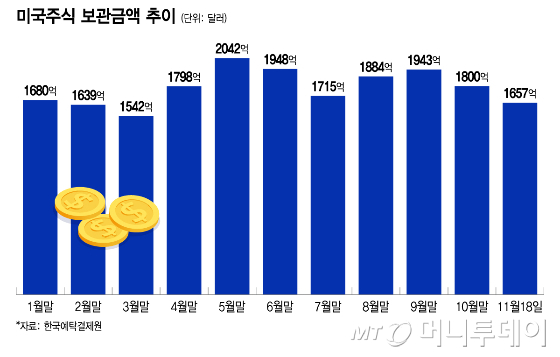
The amount of U.S. stocks held by domestic investors has recently decreased to levels seen at the beginning of this year, when the government was actively managing such investments. This is interpreted as being driven by continued stock price corrections centered on technology stocks amid growing concerns over excessive investment in artificial intelligence (AI) in the U.S. market. As net purchases of overseas stocks continue, a decline in the valuation of held shares is cited as the primary cause rather than an outflow of investment funds.
According to the Korea Securities Depository on the 22nd, the amount of U.S. stocks held by domestic investors stood at $165.7 billion (approximately 221.4 trillion won) as of the 18th, a 14.7% decrease from $194.3 billion (approximately 260 trillion won) at the end of September. It also represents an approximately 8% decline from $180 billion (approximately 240.46 trillion won) at the end of last month.
This is the first time since the first quarter of this year that the amount of U.S. stocks held by domestic investors has fallen to the $160 billion range. After reaching $168 billion in January, $163.9 billion in February, and $154.2 billion in March, the figure had consistently fluctuated between $170 billion and $200 billion.
At the beginning of this year, the government introduced Return to Domestic Market Accounts (RIA) and managed securities firms' marketing related to overseas stock investments, a period when overseas investment was shrinking. At the time, the government was concerned about capital outflows from the domestic capital market due to the surge in domestic investors' overseas stock investments. However, the recent decline in U.S. stock holdings is analyzed as being driven by the impact of falling asset values due to the U.S. stock market correction, rather than policy factors or shrinking investor sentiment.
The amount of U.S. stocks held refers to the valuation of U.S. stocks owned by domestic investors, aggregated in dollars. Even if domestic investors do not sell their shares, the total holding amount decreases if the prices of their held stocks fall.
In fact, concerns over the sustainability of investment in the AI industry have recently come to the forefront in the U.S. stock market, leading to increased volatility centered on technology stocks. Tesla ($21.8 billion) and NVIDIA ($12.5 billion), which domestic investors hold the most as of the 18th, are undergoing corrections, while leverage ETFs (Exchange-Traded Funds) tracking semiconductors and NASDAQ are also under downward pressure.
In particular, SOXL (a U.S. semiconductor 3x leverage ETF) and TQQQ (a NASDAQ 100 3x leverage ETF), which domestic investors have actively purchased, are structured in a way that losses can expand during periods of falling stock prices. It is estimated that the correction in technology stocks had a significant impact on the valuation of assets held by domestic investors. In fact, SOXL was the most net-purchased stock by domestic investors through the 19th of this month, with net purchases exceeding $2.2 billion (approximately 3 trillion won). NVIDIA ranked second at approximately $600 million (approximately 800 billion won).
It is also notable that domestic investors made net purchases of $4.1 billion (approximately 5.5 trillion won) in the U.S. market through the 19th of this month. This figure supports the trend of declining valuations of held stocks rather than a decrease in investor sentiment toward the U.S. market, and it can also be interpreted that domestic investors continue to utilize opportunities for bargain hunting amid declines in the U.S. stock market.
The market is concerned that the aggressive investment structure of domestic investors, concentrated in U.S. technology stocks and leverage products, could increase asset value volatility. There are also points raised that if aggressive buying continues during falling stock prices as it is now, the burden of losses from further corrections could grow.
An official in the securities industry said, "Although net purchases by domestic investors in the U.S. market continue despite the correction in the U.S. stock market, we can confirm that the valuation of held assets has actually decreased." The official added, "In particular, leverage products can accumulate losses as prices fluctuate up and down, so caution is needed when expanding purchases simply because prices have fallen significantly."

 in STOCK
