

"I would like to buy more if KOSPI rebounds, but I have no money. Most of my acquaintances also say they want to sell once they recover their principal."
This is the story of Kim, a retail investor in his 40s who works in the financial industry. It succinctly illustrates the reality facing individuals investing in the domestic stock market recently.
As the stock market has undergone significant corrections from its peak, price attractiveness has increased, but repeated low-price buying has actually reduced additional investment capacity.
A mentality of wanting to recover invested funds first if the market rebounds is also emerging. Concerns are rising that it will be difficult to expect retail investors, who had been supporting the market bottom by absorbing foreign selling volume this year, to play a similar role for the time being.
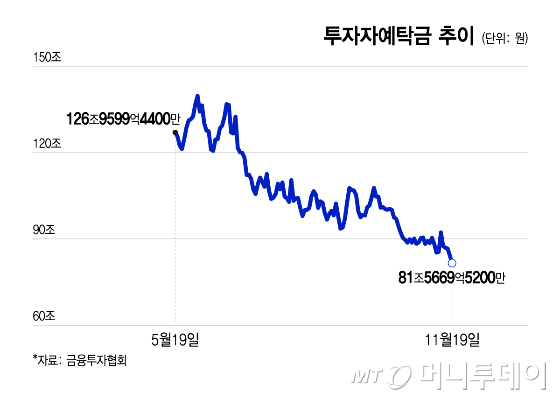
Investor deposits drop from 140 trillion won to 80 trillion won... "Retail investors already bought at low prices in the 6,000 range; additional capacity is limited"
According to the Korea Financial Investment Association on the 23rd, investor deposits stood at 81.567 trillion won as of the 19th, the lowest level since late October last year (81.091 trillion won). This represents a decrease of over 40% compared to the all-time high recorded in June last month (139.6948 trillion won).
Investor deposits refer to standby funds that investors keep in their brokerage accounts to purchase stocks or have not withdrawn after selling shares. It is a representative indicator for gauging investment sentiment and potential stock buying capacity.
Movements in "margin investing (investing with debt)" have also weakened. The outstanding balance of KOSPI credit trading loans stood at 20.2069 trillion won as of the 19th, a decrease of nearly 10 trillion won from late June last month (29.7543 trillion won).
From the perspective of retail investors, stock prices have continued to fall each time they engaged in low-price buying, causing unrealized losses to swell, and funds available for so-called "averaging down" to lower their average purchase price have also become scarce.
Kim Jae-seung, a researcher at Hyundai Motor Securities, stated, "Although the domestic stock market is seeing an expansion in its decline, there is no visible bottom due to deteriorating investment sentiment and supply-demand gaps."
He added, "Retail investors who have driven net buying in the domestic stock market engaged in low-price buying in the 6,000 to 6,500 range even during the correction market in the second half, so their additional buying capacity is limited, and time is needed for investment sentiment to recover."
If retail investors focus on recovering principal after a rebound, stock market rise becomes difficult... "Expecting possibility of Samsung Electronics share buyback in early next year"
Retail investors have been the ones mitigating foreign selling shocks each time the domestic stock market underwent sharp corrections this year.
According to the Korea Exchange, foreigners net sold about 224 trillion won worth of KOSPI shares from the beginning of this year until Nov. 20. In contrast, retail investors net bought approximately 100 trillion won in the KOSPI cash market and approximately 77 trillion won in the ETF (Exchange-Traded Fund) market.
However, recent supply-demand flows in the domestic market are rapidly cooling. With a significant portion of retail investors' existing investment funds tied up in stocks, inflows of new funds to supplement this are limited.
As seen in the trend of deposits, individuals' investment capacity is gradually decreasing. Investors with surplus funds are turning their eyes toward overseas stocks or securing interest income rather than rushing to buy domestic stocks.
Trillion-won-scale funds have flowed into representative parking-type ETFs such as KODEX Money Market Active, TIGER Money Market Active, and RISE Money Market Active over the past month.
Parking-type ETFs are products that invest in short-term bonds or short-term financial instruments to pursue relatively stable returns. The scale of net purchases of U.S. stocks by domestic investors this month also reached $4.471 billion (6 trillion won).
The issue is that even if the stock market rebounds, retail investors may use it as an opportunity to recover their investment funds rather than for additional buying.
It is analyzed that the low-price buying by individuals, which had served as a pillar of the stock market, could paradoxically become a factor constraining future stock market rises.
Ultimately, the securities industry views that other supply-demand improvement factors, such as easing foreign selling pressure, must support the recovery of retail investors' investment sentiment.
"The timing when next month's U.S. Federal Open Market Committee (FOMC) meeting and rebalancing related to major index inclusion are completed will be a turning point for easing foreign selling pressure," Kim said. "The possibility of Samsung Electronics resuming large-scale share buybacks in early next year will be an important factor changing supply-demand in the domestic stock market."

 in STOCK
