

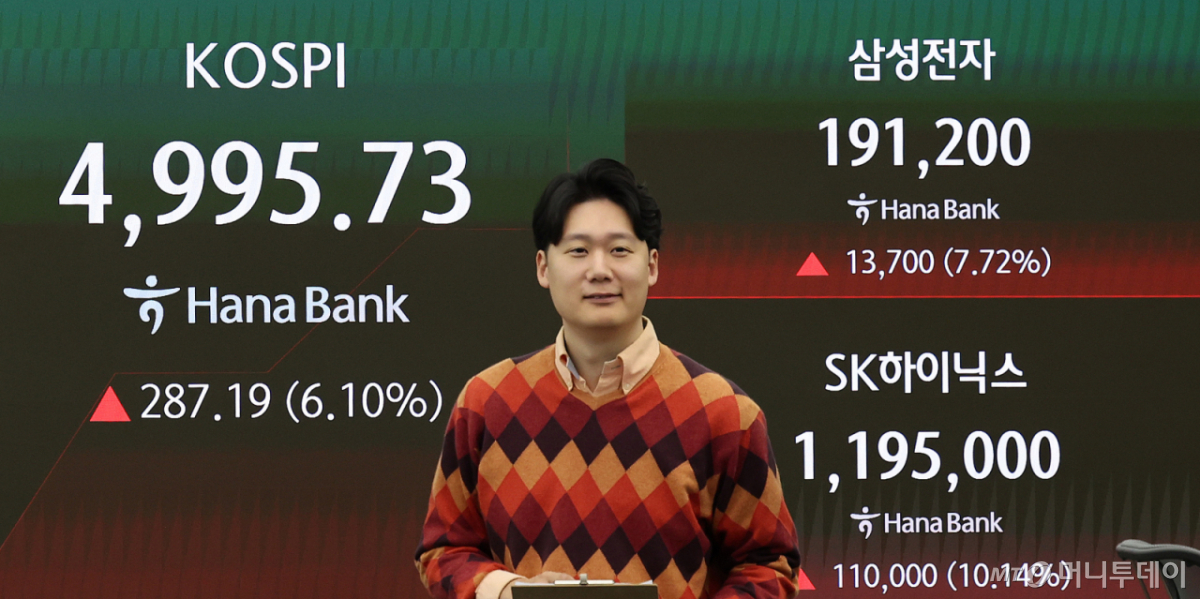
The KOSPI, which had fallen more than 3 percent despite news that the government was preparing to activate its stock market stabilization fund, surged more than 6 percent intraday. The market had failed to rebound even after earnings forecasts for Samsung Electronics and SK hynix were raised. The only major change overnight was the return of Nvidia CEO Jensen Huang. His return eased concerns over AI investment and long-term supply agreements.
Analysts say what the market ultimately needed was confidence that semiconductor earnings growth would continue.
According to the Korea Exchange on Tuesday, as of 11:04 a.m., the KOSPI stood at 4993.66, up 285.12 points (6.06%) from the previous trading session. The KOSPI opened at 4880.16, up 3.64%, and at one point during trading rose to 5065.74, recovering the 5,000-point mark for the first time in three trading days. At 9:06 a.m., the KOSPI buy-side sidecar (futures market circuit breaker) was triggered.
The KOSPI rebound appeared after news of CEO Huang's return to NVIDIA was reported on the 23rd (local time). On that day in the New York stock market, NVIDIA surged by 31.48%, the Philadelphia Semiconductor Index jumped by 14.03%, and NASDAQ closed up 6.51%. Consequently, in the opening of the Korean stock market, Samsung Electronics and SK hynix are rising by 6.99% and 8.20%, respectively. SK hynix at one point during trading rose to 1,233,000 won, recovering the 1.2 million-won range for the first time in six trading days. Buying pressure poured not only into Samsung Electronics and Hynix but also across the entire semiconductor and AI value chain.
Foreign investor sentiment also revived. Foreigners are showing net purchases of KOSPI for the first time in eight trading days. At the same time, foreigners are net buying 660.5 billion won in the KOSPI market. Institutional investors are also buying 265.3 billion won. In contrast, retail investors are net selling 1 trillion 65.8 billion won.
This shows that in this downturn, what was needed was not supply and demand measures like the stabilization fund, but psychological stability through the resolution of AI investment uncertainty. Although the government held an emergency market situation review meeting on the 22nd and decided to prepare for immediate activation of the stabilization fund if necessary, it did not yield significant results as the stock market fell by more than 3% on the 23rd.
Researcher Han Ji-young at Kiwoom Securities also pointed out regarding the news of stabilization fund preparations that "anxiety factors such as AI-related uncertainty, which triggered the stock market correction after October, have not been resolved."
Even during the sharp market decline, profit forecasts for domestic semiconductor companies rose. The consensus estimates for next year's operating profit for Samsung Electronics and SK hynix increased by 12.9% and 18.9%, respectively, over the past three months. In contrast, the semiconductor sector index has fallen by 57% since its June peak, and the 12th-month forward PER (price-to-earnings ratio) for the semiconductor sector dropped to 2.1 times. This means that while expected profits increased, the value the market placed on those profits decreased significantly.
Daishin Securities analyzed that anxieties over whether NVIDIA's AI investment and long-term supply contracts would proceed as scheduled due to CEO Huang's absence had spread to domestic memory stocks. Researcher Lee Kyung-min at Daishin Securities explained the decline in domestic semiconductor stocks, stating, "It is the result of the trust discount attached to NVIDIA shifting to Korean semiconductors, which are memory suppliers, and that trust began to be restored on the 23rd."
The researcher stated, "This sharp drop was a price created by trust, not performance," adding, "A figure who was in the midst of the event that shook trust has returned. The speed at which anxiety turns into expectation depends on remaining verification tasks such as the board investigation surrounding NVIDIA, the U.S. SEC (Securities and Exchange Commission) accounting review, confidential interviews with the U.S. House of Representatives, and U.S. government export regulations, but a PER (price-to-earnings ratio) in the 3rd-times range for the KOSPI market, where profits are increasing, is unlikely to last long."

 in STOCK
