

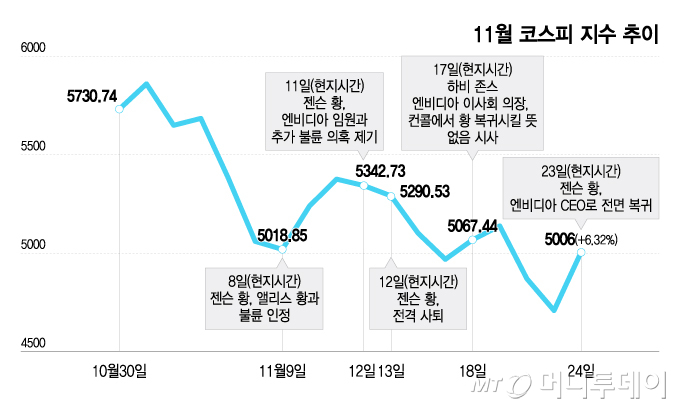
The KOSPI surged more than 7% intraday upon the return of Jensen Huang, Chief Executive Officer (CEO) of NVIDIA. The index, which had fallen 11% over the ten days since news of CEO Huang's resignation broke on the 13th, dropping to the 4,700 level, reclaimed the 5,000 mark in a single day. The market viewed CEO Huang's return as reducing the likelihood that AI (artificial intelligence) investments and long-term supply contracts would be disrupted. Securities firms see this sharp rally as a rebound reversing the decline as anxiety built up during CEO Huang's absence eased.
The KOSPI closed at 5,006.03, up 297.49 points (6.32%) on Tuesday. Overnight in the U.S. stock market, NVIDIA rose 31.48% and the Philadelphia Semiconductor Index climbed 14.03% following the announcement of CEO Huang's return. As a result, investor sentiment gathered around large-cap semiconductor stocks. Domestically, Samsung Electronics and SK hynix closed at 189,400 won and 1,158,000 won, respectively, up 11,900 won (6.70%) and 73,000 won (6.73%) from the previous trading day.
During CEO Huang's absence, the KOSPI fell nearly 12%. Behind the spread of CEO Huang's vacancy to weakness in domestic semiconductor stocks lies the AI investment structure led by NVIDIA. When NVIDIA invests in equity or provides guarantees to AI model developers and cloud companies, customers raise funds based on this to purchase NVIDIA's GPUs. NVIDIA then uses this demand as a basis to sign multi-year purchase contracts with memory manufacturers. The industry calls this 'AI circular finance.'
Lee Kyung-min, an analyst at Daishin Securities, said, "The structure is one where money and orders revolve around NVIDIA, and Jensen Huang has effectively guaranteed these commitments. This is why the stock price collapsed even without damage to earnings due to the leadership vacuum."
When CEO Huang stepped down, what investors questioned was whether customer investments, GPU release schedules, and long-term memory contracts would continue as originally planned.
Even as Samsung Electronics' and SK hynix's operating profit forecasts for next year rose by 12.9% and 18.9%, respectively, over the past three months, the 12th-month forward PER (price-to-earnings ratio) of the semiconductor sector dropped to 2.1 times. This means the market viewed the possibility of continued growth after next year's earnings improvement as low.
Securities firms see CEO Huang's return as a signal that will reverse the adjustment so far.
Han Ji-young, an analyst at Kiwoom Securities, said, "It is significant that NVIDIA and the Philadelphia Semiconductor Index recovered approximately 60% of last week's plunge in one day following news of CEO Huang's return, in an environment filled entirely with negative factors."
The immediate rebound was also driven by a pullback from the sharp decline. According to Shinhan Investment Corp, the Philadelphia Semiconductor Index fell 28% below its 200-day moving average last week. The PBR (price-to-book ratio) of Samsung Electronics and SK hynix also dropped to 1.08 times and 1.04 times, respectively, based on intraday lows on the 23rd.
Kim Seong-hwan, a researcher at Shinhan Investment Corp, explained that it was "a market that had reached a point where a technical rebound would not be surprising no matter when it came." He added, "Tech stocks have shown support multiple times precisely at this divergence level in the past, and there are only two phases where stock prices deteriorated worse than this: the dot-com bubble burst and [the period involving] Financial Services Commission."
However, a common opinion among securities firms is that it remains to be seen whether this rebound marks the start of a trend toward sustained gains. Confirmation is needed regarding revenue expansion for AI companies, easing of funding pressure on neoclouds, resulting increases in additional semiconductor orders, and the resolution of policy risks stemming from the U.S. blue wave.
Kim Seong-hwan, a researcher at Shinhan Investment Corp, advised, "Since sufficient grounds for a bullish case have not yet accumulated beyond technical and price attractiveness, it is fine to take more time to build a solid basis for a trend reversal."
Big Tech's CAPEX (capital expenditure) plans for next year are also subject to verification.
Moon Jun-ho, a researcher at Samsung Securities, said, "It is worth noting whether Big Tech will continue to raise the scale of its investment even after initially disclosing its 2027 investment plans."
This means that while CEO Huang's return has reduced anxiety over who will lead long-term contracts, confidence in the earnings growth of domestic semiconductor companies can only be restored if investment plans translate into actual GPU orders and memory purchases.
Policy challenges remain. Delays in data center permits from the U.S. blue wave, advanced semiconductor export controls, and various regulatory investigation results surrounding NVIDIA are medium- to long-term variables.
Even with CEO Huang's return, if regulatory risks are not resolved, there may be limits to the recovery of AI value chain stock prices.
Ko Ui-young, a researcher at iM Securities, said, "Fundamentally, since demand concerns stemmed from policy uncertainties such as GPU circumvention export regulations and data center delays, stock prices will recover only when a process emerges to find a policy consensus."

 in STOCK
