

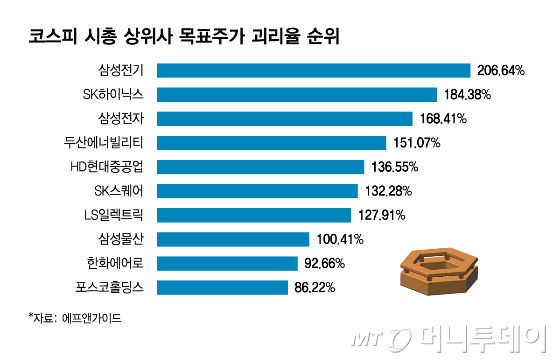
The average gap between the latest share prices of the 30 largest companies by market capitalization on the KOSPI and their target prices set by domestic securities firms stood at about 84 percent.
This means shares of the KOSPI's largest companies would need to rise by an average of more than 80 percent to reach analysts' target prices.
The sharp correction in the domestic stock market appears to have widened the gap between the corporate valuations estimated by securities firms and the prices at which shares are actually trading.
According to financial information platform FnGuide on Thursday, as of Nov. 25, the average target price for 29 companies among the top 30 KOSPI firms by market capitalization — those with available data — was 83.81% higher than their closing prices on the 25th. The target price was calculated as the average of fair value estimates provided by at least three securities firms over the past three months.
For all 29 companies included in the survey, the average target price exceeded the actual share price. Twenty companies, accounting for nearly 70% of the total, had a gap of more than 50%. Eight companies would require their share prices to double or more to reach the average target price.
Samsung Electro-Mechanics recorded the largest gap, with an average target price divergence of 204.64% based on its closing price on the 25th. Its share price would need to rise by more than three times its current level to meet the target price.
Samsung Electronics and SK hynix, ranked first and second in KOSPI market capitalization respectively, also showed gaps of 168.41% and 184.38%, placing them next after Samsung Electro-Mechanics.
The average target price for Samsung Electronics is approximately 458,000 won, while SK hynix’s is about 2.93 million won, both showing significant differences from recent actual share price trends.
Additionally, Doosan Enerbility (151.07%), HD Hyundai Heavy Industries (136.55%), SK Square (132.28%), LS ELECTRIC (127.91%), and Samsung C&T (100.41%) followed with gaps in the triple digits.
Since these results compare actual prices against the average outlook of the securities industry rather than the highest target price suggested by individual firms, it is interpreted that there is a considerable difference in perspective between the market and securities analysts.
Notably, most companies with high gap ratios were those that led the rise in the domestic stock market in the first half of this year. These are companies directly or indirectly linked to traditional leading sectors such as semiconductors, power infrastructure, and shipbuilding.
Their corporate valuations reflect medium- to long-term growth expectations driven by increased semiconductor demand from AI (artificial intelligence) industry expansion, expanded investment in power infrastructure, and strong global ship orders.
The securities industry continues to view the earnings growth potential of these companies highly. However, the market has pushed share prices down amid controversies over excessive AI investment and uncertainties regarding future growth prospects.
Analysts suggest that this widening gap is due to a decline in the premium investors assign to future growth possibilities, independent of corporate earnings forecasts.
Conversely, financial stocks among the top KOSPI sectors by market capitalization showed relatively lower gaps. Meritz Financial Group had the lowest gap among financial firms at 24.53%, followed by Hana Financial Group (37.58%), Woori Financial Group (38.61%), Samsung Fire & Marine Insurance (45.81%), and KB Financial Group (48.13%), with many companies showing gaps below 50%.
Industry officials note that financial stocks differ from previous market leaders because their corporate valuations are assessed based on relatively predictable earnings and shareholder return policies, rather than expectations for future growth.
An official in the securities industry said, "The large gap between securities firms' target prices and actual share prices should not be simply accepted as evidence of undervaluation," adding, "One must examine whether the growth outlooks and corporate valuation criteria that form the basis for calculating target prices remain valid, rather than just looking at the upside potential to reach those targets."

 in STOCK
