

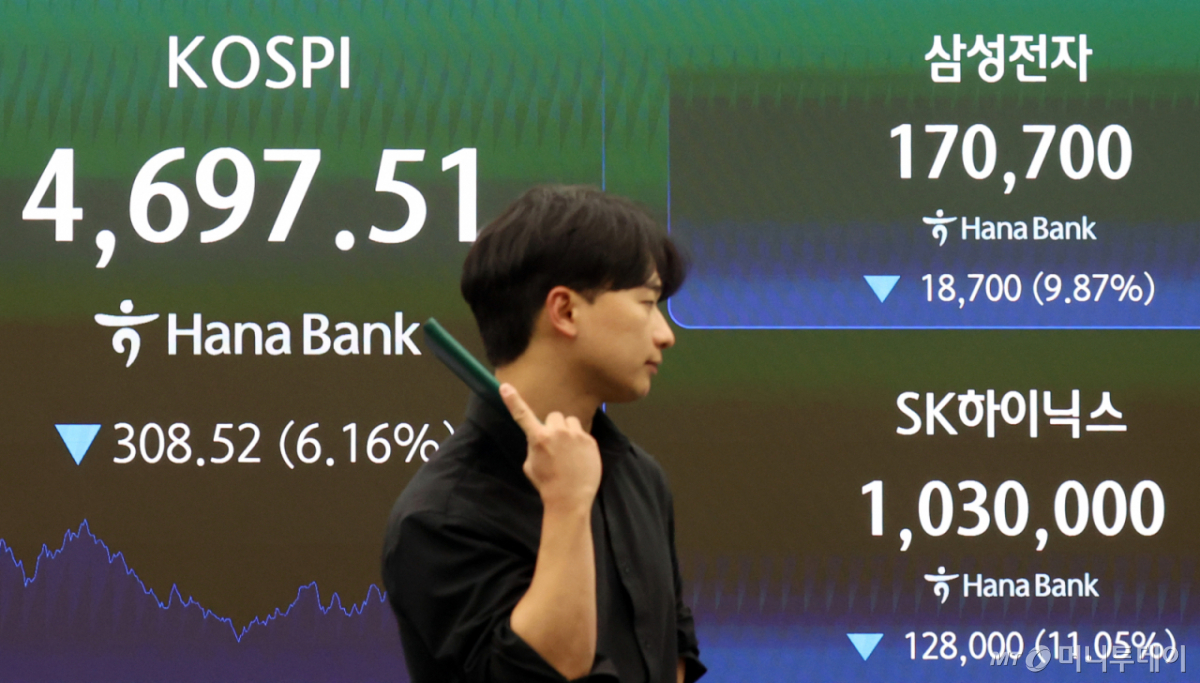
KOSPI has given back most of its gains for the year, returning to levels seen at the beginning of the year. This was driven by a sharp drop in semiconductor stocks, which had led the market on the back of expanded AI (artificial intelligence) investment, amid concerns over cooling investor enthusiasm.
In particular, it is interpreted that the decline was larger than in other countries due to growing concerns over large-cap memory semiconductor stocks, which account for half of the domestic stock market. The brief recovery seen on the 24th following the return of NVIDIA CEO Jensen Huang was also completely given back.
On Nov. 25, KOSPI closed at 4,697.51, down 308.52 points (6.16%) from the previous trading day. This is the first time in 212 trading days since January 13 that KOSPI has closed in the 4,600 range. KOSPI opened at 4,809.00, down 197.03 points (3.94%), and widened its decline. A sidecar (futures market circuit breaker) was triggered early in trading. During the session, it fell nearly 6.7%, dropping as low as 4,672.55.
In the KOSPI market, retail investors made net purchases of 1.4231 trillion won, while foreign investors and institutional investors made net sales of 1.9085 trillion won and 700 million won, respectively. Foreign investors, who had switched to net purchases for the first time in eight trading days on the previous day, reverted to net selling just one day later.
By sector, pharmaceuticals rose by over 4%, IT services, food and beverage, tobacco, entertainment, and culture rose by over 2%, and general services rose by over 1%. Electronics, which includes semiconductor stocks, fell by over 9%. Manufacturing fell by over 7%, machinery and equipment as well as medical and precision instruments fell by over 6%, insurance fell by over 5%, distribution, finance, and construction fell by over 3%, securities fell by over 2%, and real estate and transportation equipment and parts fell by over 1%.
Among top market capitalization stocks, the impact was significant for Samsung Electronics and SK hynix, ranked first and second in market cap. Samsung Electronics closed at 170,700 won, down 18,700 won (9.87%) from the previous trading day, while SK hynix closed at 1,030,000 won, down 128,000 won (11.05%). Samsung Electronics fell by more than 10% at one point during the session, dropping to 170,000 won. Based on the closing price, its market capitalization also fell below 1,000 trillion won for the first time since February 4.
Due to weakness in Samsung Electronics and SK hynix, Samsung Electro-Mechanics fell by over 12%, SK Square fell by over 11%, Samsung Life Insurance fell by over 10%, and Samsung C&T fell by over 8%. Conversely, rotating buying flows entered Samsung Biologics and Celltrion, pushing them up by over 5% and over 3%, respectively.
KOSDAQ closed at 650.64, down 15.24 points (2.29%) from the previous trading day.
In the KOSDAQ market, foreign investors made net purchases of 1.9 billion won and institutional investors made net purchases of 26.8 billion won, while retail investors made net sales of 34.5 billion won.
By sector, IT services and pharmaceuticals rose by over 2%, while general services and entertainment and culture rose by over 1%. Machinery and equipment fell by over 6%, non-metals and electronics fell by over 5%, manufacturing fell by over 3%, medical and precision instruments, metals, chemicals, transportation equipment and parts, finance, and construction fell by over 2%, while distribution, other manufacturing, and publishing and media reproduction fell by over 1%.
Among top market capitalization stocks, Alteogen rose by over 6%, Pharma Research and Samchundang Pharm rose by over 5%, and HLB rose by over 1%. Rainbow Robotics and Robotis fell by over 1%, Ecopro BM fell by over 4%, Ecopro, Rino Industrial, and HPSP fell by over 5%, Simmtech fell by over 6%, Iotechneics fell by over 8%, Wonik IPS fell by over 10%, and Jusung Engineering fell by over 11%.
In the Seoul foreign exchange market, the won/dollar exchange rate ended daily trading at 1,343.2 won, up 0.8 won from the previous trading day.

 in STOCK
