

The KOSPI has been cut in half just five months after hitting an all-time high. During this period, approximately 360 trillion won in market capitalization evaporated from the KOSPI. The domestic stock market, which had posted an overwhelming rate of increase among major global economies in the first half of the year, has fallen much more sharply than its counterparts in other countries since the second half began. Analysts note that with even defensive stocks that had weathered the downturn now buckling, appropriate investment alternatives within the market are disappearing.
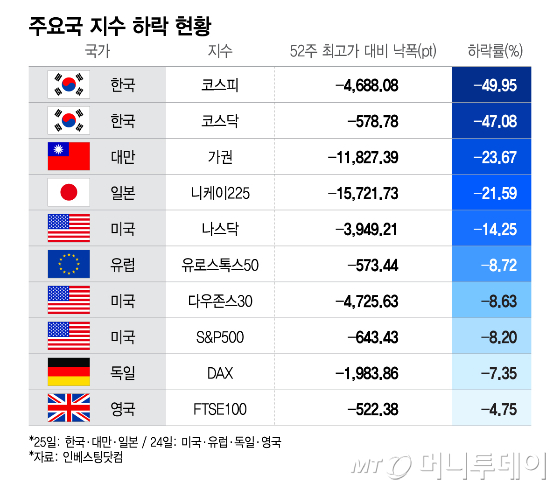
According to the Korea Exchange on the 25th, the KOSPI closed at 4,697.51, down 48.46% from its all-time high closing price of 9,114.55 recorded on June 22. The index dropped by approximately 4,400 points in five months. The KOSPI market capitalization, which had peaked at over 740 trillion won, has shrunk to around 380 trillion won. Compared with the intraday high of 9,385.59 recorded on June 19, the decline reaches 49.95%.
On this day, the KOSPI fell 6.16% from the previous trading session, relinquishing the 5,000 mark it had reclaimed the day before. Although it surged 6.32% the previous day, fueling expectations of a rebound, it effectively gave back all of that gain in a single day. Foreign investors, who had turned to net buying for the first time in eight trading sessions the previous day, drove the index lower by making net sales of nearly 2 trillion won on this day.
Even as late as June 22, when the KOSPI recorded its all-time high, its year-to-date gain exceeded 110%. It was a time when the domestic stock market received the most attention in global capital markets.
While global equity markets overall are undergoing corrections due to concerns over excessive investment in AI (artificial intelligence) and other factors, the decline in the domestic stock market is particularly pronounced. The S&P 500 and the Dow Jones 30 Industrial Average, representative U.S. indices, fell 8.20% and 8.63%, respectively, from their 52-week highs based on closing prices on the 24th (local time). The NASDAQ, centered on technology stocks, saw a decline of just 14.25%.
Taiwan’s weighted index, which has a large semiconductor industry share in its stock market similar to South Korea, fell 23.67% from its 52-week high as of the 25th. Under the same conditions, Japan’s Nikkei 225 index declined by 21.59%. The KOSPI’s drop is more than double that of Taiwan and Japan.
According to financial information provider FnGuide, as of the 23rd, not a single one of the 10th sectors in the domestic stock market has posted positive returns since the start of this month. While the IT (information technology) sector, which includes semiconductor stocks that led the first-half market rally, fell 22.57% in November alone, even consumer staples and healthcare sectors, which had maintained positive returns throughout the second half, turned negative in November.
The consumer staples sector fell 4.99% this month, while the healthcare sector dropped 0.19%. These two sectors were the only ones to post positive results, recording returns of 2.14% and 3.38%, respectively, during a period when the KOSPI has been highly volatile since the second half began. As the market correction drags on, even sectors that had shown relatively stable stock price movements are now exposed to selling pressure. Investors have found it difficult to identify new investment destinations to replace existing leading stocks, as well as defensive stocks to mitigate losses in a declining market.
The securities industry believes that additional declines in the stock market can only be prevented if rotation trading emerges, with investor funds moving from existing leading stocks to other sectors. An official at a securities firm said, “If the situation where appropriate investment alternatives cannot be found within the market persists, there is also a possibility that investment funds themselves will leave the domestic stock market,” adding, “Index volatility remains high, making it difficult to be optimistic about the recovery of investor sentiment.”

 in STOCK
