

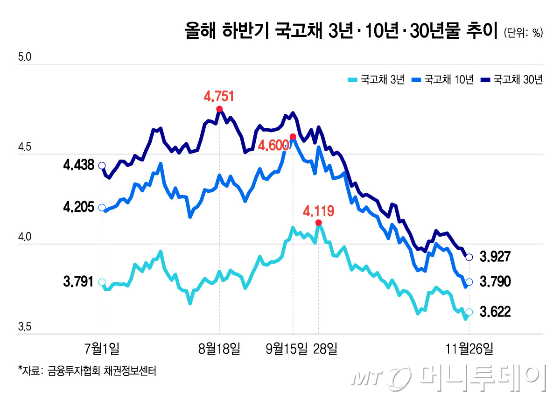
The bond market, which had been strong driven by increased preference for safe assets due to stock market weakness and expectations for the end of base rate hikes, is once again facing tightening pressures.
The Bank of Korea raised its economic growth forecast significantly at its November Monetary Policy Board meeting and left open the possibility of further base rate increases. Securities firms believe that tightening concerns, which had not been fully reflected in market rates until now, will push up government bond yields.
According to the Bond Information Center of the Korea Financial Investment Association on the 27th, the yield on three-year government bonds closed at 3.685%, up 0.063 percentage points from the previous day.
The 10-year bond closed at 3.734%, up 0.042 percentage points, while the 30th-year bond ended trading at 3.900%, down 0.027 percentage points.
At the previous day's Monetary Policy Board meeting, the base rate was raised by 25bp percentage point to 3.25%, and economic growth forecasts for this year and next were revised upward to 3.9% and 4.1%, respectively. As a result, short- and long-term government bond yields rose across the board during trading on the previous day.
Recently in the government bond market, expectations formed that the Bank of Korea's tightening cycle could conclude with this rate hike, causing yields to fall.
Kim Myung-sil, a researcher at iM Securities, explained, "Government bond yields fell rapidly as preference for safe assets following the stock price plunge coincided with foreign purchases of treasury futures," adding, "Expectations that the stock adjustment would slow consumption and delay further hikes by the Bank of Korea also contributed to bond strength."
However, signals indicating the possibility of additional tightening were confirmed at the November Monetary Policy Board meeting.
Although Hwang Geon-il and Lee Su-hyung, members of the Monetary Policy Board, issued dissenting opinions favoring a hold, seven out of 21 dots on the dot plot, which includes base rate forecasts six months ahead, were placed at 3.75%, 50bp higher than the current base rate. Both the median and upper end of the forecast range rose by 25bp compared to August.
Securities firms are divided on how high the Bank of Korea will raise the base rate during this tightening cycle. KB Securities expects the Bank of Korea to enter a hold phase after this hike, while Kiwoom, iM, SK, and Meritz Securities anticipate one additional hike in February next year, and Samsung Securities predicts two more hikes in February and May next year.
However, there is consensus that government bond yields will rebound in the short term as the possibility of further tightening is reflected in market rates, and that it may be worth buying at low levels as yields rise.
The yield rebound is expected to appear first in three-year government bonds, which are sensitive to monetary policy. iM Securities left open the possibility that three-year bond yields could rebound to the 3.7% to 3.8% range and 10-year bond yields to the 3.9% to 4.1% level.
Won Yu-seung, a researcher at SK Securities, stated, "Current market rate levels do not fully reflect a final rate of 3.50%," adding, "After market rates rise, as the end of next year's tightening cycle is expected, it may be a time when low-level buying strategies are also necessary."
Expectations also emerge that bond supply and demand conditions at year-end will limit yield volatility. This is because government bond issuance volumes will decrease, easing upward pressure on yields, while simultaneously, institutional investors' buying demand ahead of year-end settlements will also decline, leaving little room for yields to fall.
According to the December government bond issuance plan announced by the Ministry of Economy and Finance, competitive bidding volumes for 30-year and 50-year bonds will plummet from 2 trillion won and 700 billion won in the previous month, respectively, to 600 billion won and 150 billion won.
The fact that 30-year and 50-year government bond yields closed lower despite the base rate hike is also interpreted as being due to this factor. Kim Ji-man, a researcher at Samsung Securities, forecast, "Until year-end, government bond issuance will decrease and demand will be limited by year-end closing, making it difficult for yields to move significantly."

 in STOCK
