

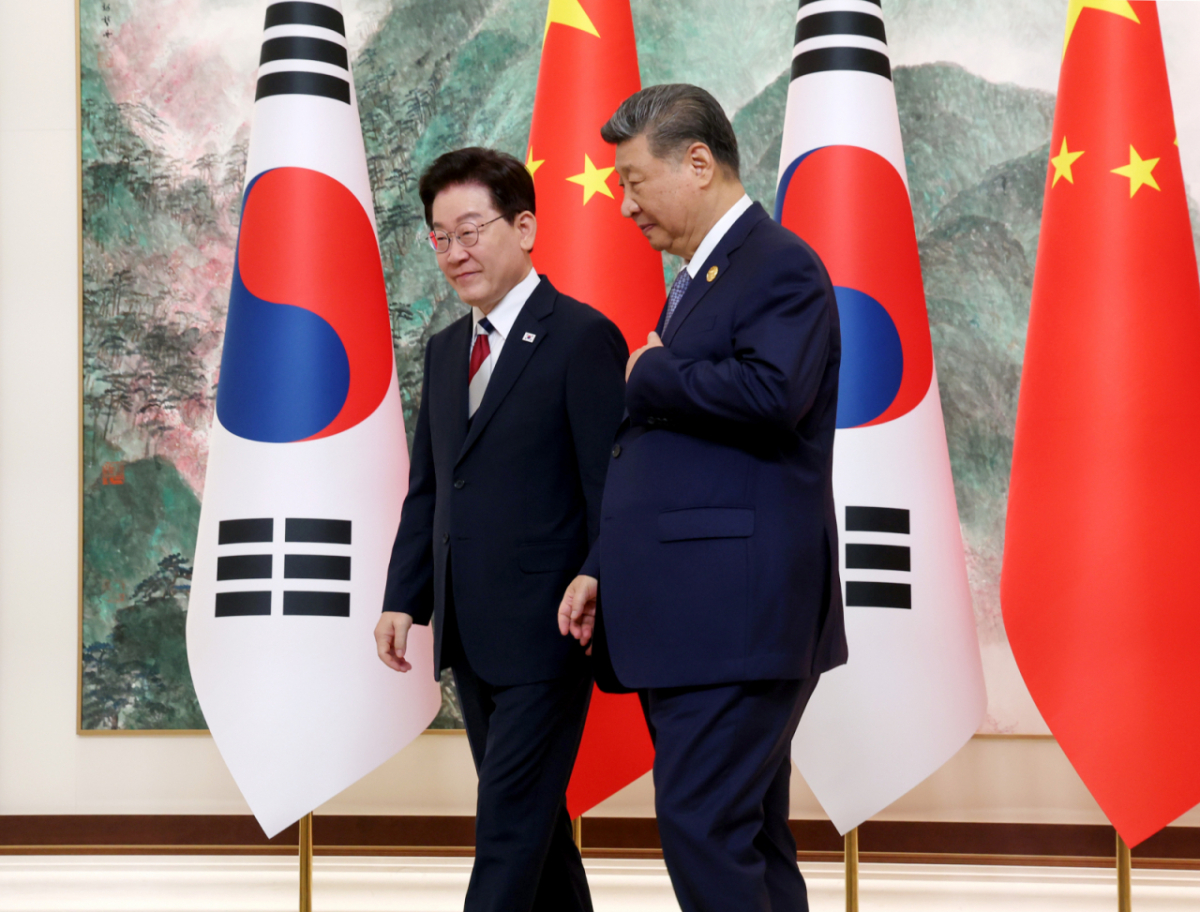
While the KOSPI has fallen nearly 18 percent this month, shares of the four major entertainment companies have climbed by as much as 31 percent. Institutional investors have supported the rally, fueled by expectations that China could lift its restrictions on Korean cultural content following the Korea-China summit.
However, analysts say several hurdles must still be cleared before concerts by Korean artists can resume in China.
According to data from the Korea Exchange on Nov. 26, the KOSPI index has fallen a cumulative 17.79% since the start of this month, while HYBE shares have risen 18.28% and SM Entertainment (SM) shares have climbed 31.15%. YG Entertainment (YG) and JYP Entertainment (JYP Ent.) shares also rose by 27.93% and 23.60%, respectively. Compared to the day before the summit ( Nov. 17 ), while the KOSPI dropped 5.18%, the four companies maintained gains in the range of 8% to over 30%.
Trading volume has also clearly increased. Comparing the average daily trading volume during regular trading hours before the summit this month (2nd–17th) and after the summit (18th–26th), SM’s volume rose from 100,000 shares to 480,000 shares, HYBE’s from 300,000 to 440,000, YG’s from 130,000 to 220,000, and JYP’s from 610,000 to 950,000. The combined average daily trading value for the four companies jumped 2.2 times, from 83.7 billion won to 180.6 billion won.
Unlike in the past, where short-term supply and demand from retail investors would concentrate and then immediately reverse, institutional investors have provided downside support this time. Institutional investors have made net purchases totaling 186 billion won worth of shares across the four companies from the day of the summit through regular trading on the 26th, absorbing selling pressure from retail and foreign investors.
The entertainment sector has been considered a representative industry marginalized in the stock market after enduring a prolonged adjustment since the second half of last year. Despite this month’s rebound, the cumulative decline for the year remains significant: HYBE at 43.73%, JYP at 32.92%, YG at 30.04%, and SM at 25.78%. The concentration of investment in semiconductor stocks and long-term share price declines are cited as factors that have dampened expectations.
Lee Ki-hoon, a research analyst at Hana Securities, stated, “Current stock prices have emerged from historical lows around a price-to-earnings ratio (PER) of 15 times, which has been supported over the past decade by factors such as the Hanban Ling and ‘No Japan’ sentiment.” He added, “Assuming that the lifting of the Hanban Ling allows major teams like BTS and SEVENTEEN to perform 25 times a year in large-scale domes where they have not yet received permits, and that sales of official merchandise account for 10% of performance revenue, an average operating profit increase of around 40% is expected for the four companies.”
Nevertheless, domestic securities firms are hesitant to immediately raise target prices for individual stocks. This is because uncertainty remains too high to immediately reflect in earnings estimates or valuation multiples. According to FnGuide, since the summit, only one report has raised a target price for an entertainment stock—SM’s—which reflected specific plans for its artists’ activities unrelated to China. Some analysts suggest that repeated failed predictions of rebounds from lows have made it difficult to confidently argue for further gains.
The turning point for earnings will be whether Korean singers pass Chinese regulatory reviews and whether large-scale performances resume. The Korea Association of Popular Music Performance Industry (KAPMI) stated on the 26th, “We positively evaluate China’s promise to grant most-favored-nation treatment across cultural services, including performances, and its agreement to expand cultural exchanges between the two countries.” However, it added, “It is regrettable that the principle of non-discrimination in pre-performance reviews has not been explicitly stated.”
Choi Min-ha, a research analyst at Samsung Securities, noted, “Codifying this in a trade agreement does not guarantee immediate passage of reviews or the resumption of tours.” She added, “Practical administrative procedures remain, such as easing broadcast censorship, visa issuance, and commercial performance permits from provincial cultural authorities in China. Therefore, for the upward trend in stock prices to continue after short-term supply and demand concentration, it is essential to confirm the official effective date and actual cases of approval by local authorities.”
Differences in sentiment across individual stocks are also a variable. In the securities market, SM, which has signed a memorandum of understanding (MOU) with Tencent and holds numerous intellectual property rights (IP), and YG, which has a strong fan base in the Chinese-speaking world, are cited as primary beneficiaries. However, if China’s “Hanri Ling” (Japanese content ban) continues, it is unclear whether groups including Japanese members will benefit.
Some observers predict that the effect of lifting the Hanban Ling may not be as significant as before, as the four companies have shifted the focus of their overseas businesses to Western countries and non-Chinese Asian regions due to the prolonged ban. Jung Ho-yoon, a research analyst at Korea Investment & Securities, stated, “In the medium to long term, even if performances resume, the domestic entertainment industry has changed significantly since the Hanban Ling began in 2016–2017.” He added, “Concert ticket sales are now growing in Japan, Southeast Asia, and the UK/US regions, making it difficult to expect dramatic profit growth as in the past even if performances in China resume.”

 in STOCK
