

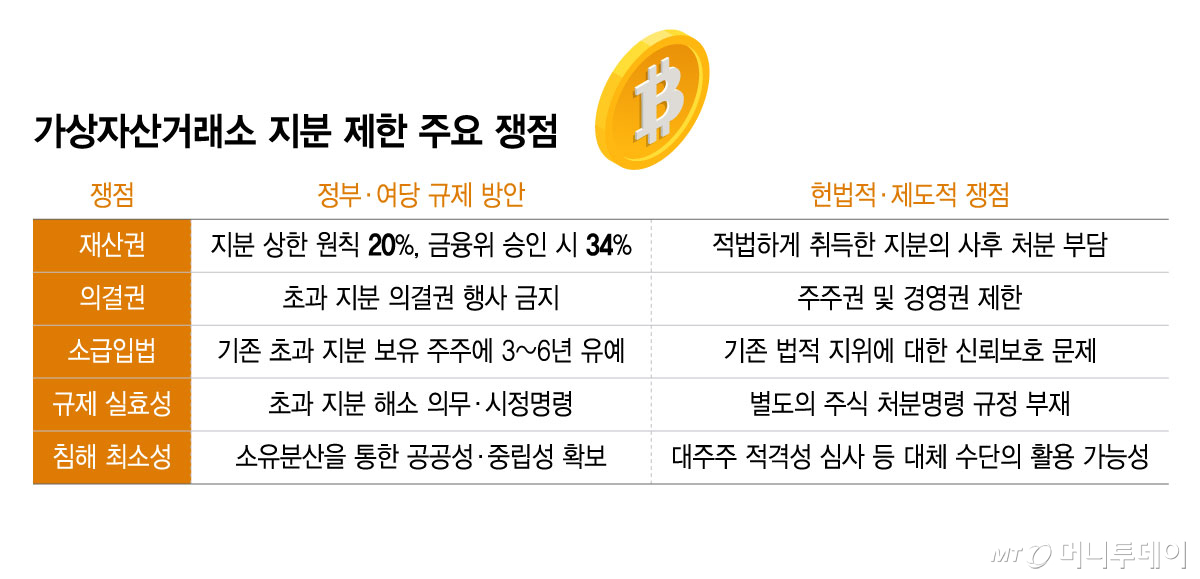
Concerns have been raised within the National Assembly’s Political Affairs Committee, the standing committee with jurisdiction over the issue, that the major shareholder stake limits for virtual asset exchanges being pushed by the government and the ruling party may be unconstitutional. The argument is that requiring the retroactive restructuring of the ownership structure of a private company formed through legal means could infringe upon constitutional property rights and freedom of business activity. Although the government has mitigated regulatory burdens by not including provisions for direct stock disposal orders, legislative friction is expected as the constitutional controversy persists.
No Forced Sale Provisions, but Controversy Over Infringement of Property and Management Rights Remains
According to political circles on the 29th, Democratic Party of Korea lawmaker Park Min-gyu, a member of the National Assembly’s Political Affairs Committee, stated on his Facebook page on the 27th that the major shareholder stake limits for virtual asset exchanges constitute retroactive regulation against existing operators and thus carry a high risk of unconstitutionality due to infringement of property rights. Lawmaker Park also noted that limiting voting rights on excess shares is constitutionally problematic and said he would seek to amend relevant provisions during the bill review process. People Power Party lawmaker Kim Sang-hoon, a member of the National Assembly’s Committee on Finance and Economy, also called for the deletion of shareholding limit provisions, raising issues such as infringement of property rights, freedom of business activity, and retroactive legislation.
Article 75 of the “Act on Innovation in the Digital Asset Industry and Protection of Users,” introduced by Political Affairs Committee Chair Yoo Dong-soo, generally prohibits holding shares exceeding 20% of the total issued voting shares of an exchange. Provisions allowing holdings of up to 34% with approval from the Financial Services Commission are expected to be included in enforcement decrees. Existing shareholders holding excess stakes will be given a three-year grace period from the date of exchange designation, with the possibility of an additional three-year extension if certain conditions are met. Shareholders who violate ownership limits will not be able to exercise voting rights on their excess shares and must promptly bring their holdings into compliance with the limits.
The bill does not include separate provisions allowing the Financial Services Commission to set a disposal deadline for excess shares and order their sale. However, once the grace period expires, holding excess shares itself will constitute a legal violation, potentially subjecting holders to corrective orders and other measures. Even without direct disposal order provisions, the structure that retroactively restricts existing shareholders’ ownership and management rights remains unchanged.
According to responses from the National Assembly Research Service released by Lawmaker Kim Sang-hoon’s office in March, the service analyzed that shareholding limits may infringe upon property rights under Article 23 of the Constitution and freedom of occupation and business activity under Article 15. In a response submitted to Lawmaker Park Min-gyu last September, the National Assembly Research Service stated that voting rights also fall within the scope of constitutional protection for property rights. The public report also noted that the public interest gained through regulation must be comprehensively weighed against the disadvantages suffered by existing shareholders.
Dispute Over Ownership Dispersion Effects... Concerns About Legislative Delays
The Financial Services Commission maintains that, given the market size has grown with virtual asset exchange users surpassing 10 million, it is necessary to ensure the public interest and neutrality of exchanges. The risk of conflicts of interest at exchanges, which simultaneously perform multiple functions such as trading support, execution, and custody of user assets, also forms the backdrop for discussions on shareholding limits. However, there is a difference between domestic similar legislation regarding ATS (Alternative Trading Systems), where capital contributions were made based on shareholding limits from the establishment stage, and virtual asset exchanges, which must retroactively change already formed ownership structures.
At a seminar by the Korean Constitutional Law Society in March, it was also suggested that regulatory measures less restrictive of existing shareholders’ fundamental rights, such as major shareholder eligibility reviews and strengthened internal controls, should be prioritized for consideration. The Financial Services Commission has stated that it has conducted various legal reviews regarding shareholding limits but has not disclosed specific review results.
The controversy over shareholding limits could also lead to delays in the overall legislation of the Digital Asset Act. The bill includes not only exchange regulations but also digital asset issuance and disclosure, business licensing, and the issuance and circulation system for won-denominated stablecoins. During the preparation of the government’s draft, legislative schedules were delayed due to disagreements over shareholding limits and the entities authorized to issue stablecoins. If disagreements are not resolved after the National Assembly public hearing on the 3rd of next month, processing of the bill may be further delayed.

 in STOCK
