

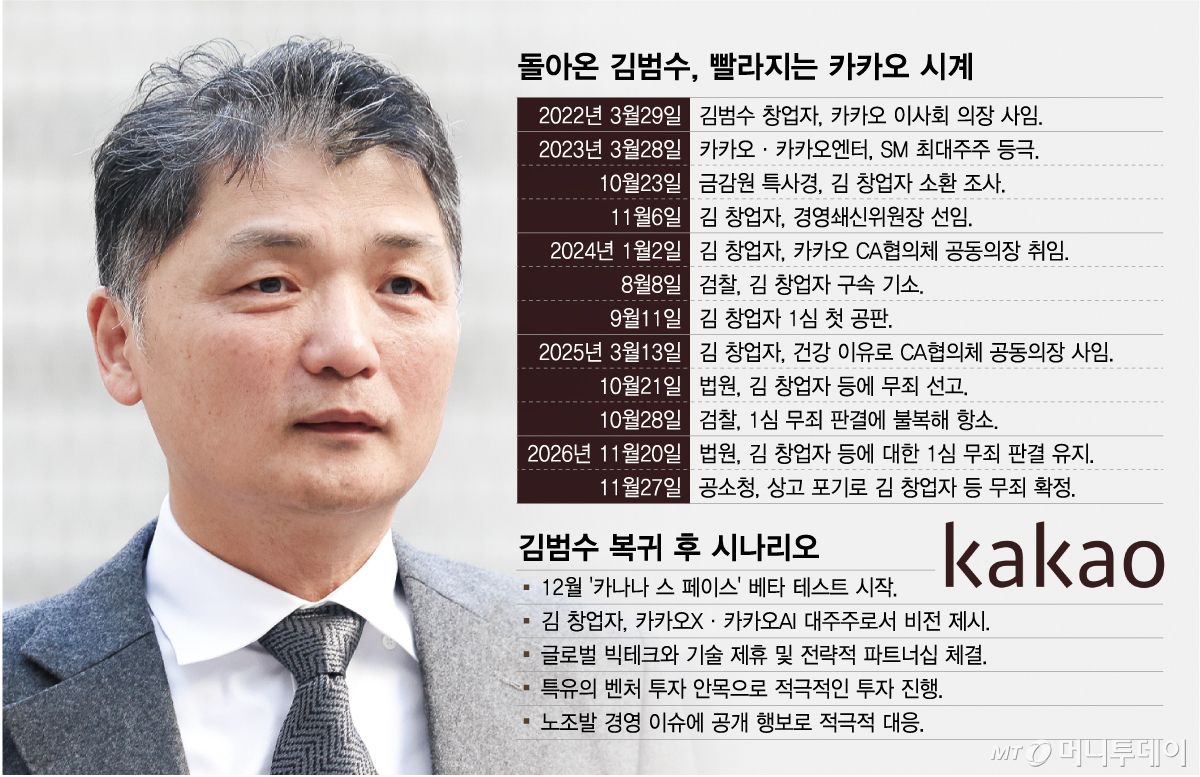
Kakao is preparing for another wave of innovation after clearing its founder, Kim Beom-soo, of legal risks. Kim, who stepped back from frontline management in 2022 amid suspicions of market manipulation, has had his acquittal finalized, leading to expectations that investments in new businesses, including AI agents, will accelerate. Market attention is also turning to the founder's public activities and whether he can lead the "second KakaoTalk myth."
According to IT industry and legal sources on the 29th, the prosecution has decided not to appeal the appellate court ruling that acquitted Kim of charges of violating the Capital Markets Act. Consequently, the case involving suspicions of market manipulation against the founder concluded with an acquittal three and a half years after it began, following the ruling on the 27th.
Kakao had been waiting for the resolution of the founder's legal risks. During this period, CEO Chung Shin-a maintained operations and led the company, but Kim's absence from frontline management hindered critical decisions such as new business ventures and acquisitions. Over the past three years, Kakao has completed restructuring measures, including streamlining its affiliates and deciding on a corporate split. The founder also served as head of the Future Initiative Center, preparing long-term growth strategies.
Kakao, which has operated various businesses, is returning to its original vision for the AI era. It plans to integrate AI agents into KakaoTalk, the service that built the current Kakao. To quickly catch up with competitor Naver (NAVER), the company aims to actively leverage the KakaoTalk ecosystem. While Naver utilizes users' search data, Kakao can leverage conversation data. If Naver's AI agent assists with search results, Kakao's AI agent claims the advantage of providing necessary information even before a search is initiated.
In this context, while Naver's ecosystem spans a vast array of products and stores, Kakao's ecosystem is built on interpersonal relationships. Through data such as "who one is in a relationship with," "when they meet," and "how money is exchanged," the AI agent can provide information that reflects preferences and relational context without additional explanation, even in complex or personal situations like birthdays and anniversaries.
As its key move for the AI agent era, Kakao will begin beta testing "Kana Space" next month. Kana Space is an AI layer accessible from anywhere within KakaoTalk by lightly swiping with two fingers. The company aims to shift from a model where users directly find and access necessary features or services on existing mobile screens to one where the AI agent performs these tasks on their behalf.
The founder's role is expected to grow in presenting Kakao's vision as a platform company and organizing its business strategies. Having stated immediately after the appellate ruling that he would "contribute his strength to new challenges and growth as the founder," Kim is likely to present visions as the major shareholder of both KakaoX and KakaoAI, rather than returning to frontline management immediately. With legal risks resolved, he is also expected to actively pursue technology partnerships and strategic alliances with global big tech companies.
The founder is also highly likely to take public action regarding recent management issues. The Kakao labor union conducted multiple strikes last summer over performance bonuses and employment stability. On the day of Kim's appellate ruling, the union publicly inquired about his stance on the corporate split and what responsibility he would take if promised results were not achieved. Industry observers predict that Kim will address these issues head-on to minimize risks.
An IT industry official said, "The clock at Kakao is expected to speed up with the founder's return." The official added, "For a long time, it appeared to be lagging behind in the AI era, which was not befitting its name as an innovative company, but we look forward to seeing how things will change from here on."

 in TECH

