

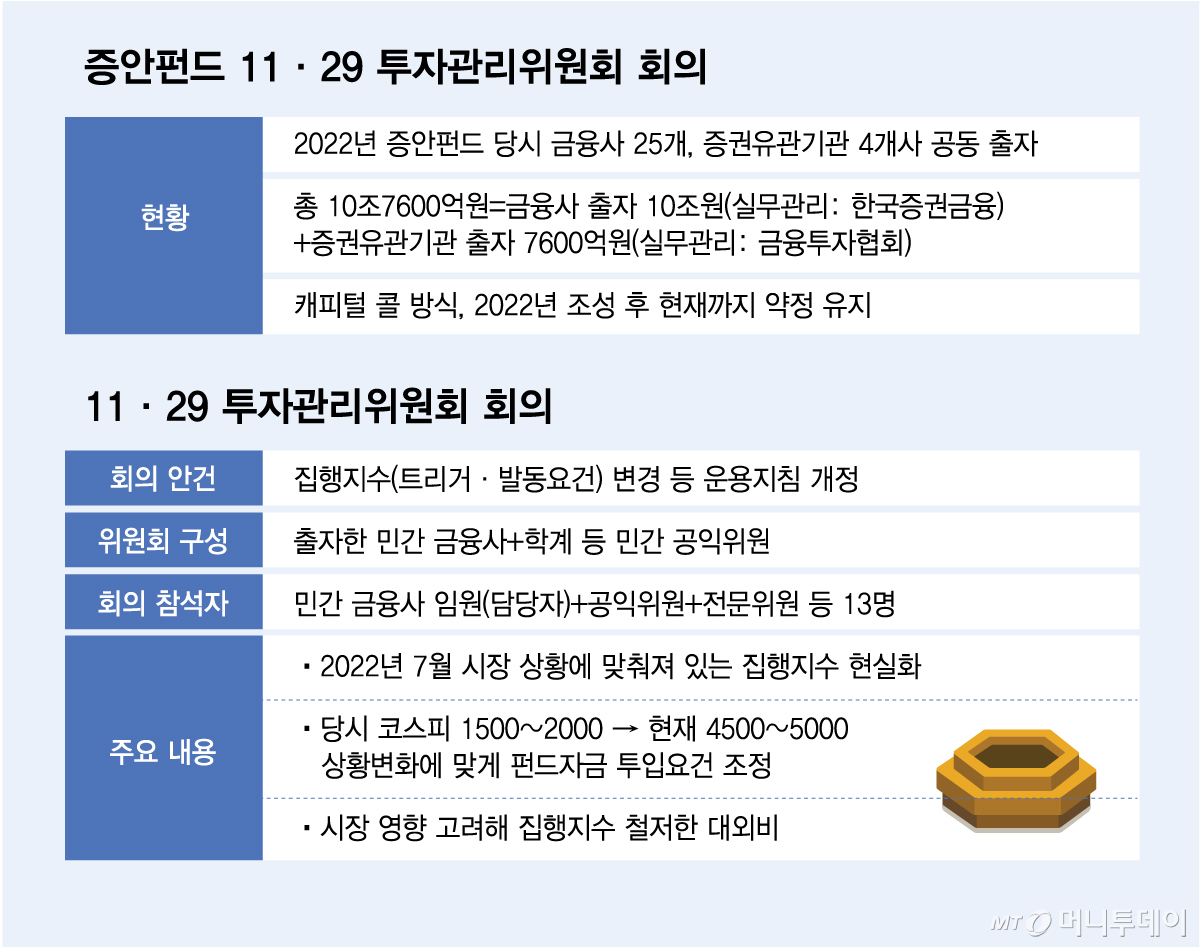
The execution index of the Securities Market Stabilization Fund (hereinafter, the Fund) is expected to be revised for the first time in about four years at the Investment Management Committee meeting on the 29th. This comes just one week after the F4 meeting, which brings together the heads of four key economic and financial authorities, mentioned preparations for the immediate activation of the Fund. Amid repeated sharp declines and surges in the KOSPI last week, the move effectively loads ammunition worth 10 trillion won. President Lee Jae-myung also commented on the Fund, saying it “could be helpful in the short term psychologically.”
According to the financial investment industry and banking sector on the day, the Fund’s Investment Management Committee will hold a meeting at 5 p.m. to revise its operational guidelines. The Fund is a 10 trillion won vehicle established in 2020 and re-contracted in 2022, centered on funds from national policy banks and commercial banks. It is distinct from the 760 billion won fund formed by four related agencies.
Until now, although a 10 trillion won fund existed, its execution index was calibrated to market conditions in the second half of 2022, making actual deployment virtually impossible. Under current operational guidelines, the execution index is set at the KOSPI 1,500–2,000 level. If the execution index is changed through today’s revision of the operational guidelines, the conditions will be in place to immediately deploy fund resources when the KOSPI plunges.
Synthesizing remarks from key officials in the financial investment industry and banking sector, there is a high likelihood that the execution index will be changed at today’s meeting. An industry official said, “Because the fund was initially established during the COVID-19 pandemic, the execution index was set to match KOSPI levels at that time,” adding, “It appears to be a session aimed at making it realistic in line with current market conditions.”
The Fund’s execution index is kept strictly confidential. If the execution index, which serves as the trigger clause for fund activation, becomes public, investors could buy and sell stocks en masse based on it, thereby diminishing the policy’s effectiveness.
Financial authorities are also reviewing the funding plans of financial institutions that have committed capital to the Fund. The Fund operates on a capital call basis, whereby financial institutions contribute the amounts they have pledged once specific conditions are met. Accordingly, major banks are considering how to immediately raise and pay in 1 trillion to 2 trillion won, while large securities firms are reviewing how to secure several hundred billion won.
The Financial Services Commission will hold an emergency market situation review meeting at the Government Seoul Complex on the morning of the 30th, chaired by Commissioner Lee Eui-won. The heads of the five major financial holding companies (KB, Shinhan, Hana, Woori, and NH), the chairman of the Korea Development Bank, and association presidents from each sector are expected to attend to discuss current issues in the financial and securities markets.
The Korea Development Bank sent emails to major banks, securities firms, and insurance companies on the 23rd to assess their ability and scale for additional capital contributions.
During a Q&A session with reporters while climbing Bukak Mountain near Cheong Wa Dae on the day, President Lee said, “Improving the market’s fundamental structure is important,” adding, “It is questionable whether it can produce substantive results compared to the overall size of the market.” He continued, “Experts will review what level is appropriate,” and added, “Volatility is abnormally high, so we must try everything we can.”

 in STOCK
