

Starting next year, if Seoul apartment prices rise by more than 7%, the capital burden on banks that have significantly increased household loans will increase by up to approximately 1%. The financial authorities are considering a plan to set annual Seoul apartment transaction price increases of 7% and 10% as "caution" and "alert" thresholds, respectively, and link these to bank capital regulations. The structure is designed to require banks with a high proportion of mortgages or those that have rapidly expanded their mortgage portfolios to accumulate more capital.
According to financial industry sources on the 29th, the Financial Services Commission and the Financial Supervisory Service have prepared detailed implementation plans for the Systemic Risk Buffer Capital (SSyRB) for the household sector, including these provisions, and are currently soliciting opinions from banks. The SSyRB is a system already adopted by major advanced countries and is a national priority task of the Lee Jae-myung administration.
This system imposes an obligation on banks to accumulate additional capital in preparation for systemic risks arising from the cumulative increase in household debt. The financial authorities are considering imposing the SSyRB if the ratio of household debt to gross domestic product (GDP) exceeds a certain level. Even if this benchmark is not exceeded, the buffer can be imposed by considering macroeconomic conditions such as mortgage growth rates and housing price levels.
In particular, the financial authorities will calculate the decline in banks' Common Equity Tier 1 (CET1) ratios through stress tests assuming a sharp drop in housing prices, and determine a common accumulation ratio for the banking sector based on this. If auxiliary indicators such as mortgage growth rates and housing price increases exceed thresholds, the common accumulation ratio will be raised.
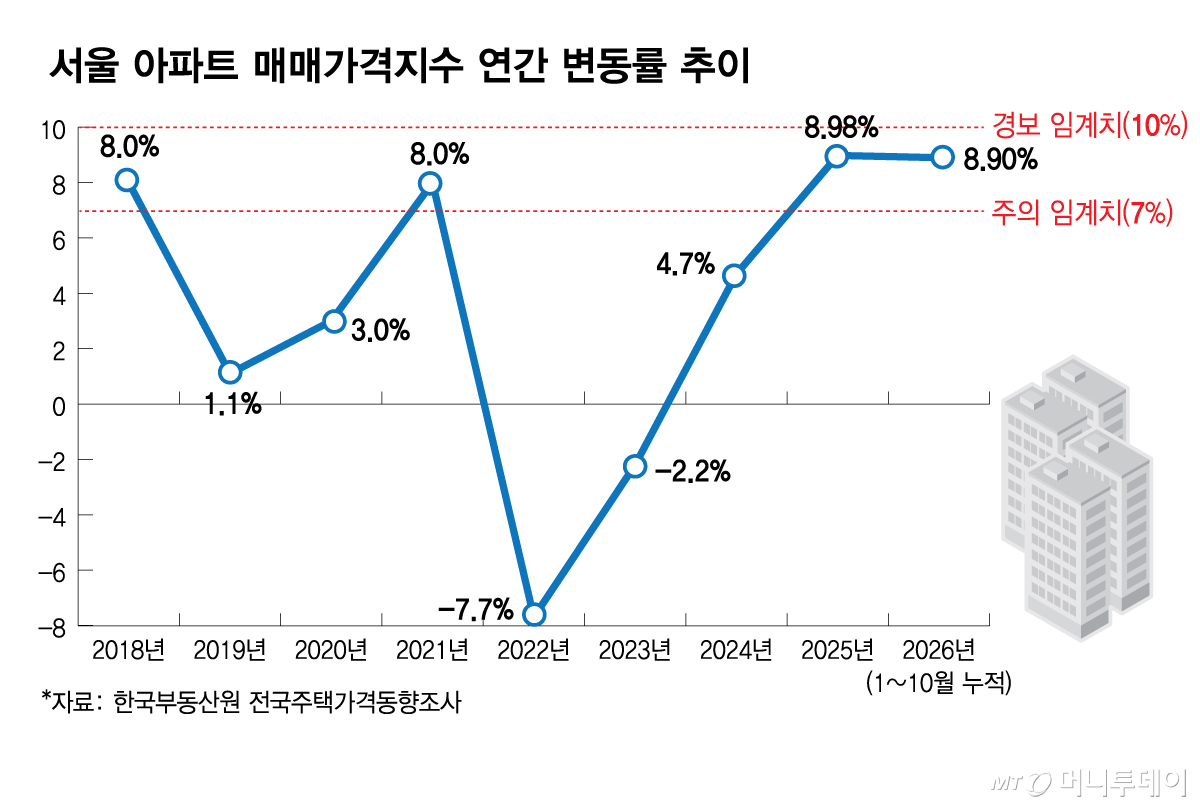
Plans are under review to classify the situation as "caution" if the banking sector's annual mortgage growth rate exceeds nominal GDP growth, and as "alert" if it exceeds it for two consecutive years. Additionally, an annual increase in Seoul apartment transaction prices exceeding 7% is considered reaching the "caution" threshold, while an increase exceeding 10% reaches the "alert" threshold. Since next year's nominal growth rate is projected to be at a high level in the 7% range, Seoul apartment price fluctuations are expected to become the main variable.
According to the Korea Real Estate Board, Seoul apartment transaction prices rose by 8.98% last year and have increased by a cumulative 8.90% through October this year. This level already exceeds the caution threshold under consideration by the financial authorities, meaning that applying the SSyRB to the current housing market conditions would be a factor in raising the common accumulation ratio for banks.
Banks with rapid mortgage growth face 1.5x weighting... Pilot operation to begin early next year
The accumulation ratio for each bank is calculated by multiplying the common accumulation ratio by the proportion of mortgage risk-weighted assets (RWA) in the bank's total RWA and a weighting multiplier based on the level of mortgage management. In particular, plans are under review to raise the ratio by up to 1.5 times for banks whose mortgage growth rate over the past year has been higher than nominal GDP growth. This differentiates capital burdens not only based on the proportion of mortgages held but also on each bank's growth speed. However, the accumulation ratio in the first year of implementation will not exceed 1%.
If the upper limit of the additional accumulation ratio of 1% is applied as is, the CET1 regulatory ratio for Domestic Systemically Important Banks (D-SIBs) would rise from the current 9% to 10%, and for other banks from 8% to 9%.
As of the end of September this year, the risk-weighted assets of the five major banks (KB Kookmin, Shinhan, Hana, Woori, and NH Nonghyup) were approximately 1,027 trillion won. If the upper limit is applied, the increase in required capital would be up to 1027 trillion won. For five regional banks including Busan, Gyeongnam, Gwangju, Jeonbuk, and Jeju, it would be approximately 94 billion won.
Since the banking sector's CET1 ratios sufficiently exceed regulatory levels, there is no immediate need to expand additional capital. However, the capital headroom available for loans or shareholder returns will decrease. If banks fail to meet their required accumulation levels, restrictions will also arise on payments such as dividends and performance bonuses necessary for shareholder returns.
The financial authorities are expected to conduct a pilot operation with banks in the first quarter of next year and push for amendments to supervisory regulations during the first half of the year. The actual timing of capital accumulation will be determined by the financial authorities within a maximum of one year when they decide on accumulation, and the obligation will be lifted if there are concerns about sudden credit tightening.
With household loan balances reaching 189 trillion 680 billion won as of the end of the third quarter this year, the financial authorities aim to curb the concentration of bank lending to households by strengthening capital regulations in addition to total volume management, and to induce the supply of funds toward productive finance.

 in FINANCE
