

With the introduction of the Systemic Risk Buffer (SSyRB) for the household sector, banks face a dual regulatory burden: the regulatory level for their Common Equity Tier 1 capital ratio is raised, while banks that have heavily engaged in high-risk mortgage loans see their capital ratios reduced.
Financial authorities plan to maintain the total volume management policy for household loans next year as well. Although the goal of reducing the household debt-to-GDP ratio to 80% by 2030 was effectively achieved four years ahead of schedule this year, authorities diagnose that the absolute level of household debt remains high once the "semiconductor effect" is excluded.
Higher capital burden for loans exceeding 2.5 billion won in home price and 400 million won in loan amount
According to financial industry sources on the 29th, while the systemic risk buffer for the household sector, to be introduced for the first time next year, is a regulation that raises the required capital ratio level for banks by up to 1%, high-risk mortgage regulations act as a burden factor because they lower banks' capital ratios.
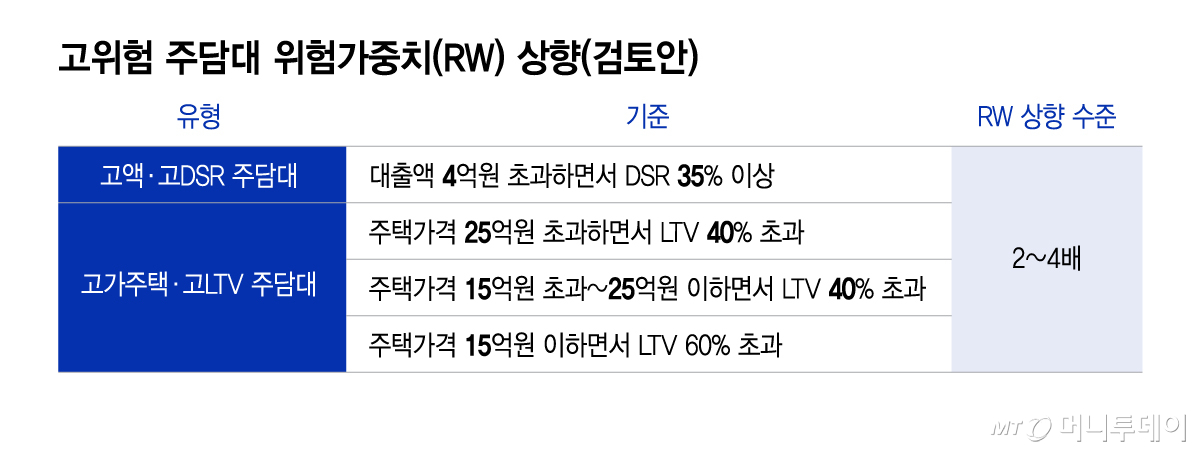
Financial authorities are reviewing a plan to classify mortgages on high-priced homes and those with high Loan-to-Value (LTV) ratios, as well as high-value and high Debt Service Ratio (DSR) mortgages, as "high-risk mortgages," and to raise the risk weight (RW) for these loans by 2 to 4 times from current levels. As RW increases, banks' risk-weighted assets expand, leading to a decline in capital ratios. Since this applies not only to new loans but also to existing ones, it will inevitably place a significant burden on banks.
Regulations on high-priced home and high-LTV mortgages are applied differentially in three categories based on home price and LTV levels: cases where the home price exceeds 2.5 billion won and the LTV exceeds 40%; cases where the price is between over 1.5 billion won and 2.5 billion won with an LTV exceeding 40%; and cases where the price is under 1.5 billion won with an LTV exceeding 60%. In each case, the risk weight will be raised by up to 4 times from current levels. Additionally, a plan is being reviewed to classify loans exceeding 400 million won in amount with a DSR over 35% as high-value/high-DSR mortgages and raise their risk weight by up to 4 times as well.
Currently, an LTV of 40% (70% for non-regulated areas) and a DSR of 40% are applied based on regulated area standards. However, analysis suggests that the impact will be considerable, particularly among regional banks, as loans from the past when regulatory levels were lower, and those located in local regions, may be newly classified as high-risk mortgages.
Household debt-to-GDP ratio falls to 70% range, but "still high compared to advanced countries"… Total volume management to continue next year
Financial authorities plan to maintain the total volume management policy for household loans next year. When announcing a medium- and long-term roadmap for household debt at the beginning of this year, authorities stated they would reduce the household debt-to-GDP ratio to around 80% by 2030. However, due to a sharp increase in GDP driven by factors such as the semiconductor boom, the household debt ratio already fell below 80% in the second half of this year, achieving the target four years early.
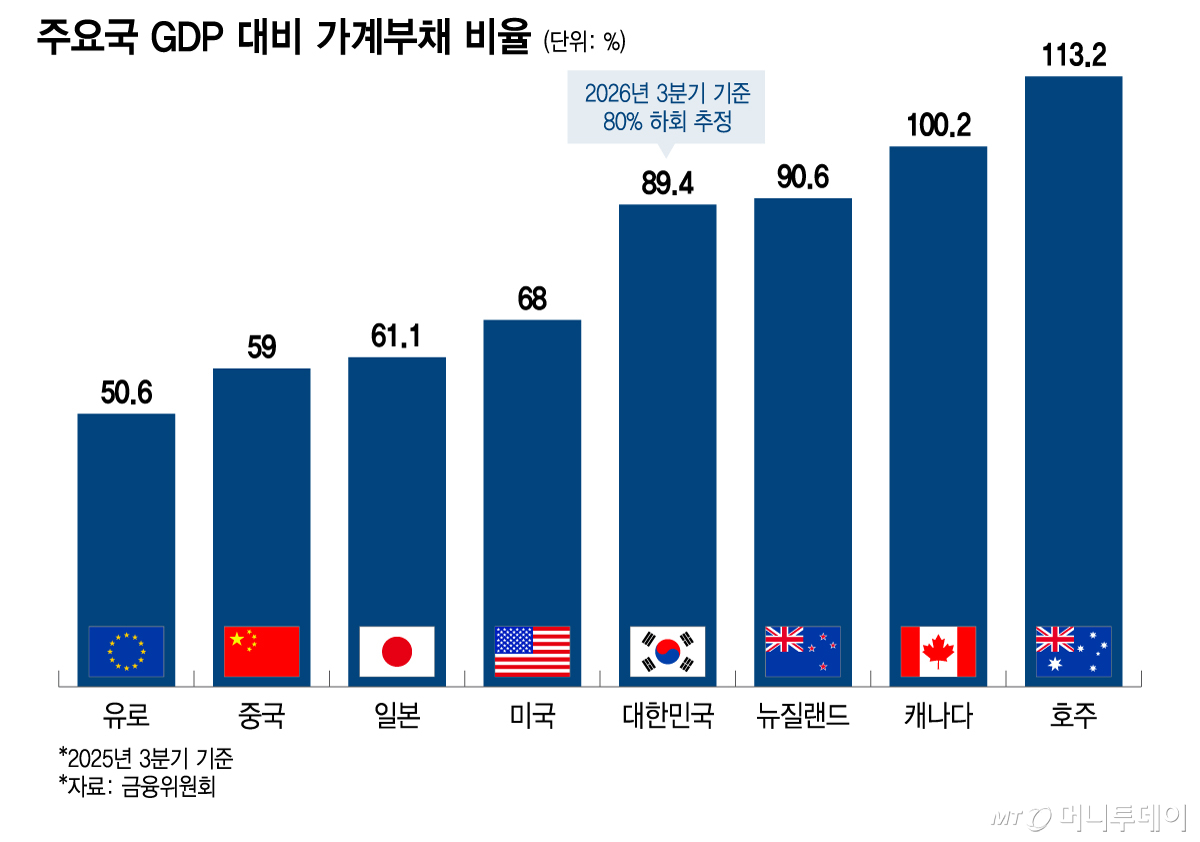
However, financial authorities diagnose that the absolute level of household debt remains high. As of the third quarter, outstanding household loans stood at 1,896.8 trillion won, approaching 1,900 trillion won. Moreover, major countries such as Eurozone nations (50.6%), China (59%), Japan (61.1%), and the United States (68%) have household debt-to-GDP ratios (as of the third quarter last year) at levels of 50 to 60%, which are significantly lower than South Korea's.
However, when setting the growth rate target for total volume management next year, authorities do not expect to use the "nominal growth rate forecast," which has been used as a reference indicator in the past, as the baseline point. This is because the nominal growth rate could rise significantly compared to previous years due to factors such as the semiconductor effect. At the beginning of this year, financial authorities set the household loan growth rate target at 1.5%, half of the annual nominal growth rate forecast of around 3%. However, the actual nominal growth rate for this year is expected to be in the 20% range, and in the 7% range next year. The household debt growth rate needs to be set much lower than these figures.
A financial authority official said, "Because the absolute figure of household debt is high and the household debt-to-GDP ratio remains at a level still higher than that of advanced countries, we will refer to this when setting an appropriate total volume management target for next year."

 in FINANCE

