

[For more diverse company information on the startups mentioned in this article, you can view them on the Unicorn Factory Big Data Platform 'Data Lab'.]
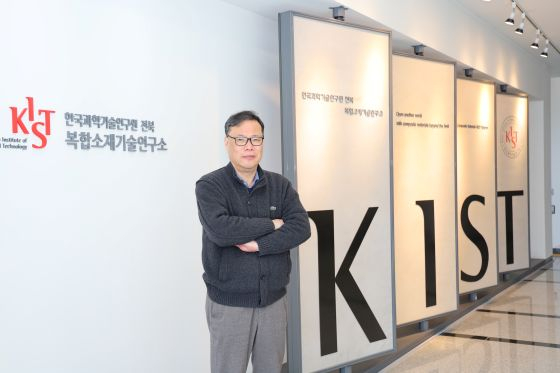
"Among composite materials, the field that demands the highest physical properties and generates correspondingly high added value is precisely 'space-grade materials.' However, in reality, domestic materials have almost no presence in Korea's space industry sector."
Director Yang Cheol-min, who leads the newly established 'Space Composite Materials Research Unit' at KIST Jeonbuk Branch, stated when asked about the background of the unit's launch that it was "to avoid repeating a 'space-grade materials, components and equipment (MCE) crisis.'" The Space Composite Materials Research Unit is KIST's '7th Mission-Centered Research Institute,' centered on the KIST Jeonbuk Composite Materials Technology Research Institute, and officially announced its launch on the 1st of this month.
Mission-centered research institutes are a newly introduced research operation system launched when KIST President Oh Sang-rok took office in 2024. They aim to be 'problem-solving research organizations' that set concrete problems faced by the nation and industry as research goals and concentrate human resources and capabilities to ensure research outcomes can be practically utilized.
Director Yang emphasized, "With the abolition of PBS (a researcher-focused project funding evaluation system) this year, it has become time to once again ask the fundamental question of why research institutes exist." He added, "At the KIST Jeonbuk Branch level, we pondered what is the most urgent and strategic mission for the nation, and the conclusion was the space sector."
The background of the unit's launch lies in a shift in the paradigm of space development. According to the roadmap of the International Space Exploration Coordination Group—a global consortium where space agencies and research teams from various countries share strategies and technologies—human activity is expected to expand beyond the moon to Mars in the near future. Space exploration is moving beyond simple scientific missions into a full-fledged space development industry stage based on establishing lunar bases and utilizing in-situ resources (ISRU).
However, Korea's reality is far from easy in the face of such changes. KIST judges that sustainable space development will be difficult if core material technologies cannot achieve self-reliance, even if rocket and satellite design capabilities and system technologies are highly advanced.
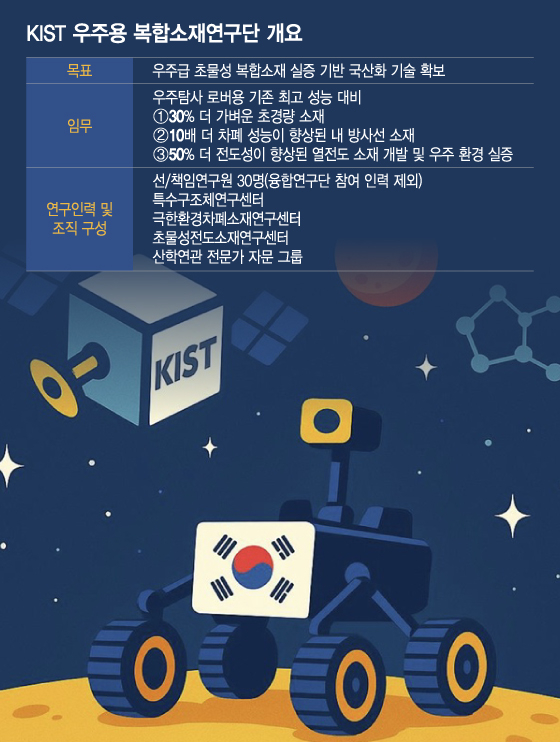
Accordingly, the core mission of the Space Composite Materials Research Unit has been set to develop 'K-space composite materials' that simultaneously possess lightweight properties, shielding capabilities, and conductivity capable of withstanding the space environment. Director Yang diagnosed, "Currently, the space sector is constrained by a metal-material-centric approach, and in terms of lightweight material technology for space applications, Korea remains at an early stage."
He further explained, "Space-grade materials must meet extreme conditions that go beyond simply being light and strong; they must withstand radiation, vacuum environments, thermal shocks from extreme cold to high heat, and even collisions with microparticles." He added, "Our goal is to develop ultra-lightweight materials 30% lighter than existing ones for space mobility such as lunar exploration rovers, shielding materials with over 10 times better radiation shielding performance, and thermal conductive materials with more than 50% improved conductivity."
He also emphasized, "The developed materials will not be limited to ground evaluation; we plan to proceed with actual space environment verification. Technologies meeting such performance requirements can also be sufficiently expanded and applied to terrestrial industries such as aircraft."
The KIST Jeonbuk Composite Materials Technology Research Institute has already accumulated experience in space environment verification over the past eight years through collaboration with NASA (the U.S. National Aeronautics and Space Administration). Through NASA's Materials International Space Station Experiment (MISSE) project, KIST has successfully exposed its independently developed radiation shielding materials to the actual space environment for several months before retrieving and analyzing them.
According to the 10th-year mission development milestone established by the research unit, Phase 1 (2026–2028) will focus on material development and ground verification, while Phase 2 (2029–2031) will pursue space environment verification through component development and satellite integration. Subsequently, Phase 3 (2032–2035) aims to expand application to actual space systems such as exploration rovers. The research unit plans to gradually transfer the developed space-grade material technologies to domestic companies and, in the long term, is also considering startup creation.
As part of its mission, the research unit is also launching efforts to develop carbon-based conductive materials to replace copper. Motors are core components commonly used in drones, robots, and space mobility, but the issue lies with the copper used for motor windings. Copper not only adds significant weight but has also seen a recent sharp price surge, increasing supply instability. Director Yang explained, "In space-grade materials, weight equals cost. The cost of transporting cargo into space via launch vehicles ranges from hundreds of millions to billions of won per kilogram; therefore, material lightweighting directly translates to reduced launch costs."

With the establishment of the Space Composite Materials Research Unit, KIST Jeonbuk Composite Materials Technology Research Institute has also reorganized its organizational structure around three research axes: the Special Structure Research Center, the Extreme Environment Shielding Materials Research Center, and the Ultra-High Performance Conductive Materials Research Center. Director Yang pointed out, "In the past, satellite launches were rare, so dependence on foreign materials was not a major issue, but now we are in an era where we must go to space frequently." He added, "If we rely on foreign materials for core components each time, both industry and national strategy will inevitably become vulnerable." He further emphasized, "The final gateway to space is ultimately materials, and we will open that gate with domestic technology."
[MoneyToday startup media platform Unicorn Factory]

 in TECH


