

# Microsoft recently canceled its contract to build a 50-megawatt (MW) artificial intelligence data center (AIDC) in Essex, UK, with Enscale, a UK AI infrastructure company. The facility was originally targeted for operation in 2027, but the timeline was pushed back to 2030 due to aging power equipment.
# Masten Hanna, Google's climate policy lead, pointed to the U.S. power grid as a bottleneck for its data centers earlier this year. She stated that the aging grid and stringent new transmission permits are hindering AI development.
As demand for AIDCs surges in the AI era, major countries around the world have entered a competition to expand their power infrastructure. Their common message is that stable power must be secured by improving aging grids and expanding public acceptance to ensure smooth AIDC operations. South Korea has also launched its three mega-projects to leap forward as a core supply chain country for AIDCs. High-quality electricity supplied stably 24 hours a day, 365 days a year, is gaining attention as a key competitive advantage.
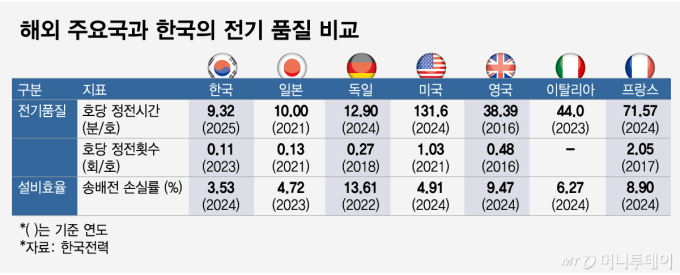
According to KEPCO on the 2nd, South Korea's average annual power outage time per household last year was 9.32 minutes. This is one-fourteenth of the more than two hours (131.6 minutes, based on 2024) that U.S. households experience annually. It is overwhelmingly shorter than France (71.57 minutes) and Italy (44 minutes). The number of outages also stands at just 0.11 per year. The power loss rate is 3.53%, one-fourth the level of major countries such as Germany.
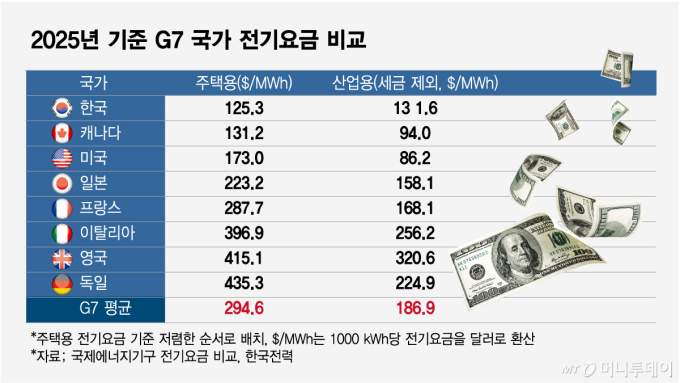
Electricity rates are also low. As of the end of 2025, South Korea's residential electricity rate was $125 per megawatt-hour (MWh), and the industrial rate was $132. This is more than half the price compared to major OECD countries, where residential rates range from $300 to $400 and industrial rates from $200 to $300.
Based on this power competitiveness, the government has moved to attract AIDCs. Through the three mega-projects (semiconductors, AIDCs, and physical AI) announced in June, it plans to secure 18.4 gigawatts (GW) of AIDC capacity by 2035 through public-private cooperation and leap forward as a production base for 'tokens,' the currency of the AI era. The plan also includes building AIDCs domestically that are needed by overseas AI companies.
U.S. big tech companies have overwhelming demand for establishing AIDCs, but building them within their own country is difficult due to aging infrastructure and opposition from local residents. It is known that 70% of the U.S. power infrastructure is more than 25 years old, with over 25% exceeding 50 years. Consequently, moves are being observed to build AIDCs in Asia, where power supply is stable.
The International Energy Agency (IEA) emphasized in its electricity report published this year that global investment in power grids must increase from $400 billion (approximately 529 trillion won) last year to $700 billion annually (approximately 927 trillion won) by 2030. This is because AIDC power consumption is projected to nearly double from 485 terawatt-hours (TWh) in 2025 to 950 TWh in 2030, while global total power consumption is expected to rise from 28,200 TWh to 33,600 TWh over the same period.
The government has also stepped up investment in power equipment. With the addition of large-scale semiconductor production bases and AIDC construction plans through the June mega-projects, adjustments to the power supply-demand plan have become unavoidable. Among these, it is focusing on expanding renewable energy such as solar and wind power.
Experts advise that, along with expanding power generation capacity, increasing investment in transmission grids and small modular reactors (SMRs) is crucial to resolving bottlenecks. Professor Choi Kyung-jin of Gachon University stated, "Exporting AIDCs requires a significant expansion of power supply, and it is important to stabilize the supply chain so that electricity can be used efficiently." He added, "Since we build data centers in less populated areas to avoid local opposition, we need to expand transmission grids to ensure smooth power usage, as well as allow direct power purchase agreements (PPAs) and SMRs."
[Production Support: Ministry of Culture, Sports and Tourism Citizen-Centered Communication Activation Project]

 in TECH

