

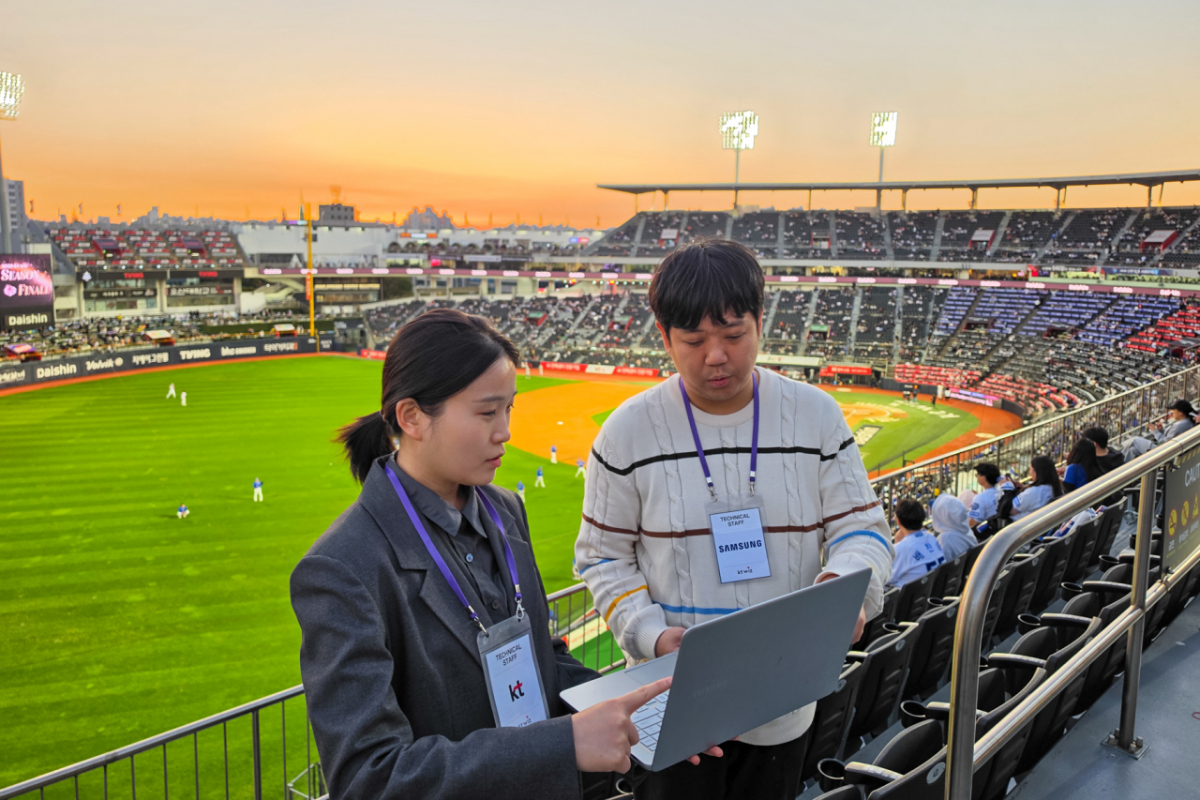
KT and Samsung Electronics have verified a technology that uses artificial intelligence (AI) to automatically distribute data traffic across mobile communication base stations. The companies succeeded in reducing the load on specific base stations by distributing the communication traffic concentrated in the stadium to surrounding base stations.
KT said Monday that, as a result of demonstrating an autonomous wireless network operation technology based on the digital twin platform "AI Cell Twin" at Suwon KT Wiz Park with Samsung Electronics, traffic imbalance between base stations improved by up to 34%, and the load on specific base stations decreased by up to 16%.
AI Cell Twin is KT's network digital twin platform that implements an actual wireless network in a virtual space. It reproduces user distribution, data usage patterns, and traffic changes in a virtual environment, allowing for trials of various communication network operation strategies.
The autonomous wireless network operation technology jointly developed by the two companies works by having AI derive the optimal network operation strategy in a virtual environment, verifying it in advance, and then applying it to the actual communication network.
While existing automation technologies operated based on pre-set criteria or individual metrics, this technology comprehensively considers user distribution, network status, and perceived quality. It also differs in that it can predict operation results in a virtual environment before applying them to the actual communication network.
The two companies conducted the demonstration at KT Wiz Park for approximately three months starting from July. Based on wireless network data collected at the stadium, they built a virtual communication environment and trained the AI.
A baseball stadium is a place where crowds gather all at once, and data usage fluctuates rapidly due to entry and exit before and after games, video viewing, and sharing of photos and videos. If traffic concentrates in specific areas, communication quality may degrade, making it suitable for verifying network operation technologies.
After completing the AI training, the two companies applied the technology during home games at KT Wiz Park. As a result, traffic that had been concentrated on specific base stations was distributed to surrounding base stations.
The companies explained that the results predicted in the virtual environment matched the actual wireless network observation data to a high degree. They also plan to continue the demonstration during fall baseball games and expand the scope of application to various environments beyond baseball stadiums.
Lee Jong-sik, head of the Future Network Lab at KT's Network Division, said, "Through this demonstration, we confirmed the possibility of applying AI Cell Twin-based autonomous operation technology to commercial networks. We will implement an autonomous operation network that proactively responds to changing network environments."

 in TECH
