

[For more diverse company information on startups mentioned in this article, please visit 'Data Lab' on the Unicorn Factory Big Data Platform.]
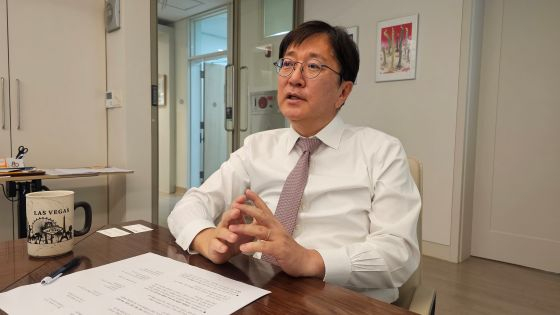
"We will expand intersections with other disciplines, such as space biotechnology and space agriculture."
Kim Young-oh, Dean of the College of Engineering at Seoul National University, explained the background for establishing the 'Space Convergence Technology Building' being pursued with a budget of 50 billion won in this manner.
As artificial intelligence (AI) and the semiconductor industry have grown rapidly, interest in engineering has reached its highest level ever. Recently, a new term called "medical-dental-traditional-medicine-pharmacy-veterinary-semiconductor" (의치한약수반), which groups medical schools, dental schools, traditional medicine schools, pharmacy schools, veterinary schools, and semiconductor contract majors, has emerged. The popularity of semiconductor contract majors, directly linked to employment at major corporations such as Samsung Electronics and SK Hynix, has surged, causing admission cutoffs for some departments to rise to levels comparable to those of medical schools.
Nevertheless, Dean Kim stated that "expecting the concentration on medical schools to ease without a clear shift in science and engineering is a major miscalculation," emphasizing that the College of Engineering must identify new growth areas to lead future industries and create stages for talent to challenge themselves. The next strategic move he highlighted is none other than 'space' and 'entrepreneurship.' We spoke with Dean Kim Young-oh, who has just completed two years in office, about the future strategy envisioned by Seoul National University's College of Engineering.
Space: A New 'Convergence Stage'
Dean Kim Young-oh, who has just completed two years in office, is positioning space as a convergence stage connecting all departments within the College of Engineering. He stated, "Space is not limited to the Department of Aerospace Engineering," adding, "We approach it with the idea of re-experiencing on Earth what we do in space." According to him, nearly every engineering field—from satellites and propulsion systems to space data centers, space semiconductors, and space construction—is connected to space.
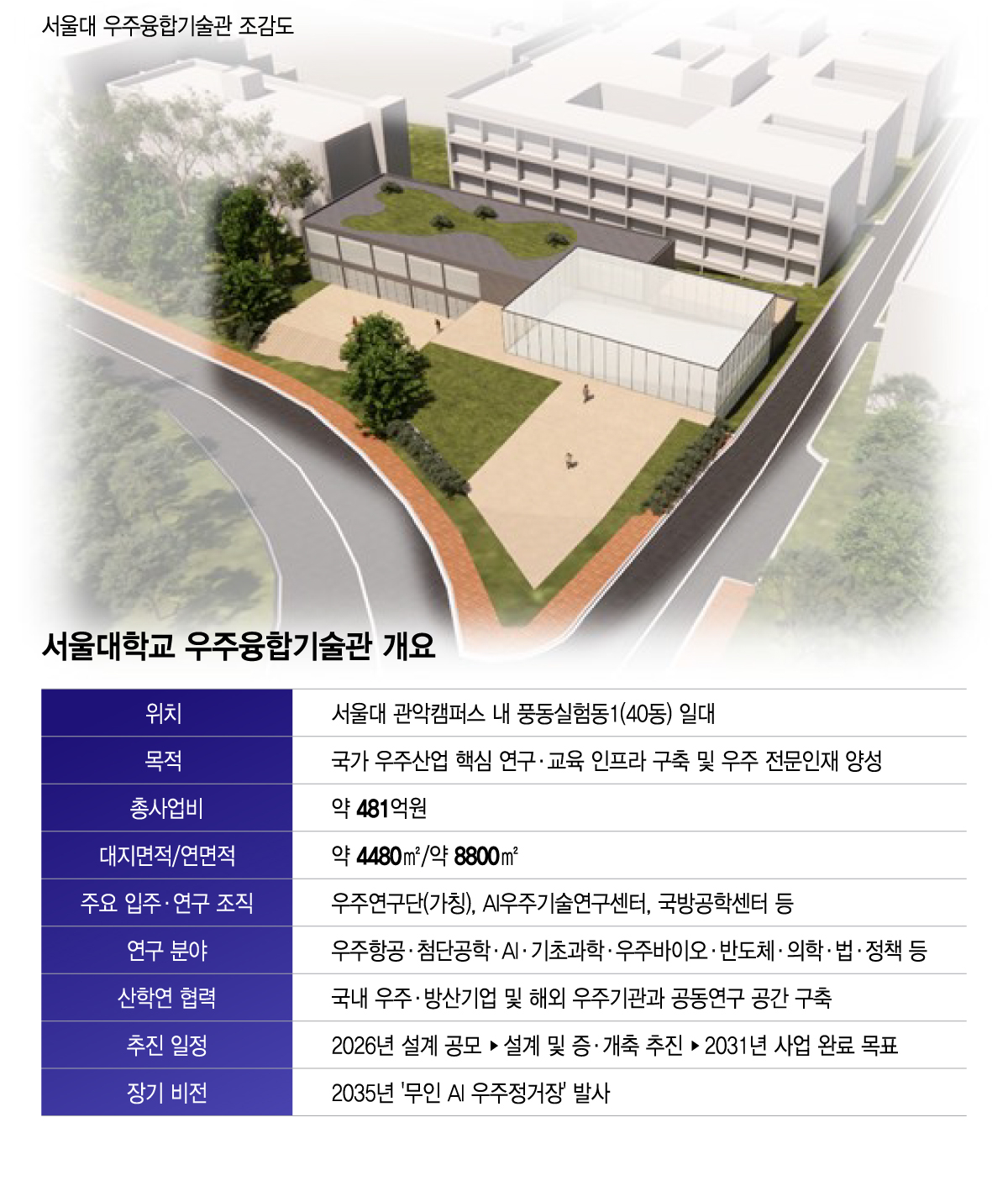
Seoul National University is currently pursuing the construction of the 'Space Convergence Technology Building' with a budget of 50 billion won. The project includes 10 billion won in private investment and 40 billion won supported by the Ministry of Education, with design work beginning this year and completion targeted for 2028–2029. There is also anticipation that Seoul National University will contribute to various R&D (research and development) initiatives promoted by the Space Administration Korea, such as satellite re-entry technology.
The connection with the defense industry cannot be overlooked. Shortly after taking office, Dean Kim asked Professor Je An-ha-myeo (Prof.) from the Defense Engineering Center about their interest in participating, and reportedly 97 out of 340 full-time professors expressed interest. Dean Kim remarked, "Even if we have an average of five graduate students per professor among 100 faculty members, that would amount to 500 researchers; with ten each, it would reach 1,000." He added, "Over the past two years, I have met many military officials and defense industry executives." Recently, private funds have also begun flowing in, such as LIG Nex1, a major domestic defense company, committing to invest 5 billion won. Dean Kim stated, "Defense and space are inseparable fields," and added, "If Seoul National University's College of Engineering establishes a strong foothold in this area, its global standing will rise by another level."
"Unconventional talent changes the world"… Bold talent development project
What Dean Kim has particularly focused on is 'creating new talent.' He mentioned being shocked after witnessing the emergence of China's AI startup DeepSeek. Dean Kim said, "Just as companies like DeepSeek were born thanks to China's 'Thousand Talents Plan,' a talent development program implemented by the Chinese government since 2008, we must reflect on our own approach and nurture geniuses in ways that drive industrial innovation."
Thus began the 'Innovative Talent That Changes the World' project. The plan selects 40 undergraduate students from second to fourth year, matches them with mentors Joo Go (Prof.), and provides an additional 10 million won to support joint research and entrepreneurship. Applications require only two pages and two questions: "Have you attempted anything that could change the world?" and "Do you have experience being deeply immersed in engineering?"
Students selected after overcoming competition of approximately three to one are directly challenging advanced research or entrepreneurship while participating in special lectures and workshops. This program has received support from the Ministry of Education starting this year, with the ministry allocating 8.5 billion won (85 billion won total) across ten universities nationwide at 8.5 billion won per institution.
The third-year entrepreneurship program goes beyond theory to focus on hands-on experience. It was modeled after Stanford University's 'Mayfield Fellowship,' which helps students grow into entrepreneurs by experiencing internships and mentorship in real startup environments. In this process, students take specialized lectures from professors in fields such as energy, batteries, and AI during the first semester, then travel to Silicon Valley in July to interact with alumni entrepreneurs. Dean Kim announced that for the second semester of this year, four successful alumni entrepreneurs will join venture capitalists on stage to guide students primarily through practical training.
"Winner of Robot Competition Surprised Even Jensen Huang, a Medical School Graduate"
During the conversation, Dean Kim shared an anecdote about NVIDIA CEO Jensen Huang's recent visit to Seoul National University, emphasizing the potential for cultivating diverse talent through 'open education' that breaks down disciplinary boundaries.
According to Dean Kim, CEO Jensen Huang was deeply impressed upon hearing that a student who transferred from medical school to engineering had won an on-campus robot competition. Dean Kim stated, "Opening pathways for students to learn across both engineering and medical schools seems to have acted as a catalyst for developing new capabilities." He further emphasized, "When engineering and medical students take each other's courses, it can lead to new innovations in fields such as medical devices."
He also added, "If students begin interacting with peers from different majors at ages 18 or 19, they will naturally develop the ability to understand and collaborate across different fields even after entering society. This capability will become Seoul National University's true competitive advantage."
Dean Kim remarked, "The current period, where space, defense industry, robotics, and AI are intertwined, is a unique era that South Korea has never experienced before," and added, "We must not miss this trend of convergence. With the belief that opportunities come to those who are prepared, I will continue to create new paths during my remaining term."
[MoneyToday startup media platform Unicorn Factory]

 in TECH

