

SK Telecom has unveiled its next-generation AI (artificial intelligence) foundation model, 'A.X K2,' developed independently, and is launching an initiative to expand AI transformation (AX) across industries including manufacturing, defense, and biotechnology. The company aims to significantly enhance inference capabilities compared to existing models and further develop trillion-parameter-scale models in the future to strengthen its global AI competitiveness.
On the 29th, SK Telecom announced that it has released 'A.X K2,' a model with 688 billion (688B) parameters, on the global open-source platform Hugging Face. By increasing the model size from last year's 519 billion (519B) 'A.X K1,' the company has strengthened capabilities in mathematical and scientific reasoning, Korean language knowledge, and long-form text comprehension.
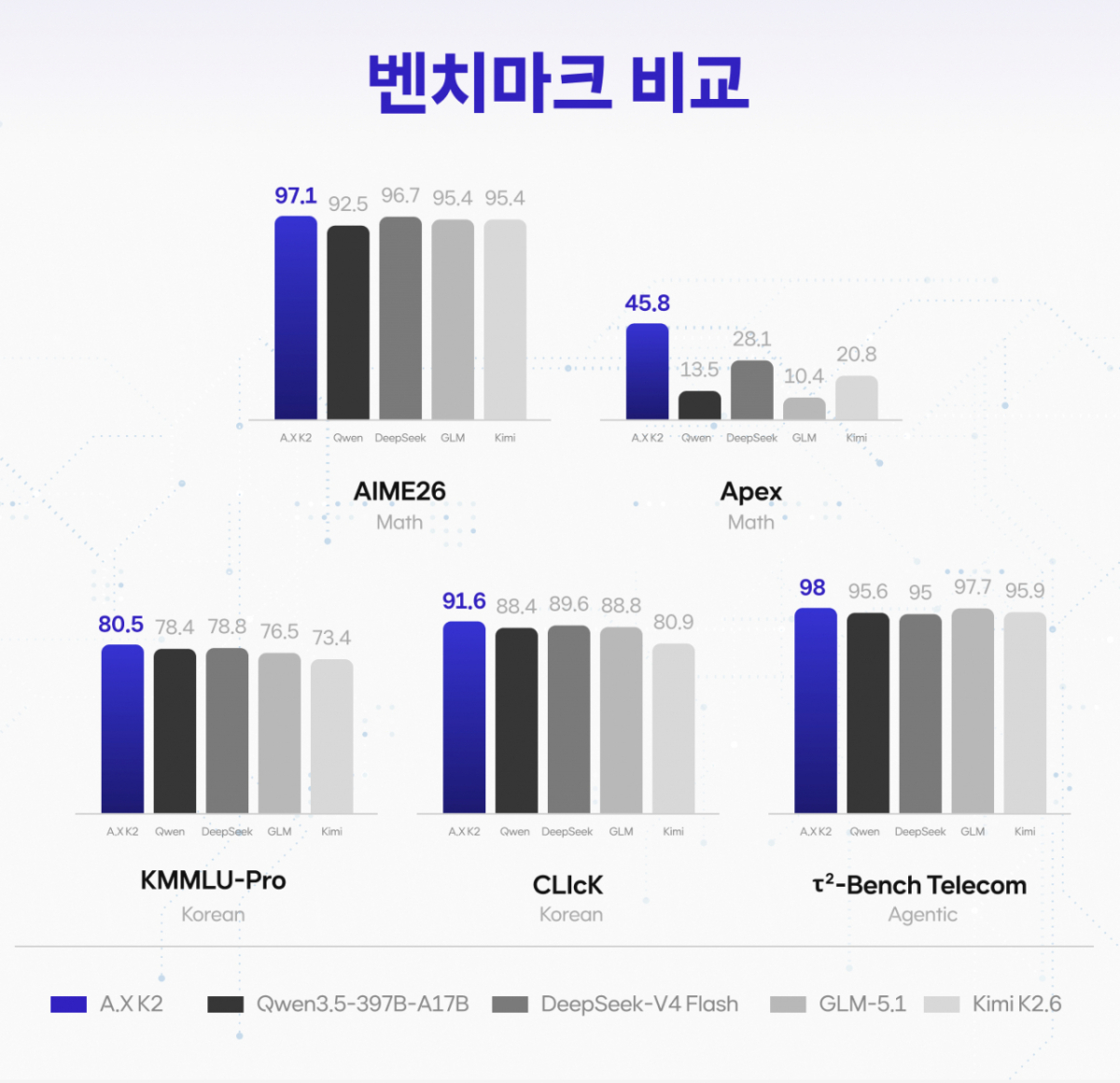
The average performance of A.X K2 across 14 domestic and international AI benchmarks improved by 32.2 percentage points compared to A.X K1. Notably, evaluations related to long-form text understanding and AI agents showed an improvement of 83.9 percentage points. SK Telecom explained that it applied its proprietary 'SGA (Sparse Gated Attention)' architecture to selectively process only necessary information even in long contexts, thereby enhancing both accuracy and efficiency.
The company stated that A.X K2 achieves performance levels comparable to recently released global AI models such as Qwen3.5-397B-A17B, DeepSeek V4-Flash, GLM-5.1, and Kimi K2.6.
SK Telecom plans to apply A.X K2 across various industrial sectors including manufacturing, defense, and biotechnology. In the manufacturing sector, it is developing a manufacturing-specific AI agent in collaboration with KG Steel and Conex, which will begin demonstration operations at the Dangjin plant starting in the second half of this year.
In the defense sector, SK Telecom has developed three quantized models based on A.X K1 in cooperation with the Ministry of National Defense, which are scheduled to be utilized by the Army, Navy, Air Force, and Marine Corps. In the biotechnology sector, it applied AI in collaboration with SK Bioscience to develop targeted therapies for intractable cancers, reducing the initial drug development research period from 1–2 years to approximately five months.
The enterprise AI service 'A. Biz' provides functions such as newsletter writing, data analysis, and report generation. Additionally, lightweight models have been applied to SK Hynix's internal AI services, A. Phone, and A. Note.
SK Telecom plans to expand its follow-up models to trillion-parameter scales to strengthen global AI competitiveness. Alongside this, it has also released derivative models including the vision-language (VL) model 'A.X K2 VL Light-Preview,' which understands both images and text; the speech recognition and understanding model 'A.X K2 ALM'; and the speech model 'A.X K2 Raon-Speech.' The company intends to expand applications across diverse fields such as document analysis, industrial sites, customer service centers, and gaming.
Kim Tae-yoon, in charge of foundation models at SK Telecom, stated, "A.X K2 has been advanced for broad application ranging from individual daily life to office environments and manufacturing sites," adding, "Going forward, we will continue to apply it across various industries to contribute to strengthening the nation's AI competitiveness."

 in TECH
