

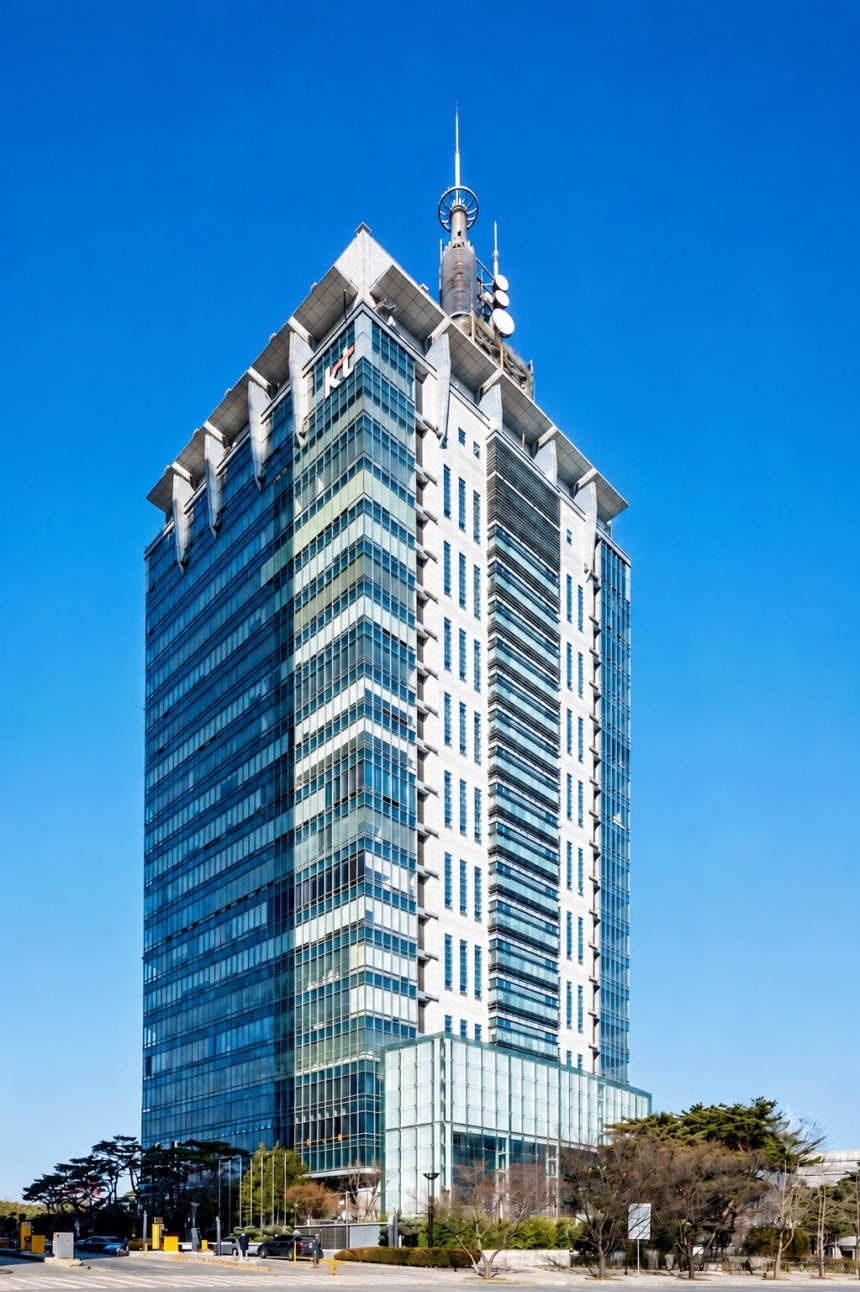
A Hanbok-style data center in Seoul's Yeouido district, adjacent to the Korea Exchange, is expanding its footprint. Given the high land prices and difficulty securing power in this area, KT Cloud has decided to add two more floors to its Yeouido data center. The target completion date is June 2027.
The primary customers of this center are securities firms. Several major securities companies have already placed their core systems here. The reason is distance. Stock orders must be executed within a fraction of a second—specifically, within one-thousandth of a second—and the shorter the distance data travels, the faster the processing becomes. In the United States, there were even ultra-short-term trading firms that profited from this split-second time gap.
This is why locations next to exchanges are considered prime real estate for data centers. While data center companies rush toward massive facilities in suburban areas, the value of urban data centers is soaring vertically.
It is reported that land costs account for 30% to 40% of data center investment costs. For projects in the trillions of won, thousands of billions of won go directly to land acquisition first. However, in urban areas where large-scale power can be secured, finding available sites remains difficult despite having funds.
This is why assets held by telecommunications companies are attracting attention. Old telephone office buildings and communication stations remaining in prime locations across the country, especially in Seoul, were once hubs for telephone lines and optical cables, meaning they already possess buildings, power infrastructure, and communication networks. As communication equipment has become smaller and operations more automated, vacant spaces have emerged within these buildings. A telecommunications industry official stated, "There are still branch-level spaces in Seoul where servers can be installed," adding, "Existing facilities can be repurposed without purchasing new land or constructing new buildings." In fact, KT has announced plans to transform over 3,500 communication stations nationwide into hubs for processing AI computations close to users.
The farther electricity is transmitted, the greater the loss along the way. Even if 100 units are sent from a power plant, the receiving end may not receive all of them. Utilizing existing urban power grids reduces such losses. A shorter transmission distance becomes a competitive advantage for data centers.
Not just any telephone office will suffice. The "diet" of AI servers has changed completely compared to the past. In the past 20 years, a single refrigerator-sized cabinet (rack) housing stacked servers consumed around 5 to 10 kilowatts (kW). Latest AI equipment uses 120 kW per cabinet, and next-generation products expected to launch within the year are projected to reach 600 kW. This represents a tens-of-times increase in less than a decade. Some describe it as "fitting enough electricity for an entire neighborhood into a space the size of a public phone booth."
The more electricity is consumed, the more heat is generated. Air cooling becomes insufficient, requiring water-based cooling systems, and floors must be reinforced to support heavier equipment. In practice, telecommunications companies are not replacing all facilities at once but are installing water-cooling systems in centers that meet the necessary conditions. Among old telephone offices, those with power reserves and suitable construction conditions are gaining attention.
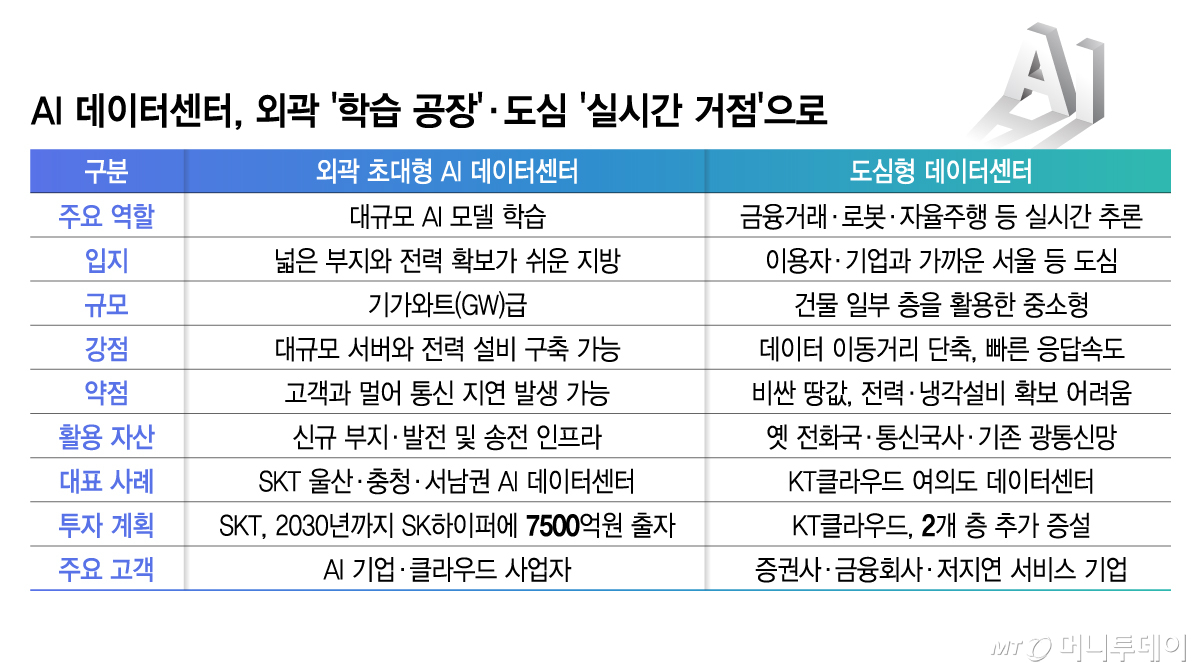
Of course, large-scale investments in suburban areas will continue. SK Telecom established a specialized AI data center subsidiary named "SK Hyper" on the 23rd and committed to contributing 750 billion won by 2030. Starting with Ulsan, the company plans to build large-scale centers in the Chungcheong and southwestern regions, with the goal of expanding capacity up to 15 gigawatts (GW) by 2035 depending on market conditions. Such facilities operate at gigawatt levels; one GW is equivalent to the power generated by a single nuclear reactor.
The roles of AI infrastructure are diverging. Massive suburban centers using nuclear-level power serve as "factories" for training AI, while smaller urban hubs handle services requiring immediate responses, such as financial transactions and robotics or autonomous driving.
An industry official stated, "The success or failure of the AI data center business does not depend solely on securing new land and power," adding, "How quickly existing urban hubs and communication networks can be converted into AI infrastructure is also crucial."

 in TECH

