

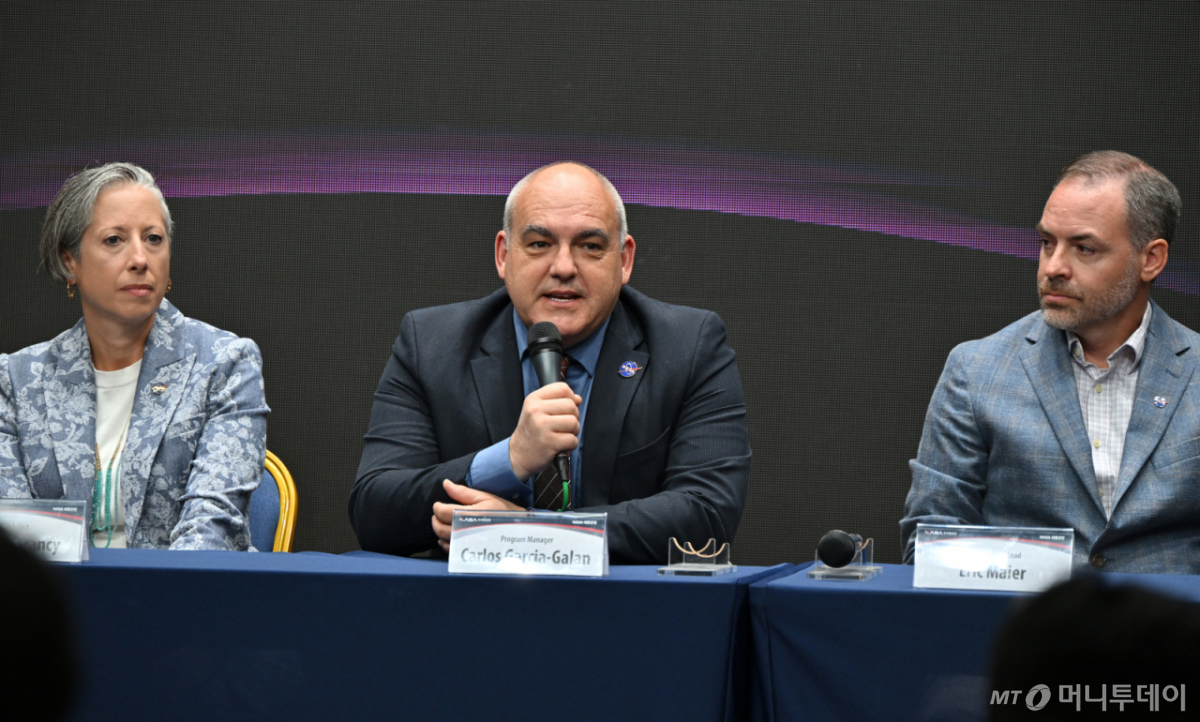
NASA, which has selected the Moon as a forward base for Mars exploration, has requested South Korea’s cooperation in building an international Moon base in the 2030s. A team led by Carlos Garcia Galan, head of NASA’s Moon Base Construction Project, visited South Korea to discuss cooperation plans in space exploration, including Moon base construction.
At a press conference held on the 29th at the Korea Science Center in Yeoksam-dong, Gangnam-gu, Seoul, Head Galan stated, "South Korea not only has interest and capability in building a Moon base but also possesses industrial strength," adding, "We want South Korea to participate in NASA’s Moon base construction." Areas of cooperation mentioned include lunar landers, lunar communications, surface mobility systems for cargo transport, and lunar resource sampling technologies.
Nujud Meranci, Chief Technology Officer (Senior Architect) of the Moon Base Construction Program, said, "We have analyzed and investigated South Korea's capabilities to identify areas where we can cooperate." She added, "South Korea has strengths in communications and robotics, including its experience with the lunar orbiter 'Danuri,' and we will discuss these in more detail during this visit." Danuri is an unmanned lunar exploration spacecraft launched by the Korea Aerospace Research Institute in 2022.

Special emphasis was placed on robotics capabilities considering human usability. Head Galan stated, "Construction of the Moon base begins with exploration of the lunar south pole, and this is a phase to confirm whether humans can move stably on the lunar surface." He further mentioned, "We will discuss cooperation while keeping in mind sophisticated robotics that can be used by humans at an actual operational level."
He continued, "Building a Moon base is like constructing a new city," adding, "Since we are challenging the impossible, we want to join hands with reliable allied nations." However, he added, "It is too early to mention specific cooperating companies or institutional investors."
The United States has resumed human lunar exploration half a century after the Apollo program of the 1970s. Unlike the Apollo program, which focused on one-time landings and explorations by humans, the Artemis program aims for long-term human habitation on the Moon. The ultimate destination is Mars. The Moon serves as a forward base to mine resources needed for Mars exploration and habitation and to build communication networks.
The target location is the lunar south pole. This region is permanently shadowed, receiving no sunlight. Due to the lack of light, it is expected that layers of water ice, undisturbed for billions of years, exist at the bottom of craters. Water is an essential element for human survival. It can supply drinking water and oxygen and also serve as fuel. This is why a habitation base is planned for the lunar south pole.
The problem is that there is insufficient data to understand the actual environment of the lunar south pole. Therefore, the Moon base construction plan consists of three phases. Phase 1 involves sending unmanned rovers and resource exploration equipment to the lunar surface by 2029 to survey resources. Phase 2, scheduled from 2029 to 2032, will establish initial infrastructure such as communications and power systems to enable human habitation and secure related operational capabilities. Finally, starting after 2032, the project will enter a full-scale "quasi-permanent" stay phase, where astronauts will reside on the Moon on a regular basis.
Head Galan stated that cooperation areas with South Korea could be finalized within three months from now. NASA officials will remain in South Korea until the 31st to conduct an Artemis workshop with the Space Agency.


 in TECH


