

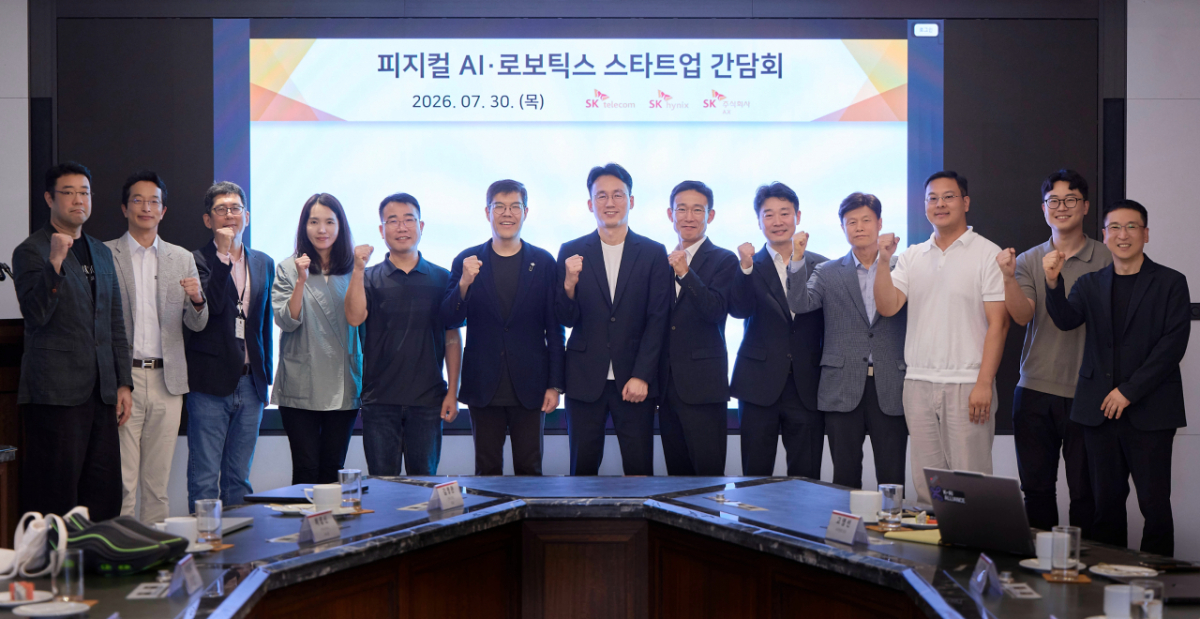
SK Telecom announced on the 31st that it is expanding collaborations with eight physical AI startups to strengthen its robotics ecosystem.
On the 30th, SKT held a 'Physical AI and Robotics Startup Meeting' at its Seorin Office in Jongno-gu, where it shared industry trends in robotics technology that enables robots to perceive the real world and make independent judgments and actions—known as 'physical AI'—and discussed opportunities for business cooperation.
The event was attended by senior executives from SKT, the SK Group AI Committee, SK Hynix, SK AX, and other SK member companies, along with CEOs of eight leading domestic startups in the physical AI and robotics sectors. The participating companies include Gauss Labs, RealWorld, MakinaRocks, C-Meso Robotics, Wirobotics, Yurobotics, Config Intelligence, and Holiday Robotics.
The eight participating companies possess diverse robotics technologies and solution capabilities covering all areas of physical AI, including humanoid robots, wearable robots, industrial collaborative robots, RFM Robot Foundation Models, and AI models supporting robots.
The meeting began with SKT's presentation on its direction for advancing physical AI initiatives, followed by introductions to the core technologies, current business status, and collaboration proposals from the eight participating startups, concluding with a roundtable discussion.
Attendees focused their discussions on joint validation plans in industrial settings such as manufacturing, logistics, and services. They also exchanged views on collaborative approaches combining SK Group's capabilities in AI semiconductors, AI data centers, digital twins, and AI models with the physical AI technologies of startups.
In particular, SKT discussed with participating companies strategies for building robot learning datasets for RFM development within a digitally twin space that virtually replicates industrial environments. Given that data acquisition and validation environment construction are key challenges in the physical AI field, SKT expects this collaborative discussion to accelerate the transition of research-stage technologies into real-world applications and commercialization.
Moving forward, SKT plans to foster an open ecosystem by continuously promoting collaboration across all areas of physical AI—including robot hardware, data, and models—through ongoing exchanges.
Yoo Kyung-sang, Head of SKT's AI CIC, stated, "In the physical AI industry, meaningful innovation becomes possible only when a full-stack AI ecosystem—from semiconductors to robot foundation models and applied services—is organically connected." He added, "We will continue to expand partnerships with domestic physical AI startups to drive the development of the robotics ecosystem."

 in TECH
