

The legacy family bundle products offered by the three major telecom operators, which provided unprecedented discounts to long-term users, are disappearing into history. This policy reflects market changes such as the rise in one- and two-person households and an increase in new subscribers following the hacking incidents involving the three telecom companies. Some analysts also suggest this move is aimed at securing funds for AI investment.
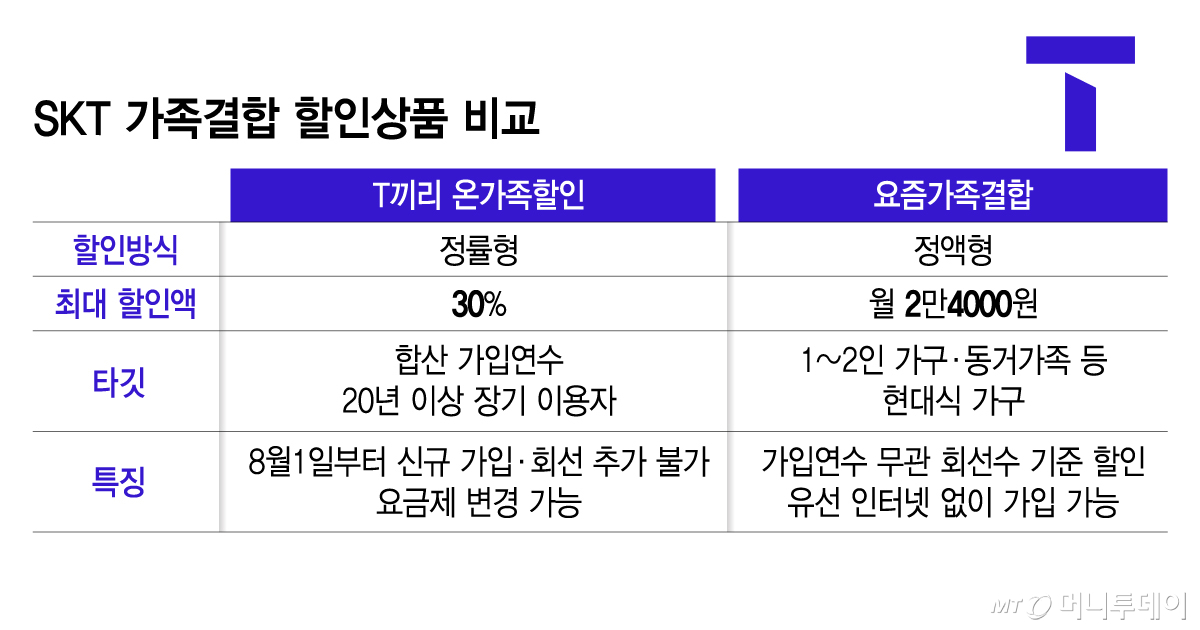
According to SK Telecom on the 2nd, new subscriptions and line additions for the family bundle product "T Family Discount" ended on August 1. Existing subscribers can maintain their benefits even if they change their plan, but they cannot add spouses or children. In cases where members leave due to reasons such as the death of a long-term user, the discount rate may decrease.
The "Family Discount" is a "proportional discount product" in which the discount rate is determined by the total number of years of mobile and wired internet subscriptions among family members. For 5G/LTE plans, if the combined subscription duration is 20–30 years, a 10% monthly discount is applied; for 30 years or more, a 30% discount is granted. When combined with an additional 25% discount from a selected contract option, the total discount rate can reach up to 55%. Up to five lines can be bundled together.
SKT has reformed its "Modern Family Discount" product—a "fixed-amount discount product"—to allow usage without requiring wired internet subscriptions as an alternative. The plan offers discounts of △6,000 won for two lines, △15,000 won for three lines, △20,000 won for four lines, and △24,000 won for five lines per month. The discount amount is divided by the number of bundled lines and applied to each line individually. Its key feature is that the discount amount is determined solely by the number of bundled lines, regardless of subscription duration.
Dissatisfaction has arisen among consumers who feel their benefits have diminished. On internet communities, reactions include statements such as "We chose SKT out of consideration for our parents and children even though it was more expensive than MVNOs, but now that advantage is gone," and "We will live as 'locust families,' switching telecom providers based on the benefits offered."
SKT explained that the reform aligns with demographic shifts toward an increase in one- and two-person households. While the legacy Family Discount required wired internet lines, the Modern Family Discount allows enrollment with just two mobile phone lines. The company also considered the rise in new subscribers who switched from other telecom providers following last year's hacking incidents involving the three major operators.
The reform of bundle products is not limited to SKT. KT halted new line additions for its "Customized Bundle" product earlier this month. Although it was a legacy product that had already stopped accepting new subscriptions in 2010, existing subscribers are also now barred from adding family members. LG Uplus has excluded certain low-cost plans from eligibility for bundle discounts.
Industry experts explained that this is an inevitable choice amid market saturation and declining ARPU (average revenue per user). Even if costs rise, it is better to provide benefits to a larger number of general users rather than a small group of long-term users. An industry insider stated, "Users who receive the maximum bundle discounts are also heavy users of partner benefits such as movies and restaurants—they belong to the 'high-involvement' segment with particularly low profit margins."
Some analysts suggest that the three major telecom operators, which have identified AI as a future growth engine, are taking steps to secure investment capacity. SKT is leading SK Group's 15GW-scale AI data center (DC) construction project. SK Group plans to invest approximately 1,000 trillion won, including strategic investments and project financing. KT aims to transform into an "AI Transformation (AX) Platform Company" by investing 18 trillion won over the next five years, with 5 trillion won allocated specifically for expanding 1GW-class AI data centers. LG Uplus also recently announced plans to add approximately 1.3 trillion won in investment to the second phase of construction of the largest AI data center in the Seoul metropolitan area currently under development in Paju.

 in TECH
