

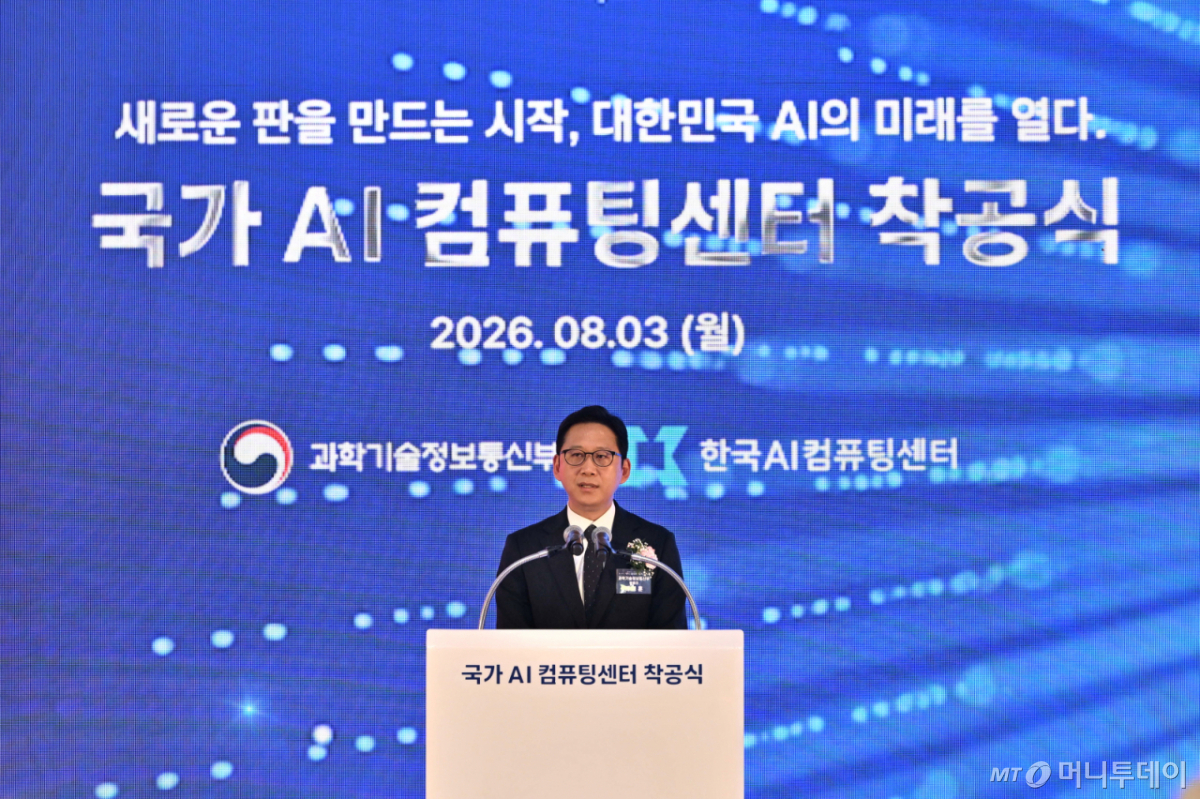
"Today is a historic day marking the beginning of South Korea's AI revolution."
Bae Kyung-hoon, Vice Minister of Economy and Finance and Minister of Science and ICT, stated at the groundbreaking ceremony for the National AI (Artificial Intelligence) Computing Center held at the Datacenter Park in Solarisido, Haenam-gun, Gwangju Metropolitan City, Jeollanam-do on the 3rd, saying, "South Korea will grow from a nation that utilizes AI and supplies memory semiconductors into a core country of the AI supply chain."
Government officials, National Assembly members, local government representatives, and industry leaders gathered at the groundbreaking ceremony held under scorching heat exceeding 36 degrees. On an outdoor stage next to a temporary event venue set up in the middle of the vast site, attendees broke ground for the National AI Computing Center. By 2028, core infrastructure for South Korea's AI industry will be built on this currently empty lot.
Attendees at the groundbreaking ceremony included Vice Minister Bae, along with National Assembly members Park Ji-won, Han Jun-ho, and An Do-gyeol; Jeollanam-do Governor Min Hyung-bae; Min Hyeong-bae, President of Korea AI Computing Center (KOACC); Lee Jun-hee, CEO of Samsung SDS; and Kim Yu-won, CEO of Naver Cloud. Key figures from the government, National Assembly, local governments, and industry were present.
The National AI Computing Center is core infrastructure for the government's "AI Highway" initiative. It will provide the latest AI computing resources to academia, industry, and research institutions to support the development of super-large-scale AI models and verify domestic AI semiconductors in actual service environments.
The project was awarded to a Samsung SDS consortium following a public recruitment last year. The consortium includes Samsung SDS, Naver Cloud, Samsung C&T, Kakao, Samsung Electronics, and KT. KOACC, established by the government in June, will be responsible for construction and operations.
Lee Jun-hee, CEO of Samsung SDS, stated, "The National AI Computing Center is not merely a facility but a collaborative model where the government and private sector jointly enhance South Korea's AI competitiveness." He added, "We aim to build top-tier AI infrastructure, maximize synergies through public-private cooperation, and create a hub in Haenam that attracts AI industry ecosystems and talent."
The center will be constructed with an investment of 2.4 trillion won within Solarisido Enterprise City, Gusung-ri, Sanim-myeon, Haenam-gun. By 2028, the facility plans to install 15,000 GPUs (graphics processing units) and expand to 50,000 units by 2030 to operate as a national AI computing hub. Starting next year before completion, some AI computing resources will be provided from Samsung SDS data centers to meet the AI computing demands of academia, industry, and research institutions. The government plans to verify domestic AI semiconductors in the R&D (research and development) zone within the center and apply products with confirmed performance to commercial services, thereby activating the domestic AI semiconductor ecosystem.
Vice Minister Bae remarked, "Just two years ago, we were worried about how many GPUs South Korea had, but now global companies are moving into the stage of investing in South Korea's AI infrastructure." He continued, "Now, it is more important not just how many we secure, but how we utilize them to become protagonists of the AI era." He emphasized, "The government will also provide support until the end to ensure the successful construction and operation of the National AI Computing Center."

 in TECH
