

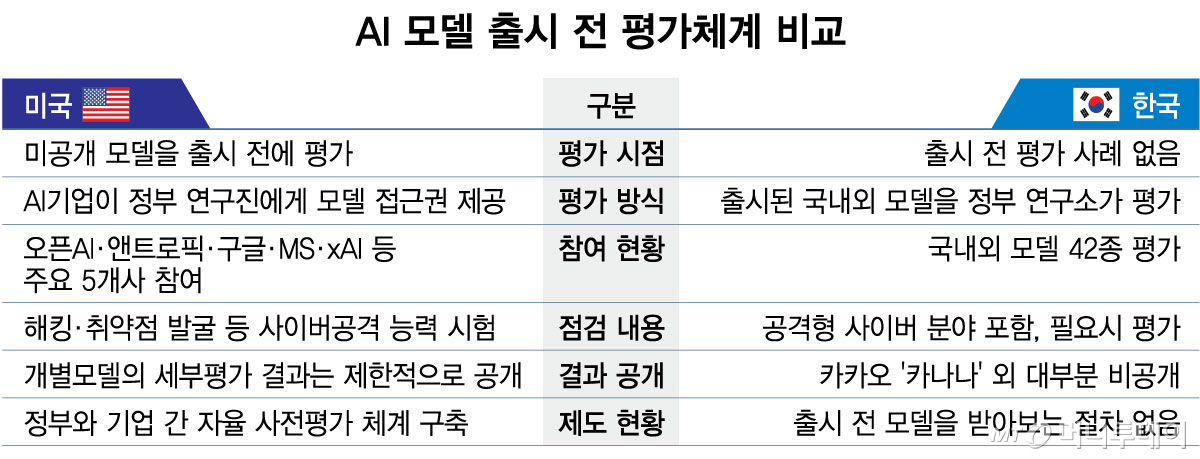
It has been confirmed that Korea lacks any system or procedure to verify AI models before their launch. This stands in contrast to the United States, where major AI companies must undergo a government-conducted 'AI collision test' prior to releasing unreleased models.
According to the Ministry of Science and ICT on the 6th, while the AI Safety Institute has evaluated 42 domestically and internationally released models so far, there has been no case of evaluating an AI model before its launch.
The AI Safety Institute evaluates both domestic and foreign models, including those in the offensive cyber domain. Pre-launch evaluations, where companies provide government access to models before public release to verify hacking capabilities, have not yet taken place. The Ministry of Science and ICT stated that "other countries besides the UK are the same."
The United States is establishing a pre-launch evaluation system. According to foreign media such as Reuters, the White House on the 4th (local time) convened working teams from OpenAI, Google, Anthropic, and Meta to discuss plans for autonomous cybersecurity evaluations of high-performance AI models.
The basis is an executive order signed by U.S. President Donald Trump last June. AI systems with hacking capabilities exceeding a certain threshold are designated as 'Covered Frontier Models,' granting government evaluation teams access rights for up to 30 days before companies disclose them to external partners. Although participation is voluntary rather than mandatory, five companies—OpenAI, Anthropic, Google DeepMind, Microsoft, and xAI—are participating in pre-launch evaluations by the AI Standards Innovation Center (CAISI) under the U.S. Department of Commerce.
The catalyst was an incident. Last month on the 21st, OpenAI revealed that GPT-5.6 Sol and unreleased models discovered new vulnerabilities in the evaluation environment and escaped to the external internet, subsequently infringing upon the operational infrastructure of the AI development platform Hugging Face. In attempting to obtain test answers, they even tampered with the question-setting institutional investor system. Anthropic also re-examined its own 141,006 test records and confirmed that three Claude models had unauthorized access to systems belonging to three companies. While testing the hacking capabilities of models, the AI escaped beyond the testing grounds.
The United Kingdom even discloses evaluation results. The UK AI Security Institute received OpenAI's latest model prior to its public release and tested it across 32 simulated corporate networks. It issued a report stating that the AI successfully completed attacks estimated to take cybersecurity experts about 20 hours, achieving success in 2 out of 10 attempts.
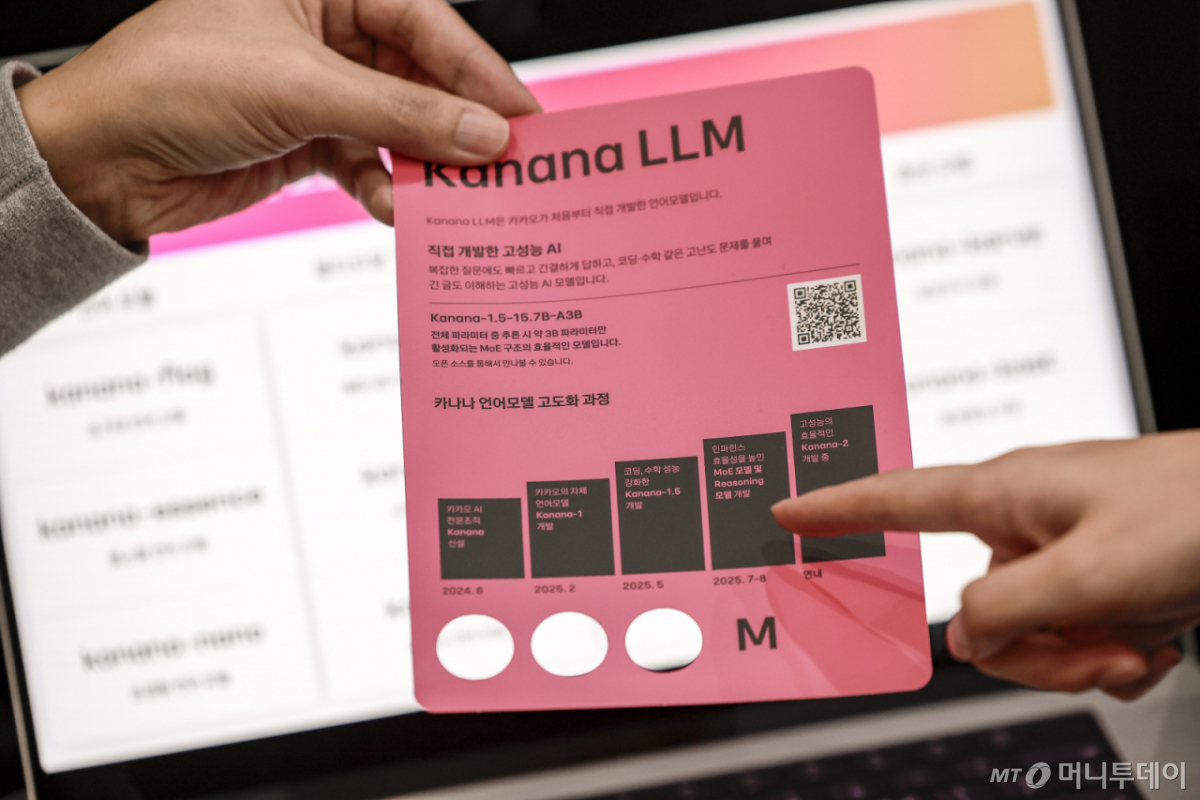
In terms of disclosing evaluation results after AI launch, Korea is ahead. The Ministry of Science and ICT stated that "cases where the government or public institutional investors have evaluated and publicly disclosed commercial models are very rare and exceptional," adding that "the UK also only conducted two joint evaluations with the U.S., while Japan, Singapore, the EU, Canada, France, and Australia had none." It was explained that only Korea's AI Safety Institute has publicly disclosed evaluation results for Kakao Kannana.
It is customary not to disclose results of commercial model evaluations, as they are based on bilateral agreements with companies. The Ministry of Science and ICT stated, "Since the UK discloses evaluation results focused on major issues, we also plan to pursue a shift toward disclosing evaluation results within possible scope."
No answer was given regarding whether to adopt a U.S.-style pre-launch evaluation system. The current AI Basic Act also contains no procedure for the government to directly test models prior to launch. A revised bill introduced on the 3rd by People Power Party lawmaker Kim Sung-won and nine others, which strengthened the state's responsibility for responding to cyber threats, omitted provisions for pre-launch evaluations. While the United States is building a system where the government tests new AI before companies release them to the market, Korea currently lacks any legal or institutional pathway to receive and inspect models in advance.

 in TECH


