

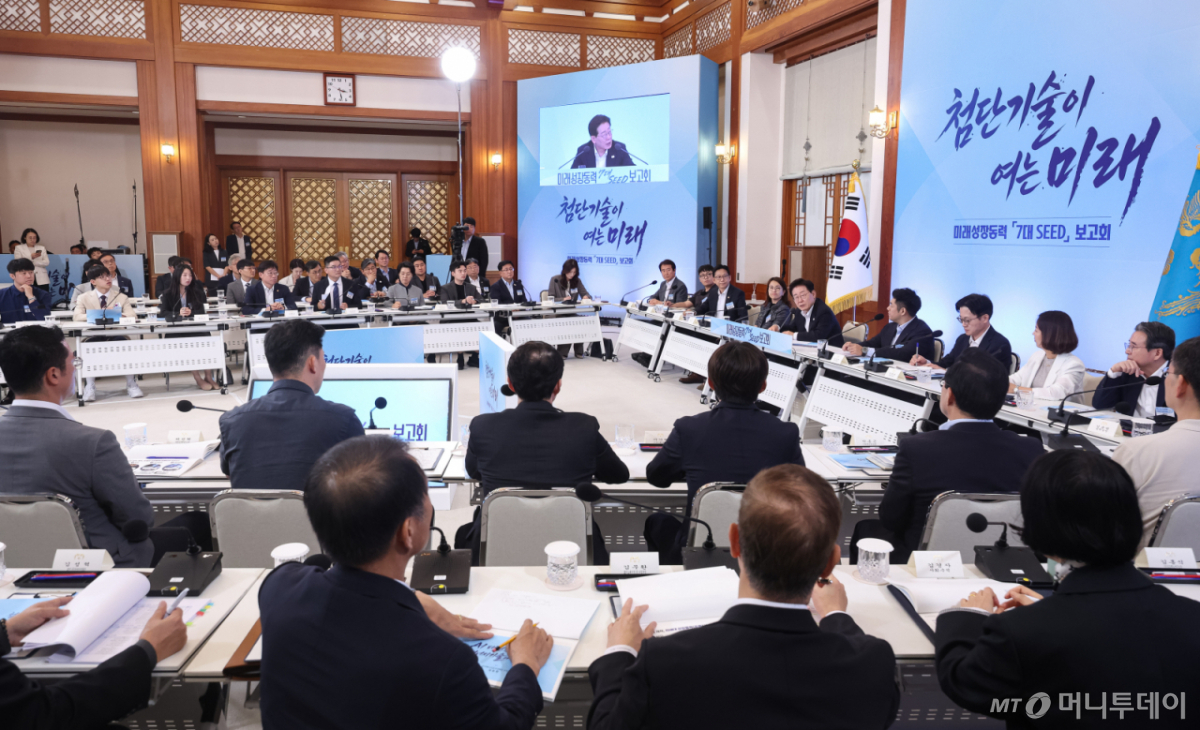
The government's announcement of the 7th Major SEED projects on the 12th is interpreted as the formal start of efforts to secure South Korea's future growth engines. If the three mega projects released in June this year—semiconductors, physical AI (artificial intelligence), and AI DC (data centers)—were a "short-term" prescription to treat South Korea trapped in a low-growth trend, then the current 7 Major SEED projects carry the meaning of a "long-term" structural improvement plan designed to sustain growth after recovering from the low-growth disease.
The 7 Major SEED projects are divided into three major areas: △'Future Clean Energy Seeds', △'Next-Generation Frontier Seeds', and △'Advanced Materials and Minerals Seeds', each containing seven specific tasks tailored to their respective fields.
The government's rationale for selecting the seven seeds is based on the judgment that while focusing current national capabilities on industries such as semiconductors, AI, and data centers can help overcome the immediate low-growth trend, it cannot guarantee growth engines 10 to 20 years from now.
Earlier this year in June, the government announced three mega projects including a massive investment plan of 800 trillion won for the Southwest Semiconductor Cluster. The goal is to group semiconductors, physical AI, and AI data centers into a single industrial ecosystem to alleviate concentration in the capital region and propel South Korea into a powerhouse of AI and advanced manufacturing. This strategy aims to create a first-mover advantage in three major fields where South Korean manufacturing excels, thereby overcoming the low-growth trend that has kept growth rates stuck at around 1%.
The 7 Major SEED projects are interpreted as an initiative to establish a long-term growth strategy following the three mega projects. Vice Prime Minister and Minister of Science and ICT Byung-hoon Baek attended the 'Future Growth Engine 7 Major SEED Report Meeting' chaired by President Lee Jae-myung at the Chungmu Room in Cheong Wa Dae that afternoon, comparing the three mega projects and seven SEED projects to advanced technologies that power Robo-Taekwon V. He emphasized, "The 7 Major SEED projects are a collection of advanced technologies that will allow Taekwon V, which we imagined and dreamed of, to become a complete form beyond reality."
Officials from the Ministry of Science and ICT explained, "In a rapidly changing technological environment, securing only a first-mover advantage in current key industries makes it difficult to guarantee South Korea's sustainable growth. The government aims to plant seeds of advanced technology now and nurture them from a long-term perspective to secure South Korea's next-generation food sources 10 to 20 years from now."
The composition of the 7th Major SEED projects also focuses on laying the groundwork for long-term industrial growth and securing new industry technologies that will lead next-generation growth. First, 'Future Clean Energy Seeds', which contain a power response strategy, are composed of three seeds: △SMR (Small Modular Reactors), △Nuclear Fusion, and △Breakthrough Renewable Energy.
Considering the current situation where power demand is surging due to AI DCs, supplying high-quality electricity stably will be essential to secure future growth engines. Furthermore, in order to respond to international regulations such as carbon reduction and create a sustainable growth environment, a shift from fossil energy to clean energy is necessary. The government presented its goal of commercializing SMR, which has been noted as the next-generation nuclear reactor, while also establishing a stable power foundation through harmony with renewable energies including solar, hydrogen, and wind.
Supply chains for core minerals and advanced materials such as materials, components and equipment (MCE) are also among the fields that determine future growth engines. As seen in previous trade dispute cases such as export restrictions on rare earths and semiconductor materials, it is the consensus of both the government and industry that supply chains in the field of advanced technology have already entered the realm of international security.
According to the government, for South Korea to continue stable production activities in advanced fields including semiconductors and to continuously grow its economy through exports, technologies capable of substituting or reducing advanced industrial materials and rare resources are needed, and a mineral security network must be secured. Minister of Trade, Industry and Energy Jeong-gwan Kim emphasized, "Everyone knows that without the backing of core minerals and materials, components and equipment, even the three mega projects and next-generation key technologies would amount to nothing more than a castle built on sand."
The government stated, "In an era of nationalism-first, advanced supply chain ecosystems have emerged as a core element of national security. While South Korea possesses excellent final product manufacturing capabilities, its supply chain backbone is weak. We must distinguish between △items essential for national survival, △items that cannot be produced domestically, and △items requiring capability enhancement to build a strategic 'advanced supply chain ecosystem'."
Furthermore, the government outlined its plan to secure technologies that break through human limitations on top of foundations such as energy and supply chains, namely 'Next-Generation Frontier' technologies. Specifically, this includes projects such as △Quantum SEED, which aims to develop a domestic 100-qubit-class quantum computer by 2029 and leap to first place in quantum chip manufacturing capabilities by 2035; △Space and Aviation SEED, targeting moon landing by 2030 and the establishment of an independent low-orbit satellite communication network by 2035; and △Advanced Bio SEED, involving the construction of AI-bio infrastructure by 2030 and the commercialization of BCI (Brain-Computer Interface) products by 2035.

 in TECH
