

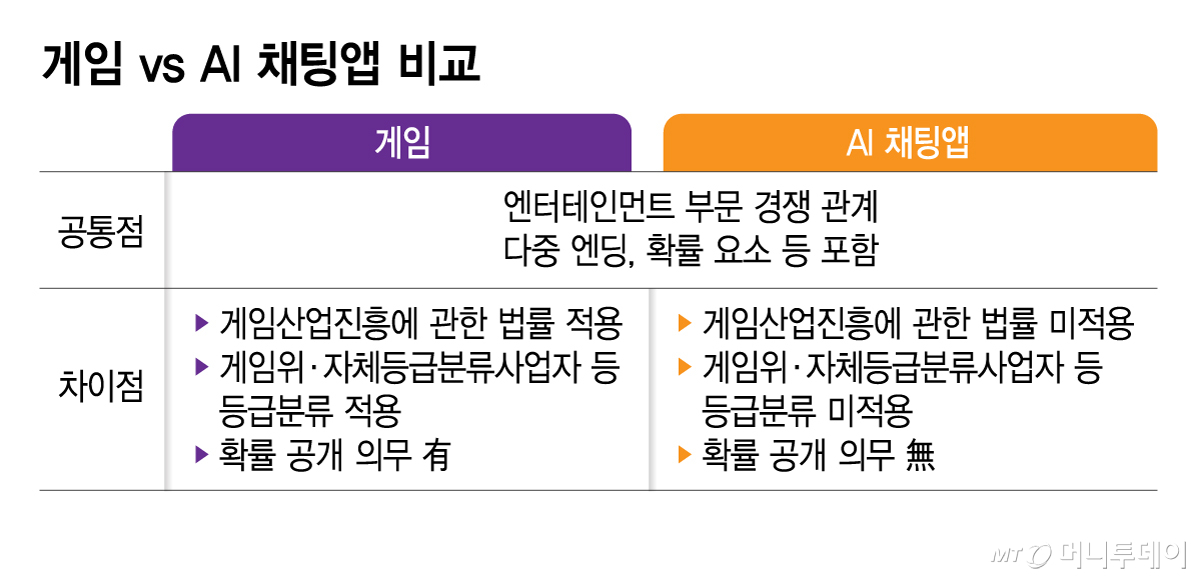
An interpretation has emerged that probabilistic events in AI character chat apps could be classified as 'games.' In severe cases, they may be reviewed to determine if they qualify as 'gambling games.' As AI chat apps increasingly resemble games, the issuance of related guidelines has drawn attention.
On the 13th, the Game Rating and Administration Committee (GRAC) responded to a query from Money Today: "A structure where users participate in events using paid currency and outcomes—including acquisition or loss of currency—are determined by probability is an important factor considered when assessing game characteristics." The committee added, "If such a structure is implemented as content within the service, it is likely to be classified as a 'game' under the Game Industry Promotion Act."
The committee further stated, "When results are determined through random methods and property gains or losses occur based on those results, it is necessary to separately review whether they qualify as 'gambling games.'" However, the GRAC drew a line at simple conversation functions. The committee noted, "It is difficult to classify services that only allow users to converse with AI as games."
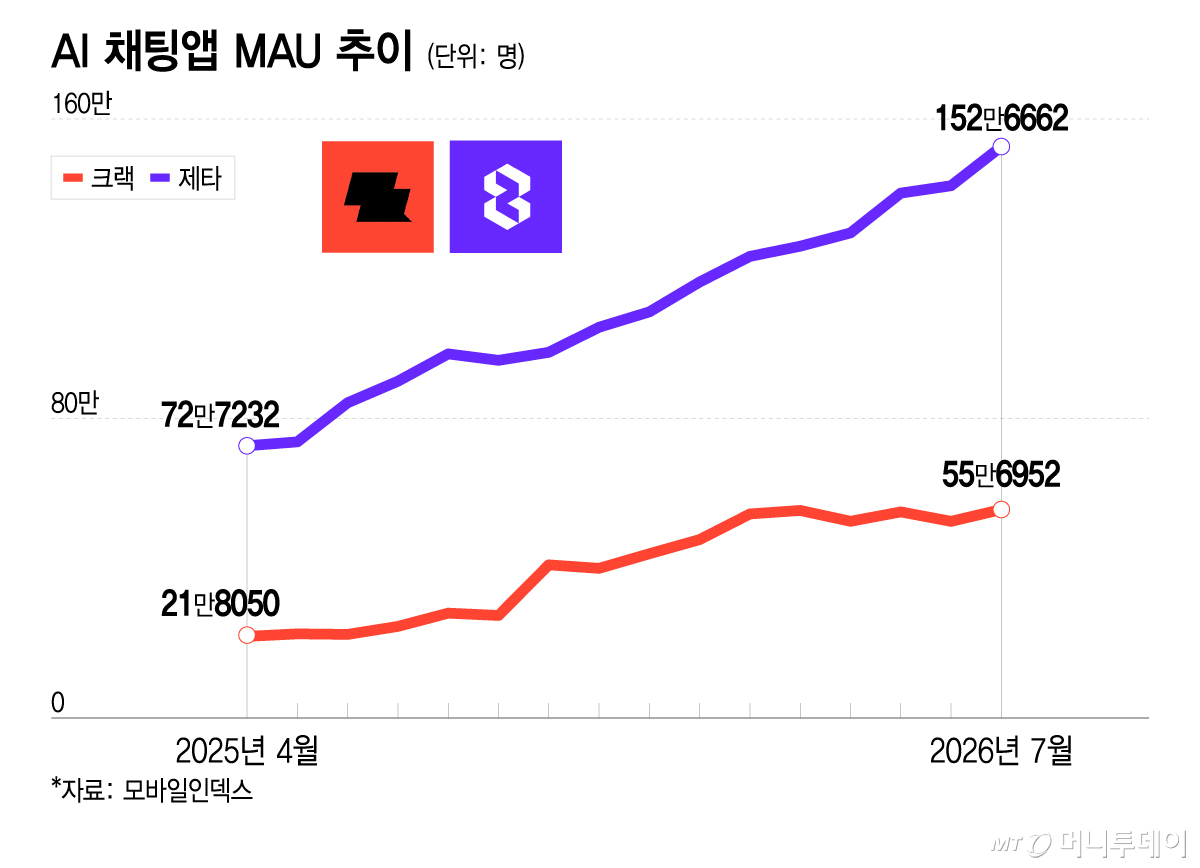
AI character chat apps are services where users chat with characters implemented via AI. Representative examples include 'Crack' by Lutton Technology and 'Zeta' by Scatter Lab. These apps gained attention for implementing provocative character concepts such as "A female friend who visits your shared room" and "A popular girl who dislikes me."
The 'probabilistic events' highlighted by the GRAC refer to campaigns like 'Cracker Baking' conducted by Crack on December 1 of last year. When users spent paid currency called 'crackers,' the event would either multiply the amount by 2 to 100 times or cause it to disappear entirely based on probability. Based on publicly disclosed success rates—49% for 2x, 9% for 10x, and 0.6% for 100x—the expected return rate was calculated at 98% for a 2x challenge and 60% for a 100x challenge. Mathematically, the more users repeated it, the more they lost.
Lutton issued an apology just one day after launch on December 2 of last year, followed by announcements to shorten the event duration, implement measures to protect minors, and terminate the event early. Subsequently, on December 3, the company closed the event. Lutton stated, "Although we conducted a preliminary legal review through an external law firm, we terminated the event early after receiving user complaints expressing concern about gambling potential immediately after the event began." The company added, "We have no plans to conduct similar probabilistic events again."
AI chat apps are in a competitive relationship with games over users' leisure time. Their revenue models and usage patterns are also becoming increasingly similar to those of games. Story progression methods featuring multiple endings resemble traditional visual novel (moe romance simulation) genre games. Some even determine success or failure based on dice rolls. Zeta compares its app's open-ended conversation style to "open-world games."
The problem lies in the difference between regulations and obligations. Games are subject to the "Act on the Promotion of Game Industry." Consequently, content must undergo rating classification by the GRAC or a self-rating classification operator before release. If content changes during live services, post-management oversight is also required. When selling probabilistic items, there is an obligation to display probabilities both inside and outside the game.
Meanwhile, AI chat apps have grown into services that earn as much money as games. As of this day, Crack and Zeta ranked sixth and eighth, respectively, in the Google Play Entertainment category by revenue. Even when expanding the scope to include all non-game apps, they still rank high at 15th and 17th.
The loophole lies in the distribution structure. At launch, category classification was determined based on the operator's choice. The GRAC clarified regarding suspected unclassified game content: "If content suspected to be a game is identified or if reports or complaints are received, we can verify the actual service content and take necessary measures." In other words, scrutiny only occurs after suspicious elements emerge or reports are filed.

 in TECH

