

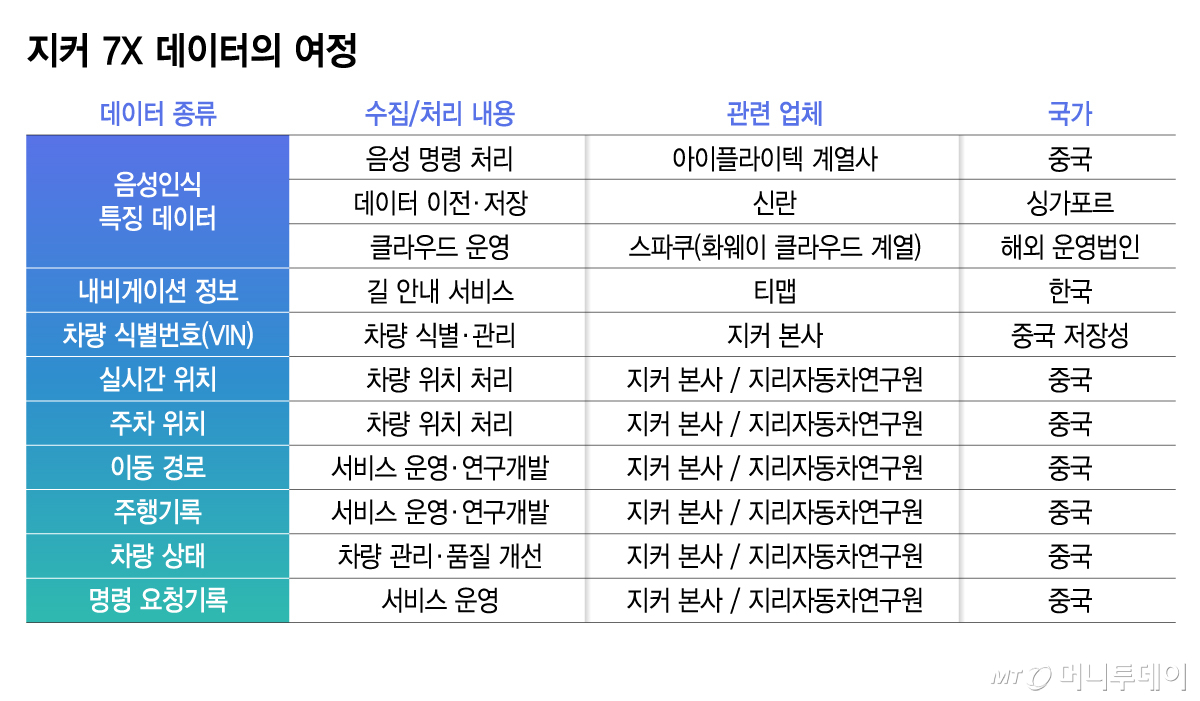
A driver of a Chinese electric vehicle brand ZEEKR 7X says to the voice assistant inside the car, “Let’s go home.” The navigation screen displays T-map, a domestic Korean map service. However, the destinations for the data generated by the vehicle vary. Voice recognition-related information travels through service networks managed by Chinese companies to Singapore, while real-time location, travel routes, and driving records become targets for processing at China’s headquarters and research institutes. In short, information from the car is split among South Korea, Singapore, and China.
According to ZEEKR Korea’s privacy policy released on the 22nd, voice command processing is handled by iFlytek, a subsidiary based in Suzhou, China. This company was contracted by ZEEKR for voice recognition services. “Voice recognition feature data” from Korean drivers is transferred to Shilan, iFlytek’s Singapore-based subsidiary.
Shilan further entrusts cloud operations to Spaku. Spaku is the overseas operating entity of Huawei Cloud in China. The structure involves Chinese companies managing voice recognition services, related data being stored in Singapore, and cloud infrastructure operated by Huawei affiliates.
Information generated directly by the vehicle takes a different path. ZEEKR’s privacy policy lists the following as personal information transferred overseas: Vehicle Identification Number (VIN), real-time location, parking location, travel routes, driving records, vehicle status, and command request logs. The entities receiving this data include ZEEKR’s headquarters in Zhejiang Province, China, and Geely Automobile Research Institute in Ningbo.
While domestic drivers use T-map to find their way, the location and driving information generated separately by the vehicle is utilized for service operations and research and development by Chinese automakers. The navigation service visible on the screen and the data processing network operating behind the scenes are entirely different systems.
The purposes of processing also vary depending on the type of information. ZEEKR cites in its privacy policy objectives such as providing connected services, vehicle management, quality improvement, and research and development. This means that information accumulated during driving can be used not only to determine the vehicle’s current location but also for service improvements and R&D.
Especially, vehicles continuously generate location and travel route data during use. Details such as when and where the vehicle was parked, which routes were taken, and the vehicle’s condition at any given time can all be recorded simultaneously. As automakers increasingly combine software and AI, the variety of data generated by vehicles continues to grow.
Users have some options to restrict data transmission, but choices are limited. They can turn off the voice assistant feature, activate the vehicle’s “full privacy mode,” or withdraw from their ZEEKR account. However, ZEEKR explicitly states in its privacy policy that refusing overseas transfer of personal information may result in the inability to use related services. This implies that reducing overseas data transmission may require giving up certain features like the voice assistant or parts of the connected functionality.
Consumers have virtually no channel other than the privacy policy to verify such data flows. Vehicle specification sheets detail battery capacity, output, driving range, and charging speed. In contrast, it is difficult to easily determine which companies receive drivers’ voices, real-time locations, and travel routes, or in which countries this data is processed.

 in TECH
